

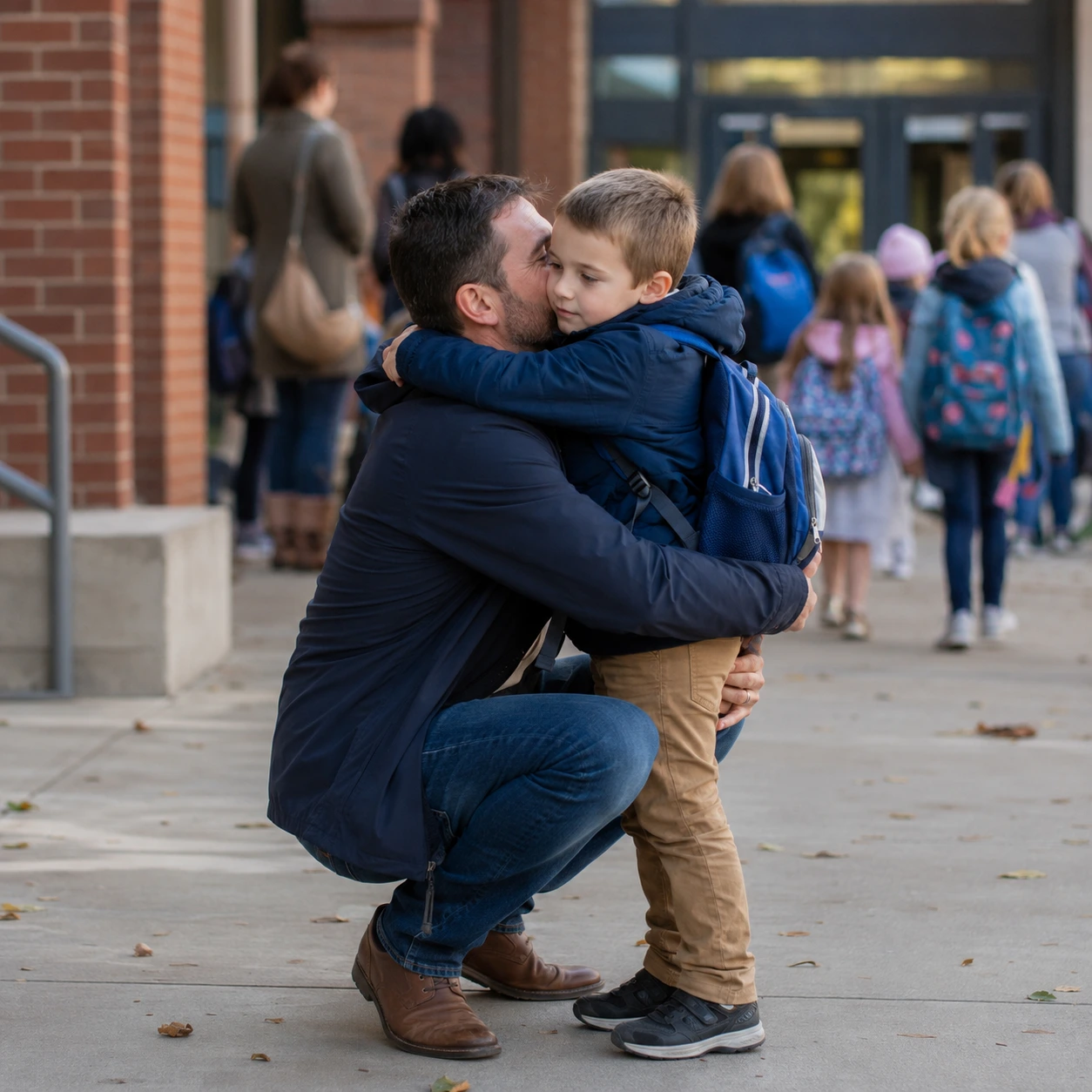
Every summer, parents start asking the same anxious question. Is my child really ready for kindergarten? The question usually arrives disguised as a checklist. Can my child write their name? Count to 20? Recognize every letter? Sit still for a full lesson? Tie their shoes? Read a few simple words?
Those skills can help, but they are rarely what a kindergarten teacher is actually watching for. Many educators care less about whether a child arrives already reading than whether that child can walk into a classroom, separate from a caregiver, name a need out loud, follow a simple direction, and recover when something does not go as planned. That last part, the recovering, turns out to matter more than almost anything on the checklist.
The American Academy of Pediatrics has made a similar argument at the policy level. Its 2019 clinical report on school readiness frames the concept as something shared among three parties: the readiness of the individual child, the readiness of the school to meet that child where they are, and the capacity of the family and community around them. Readiness, in other words, was never meant to rest on a five year old alone.
During the first month of school, teachers are quietly reading all three of those parties at once. They watch what happens at arrival, during cleanup, at lunch, on the playground, in small groups, and in the moments a child is asked to wait. Those ordinary moments tend to reveal more than any worksheet could.
Emotional Readiness Matters More Than a Perfect Academic Start
The first few weeks of kindergarten can feel enormous to a young child. The classroom is unfamiliar. The routines are new. The day may run longer than preschool did. There are more children, fewer adults, and many more moments when a child has to wait for help.
Teachers notice how children respond to those changes. Some walk in confidently. Others cry, cling to a parent, or go unusually quiet. None of those reactions on its own means a child is not ready. Separation anxiety can take time to settle, especially for children who have not spent many full days away from home, and clinicians who study childhood anxiety say the transition years, kindergarten among them, tend to be when it peaks. Rachel Busman, a clinical psychologist at the Child Mind Institute, has noted that separation anxiety often spikes hardest during exactly this kind of transition year. What matters by week four is not whether a child struggled on day one, but whether they are gradually settling, connecting with the teacher, and joining in.
Teachers also watch how children handle frustration. A child does not get the crayon color they wanted. Another student sits in the spot they had their eye on. A block tower falls. A teacher asks the class to stop playing before anyone feels finished. Emotional readiness for kindergarten does not mean a child never cries or melts down over any of this. It means they are beginning to learn how to come back from it.
Parents can build this at home by letting children sit with manageable frustration instead of rushing to fix every problem. A few simple phrases go a long way: "I see that you are frustrated." "What can you try next?" "Would you like help, or do you want another minute?" A child who can name a feeling, accept comfort, and return to what they were doing is practicing a real school readiness skill, not just being patient for its own sake. Parents working on their own patience in these moments, incidentally, are practicing the same muscle; the pause-and-perspective habits that make for a more patient parent tend to model the exact recovery skill a child is trying to learn.
Independence Is Not About Doing Everything Alone
Kindergarten teachers do not expect five year olds to function like older children. They do need students to manage a few basic routines with growing independence.
During the first month, teachers notice whether children can hang up a backpack, open a lunch container, use the restroom, wash their hands, put on a jacket, and clean up materials with limited help. In a classroom of 20 or more children, one teacher cannot complete every personal task for every student. Children who can manage basic routines simply have more time and energy left over for learning.
Independence also includes knowing when and how to ask for help. A child does not need to struggle silently with a stuck zipper or an unopened snack. The goal is recognizing the problem and saying something: "I need help opening this." "I cannot find my folder." "I spilled my water." "I need to use the bathroom." Small sentences, but they change how successfully a child moves through the school day.
Parents can practice this without turning home into a training camp. Let children carry their own backpacks. Encourage them to put away shoes and jackets. Practice opening the containers that will show up in their lunch box. Choose clothing the child can manage alone, especially during the first weeks. Velcro shoes, elastic waistbands, and easy-open bags are not signs of failure. They are tools that let a child feel capable. The same logic applies outside the morning rush, too. A summer with some genuinely unscheduled stretches, where a child has to figure out what to do with an empty hour on their own, tends to build the same muscle as the backpack and the zipper: quiet, unsupervised independent play where a child practices solving their own small problems before anyone steps in to help.
Language Development Is More Than Knowing Vocabulary Words
Teachers pay close attention to how children communicate. Can the child explain what happened? Answer a simple question? Tell an adult what they need? Listen while someone else is speaking? Take part in a back and forth conversation?
Children enter kindergarten with a wide range of language ability. Some tell detailed stories. Others use shorter sentences. Some are learning English alongside another home language. Some need extra time to organize their thoughts. Readiness does not require every child to sound the same. Teachers are looking at a child's ability to communicate and make meaning, not their vocabulary size.
At home, one of the best ways to support language development is ordinary conversation, the kind that asks for more than a yes or no. Instead of "Did you have fun?" try "What was the funniest part?" or "What happened first?" or "Who did you play with?" Reading aloud stays valuable even once a child can recognize words on the page. Pause to ask what they think happens next. Talk about how a character might be feeling. Invite them to retell the story their own way.
Teachers also notice whether children can follow classroom language, the kind stacked into a single instruction: "Put your paper in the tray, push in your chair, and meet us on the rug." That requires a child to listen, remember, and act, all in sequence. It is a skill that grows through practice, not one a child either has or does not.
Following Directions Is Really About Listening and Self-Control
Many parents worry their child will not sit still long enough. Kindergarten teachers know young children need movement, and a developmentally appropriate classroom is built around transitions, songs, hands-on work, and chances to get up. Still, children have to be able to participate in a group.
Teachers notice whether a child can pause, look toward the speaker, and attempt a direction, and whether they can shift from one activity into the next. Following directions is hardest when children are tired, overwhelmed, distracted, or deep in play, which is exactly why transitions reveal so much during the first month.
A teacher might say, "You have two more minutes, and then it will be time to clean up." Some children start preparing right away. Others ignore the warning until the last second. Some get upset when playtime ends. All of this is normal, and children benefit from learning that routines keep moving even when they would rather keep playing.
Parents can build this at home with clear, short instructions, starting with one step before adding more: "Put your shoes by the door." "Bring your cup to the sink." Once that lands, try two together: "Put away the blocks and wash your hands." Five instructions shouted from another room, followed by frustration when only one sticks, tends to backfire. Young children generally need eye contact, simple language, and a moment to actually process what they heard. None of this is about blind obedience. It is the slow, ordinary work of learning to listen and take part in a shared space.
Social Skills Can Shape the Entire School Day
For some children, kindergarten is the first time they spend most of the day inside a large group of peers. Teachers notice quickly how students enter play, share materials, take turns, and respond when something goes wrong.
A socially ready child does not need to be outgoing. Quiet children can be entirely prepared for kindergarten. The real question is whether the child is starting to function as part of a small community. Can they wait briefly for a turn? Hear "no" without becoming aggressive? Play near or with other children? Use words when a problem comes up? Recognize that someone else might want something different?
Conflict is expected. Two children will want the same toy. Someone will cut in line. A classmate will say something hurtful without fully grasping the impact. Teachers do not expect five year olds to resolve every disagreement on their own, but they do look for the early signs of problem solving. Parents can help by practicing a few phrases in advance: "Can I play too?" "I was using that." "Can I have a turn when you are done?" "I do not like that." "Can you help us?" These give children an alternative to grabbing, hitting, yelling, or shutting down. Social skills like these do not arrive fully formed. Playdates, playgrounds, family gatherings, and community programs all offer practice. The goal is never to force a shy child into being outgoing. It is helping every child get a little more comfortable talking to others.
Academic Skills Help, But They Are Not the Whole Story
Teachers do notice whether a child recognizes letters, understands basic number concepts, holds a pencil, identifies colors, and can follow a story. Those abilities are a useful starting point. But kindergarten exists to teach children, not to test what they already know.
A child who cannot yet read may still be entirely ready to learn. A child who reads fluently may still struggle with waiting, sharing, or hearing correction. The National Association for the Education of Young Children makes a related point to parents directly: strong kindergarten classrooms build on what a child already knows and can do, then stretch them toward what they cannot do yet. Readiness is a starting line, not a finish line, which is part of why reducing it to memorized letters and numbers misses so much.
More meaningful signs tend to be curiosity, persistence, and a willingness to try. Does the child ask questions? Enjoy books? Finish a simple puzzle? Keep trying when something is hard? Notice patterns and talk about what they observe? Teachers generally prefer a child who is curious and teachable over one who has memorized advanced skills but falls apart the moment an answer is not immediately obvious. Parents do not need to spend the summer rebuilding a classroom at the kitchen table. Reading together, counting everyday objects, drawing, building, cooking, and talking provide plenty of real preparation, and they build school readiness without turning a five year old's summer into a rehearsal.
What Schools Wish Parents Knew
Teachers wish more parents understood that the first month of kindergarten is an adjustment period for nearly everyone in the building, adults included.
Children may come home exhausted, emotional, unusually quiet, or ready to release every feeling they held together all day. A child who behaved calmly at school may fall apart at home, because home is where it finally feels safe to let go. Parenting educators have a name for this pattern, restraint collapse, coined by the counsellor Andrea Loewen Nair to describe what happens when kids hold it together all day and only release it once they reach somewhere safe. Knowing the pattern has a name does not make the after-school meltdown less exhausting, but it does mean it is not necessarily a sign that something is wrong.
Parents can help by keeping after-school routines simple. Offer a snack, water, quiet time, and a chance to reconnect before launching into a long list of questions. Instead of "What did you learn today?" try something more specific: "Who sat near you?" "What made you laugh?" "What was hard?" "What did your teacher read?" "Did anyone help you today?"
Schools also wish parents would flag concerns early. If a child struggles to separate, has trouble using the restroom, cannot follow directions, seems overwhelmed by sensory input, or does not speak up in groups, sharing that early can help a teacher respond in a more targeted way. And if those concerns persist and look like something more than a typical adjustment, requesting a formal evaluation for an IEP or a 504 plan starts a process districts are legally required to move on within a set timeline. Teachers are not looking for perfect children or perfect parents. They are trying to understand what each student actually needs.
Families can also support school routines just by keeping them steady. Regular attendance, consistent sleep, labeled belongings, and on-time arrival sound basic, but they create real stability. A child who arrives rested and unhurried simply has a better shot at starting the day calm.
How to Prepare Without Creating Pressure
Kindergarten preparation should build confidence, not fear. Visit the school if you can. Practice the morning routine before it counts. Read books about starting school. Let the child help pick a backpack or lunch bag. Talk honestly about what the day may include.
Try to avoid repeatedly asking, "Are you scared?" That question can unintentionally suggest school is something to be afraid of. Instead: "It is normal to feel excited and nervous." "Your teacher will help you learn the routines." "You do not have to know everything on the first day." "We will practice together."
Parents should also resist comparing children to each other. One child may read early but struggle socially. Another may be highly independent but need speech support. A third may take longer to separate but thrive academically once settled in. Readiness is not a race, and treating it like one mostly just adds pressure nobody in the room needs.
The Real Goal of Kindergarten Readiness
A child is ready for kindergarten when they are prepared to begin, not when they have already mastered everything kindergarten is there to teach. Kindergarten readiness means a child can join a community, communicate a need, attempt something new, follow a basic routine, and start building relationships with adults and peers they did not choose.
Some children arrive with strong academic skills already in place. Others grow quickly once school starts. Most carry a mix of strengths and areas that still need support, and that mix is exactly what kindergarten is built for.
Parents can prepare children best by building routines, encouraging independence, reading and talking together, practicing patience, and helping children understand that mistakes are simply part of learning. The first month will not be perfect. There will be tears, forgotten folders, unopened lunch containers, and stories that make almost no sense on the car ride home. There will also be new friendships, proud moments, unexpected growth, and the beginning of a much larger world.
Your child does not need to walk into kindergarten already knowing everything. They need to walk in believing they can learn.


Comments (0)
No comments yet — be the first to share your thoughts.
Leave a comment