

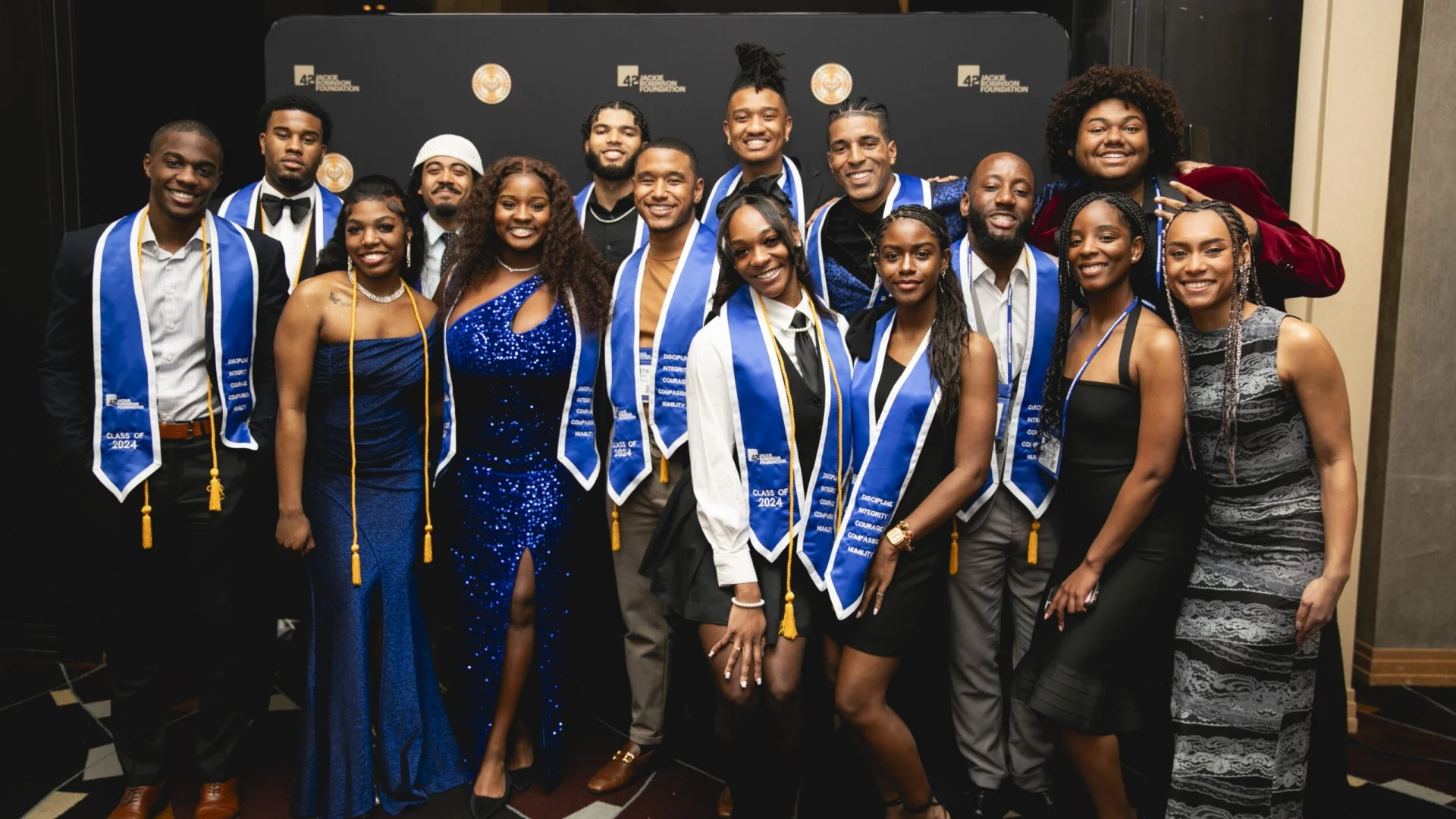
Somewhere on the Jackie Robinson Foundation's application page sits a question from a student who has never played a sport of any kind and wants to know whether that ends the conversation. The answer is no. The award named for the man who broke Major League Baseball's color line in 1947 is, in the foundation's own description, a merit-based academic scholarship.
The 2026-27 application opened Sept. 1 and closes at 5 p.m. Eastern on Thursday, Jan. 14, 2027, and the foundation's application FAQ states that it grants no extensions. Seniors in the Class of 2027 who are U.S. citizens, can document financial need and bring a record of academic excellence, leadership and community service are eligible. The foundation's scholarship page sets the award at up to $35,000 over four years. Its FAQ says about 60 awards go out in a typical year, drawn from what it describes as thousands of applications.
Rachel Robinson started the foundation in 1973, and it is headquartered at One Hudson Square, 75 Varick Street, in Lower Manhattan. Every scholar, whether enrolled in Buffalo or Atlanta, is brought to New York City at the foundation's expense for a four-day Mentoring and Leadership Conference each year. The program counts more than 2,200 scholars and alumni and reports a 98 percent graduation rate.
Who Qualifies, and Who the Rules Leave Out
The eligibility list on the foundation's 2026-27 flyer runs seven lines, and the second one does the most sorting by requiring applicants to be United States citizens. That wording leaves out lawful permanent residents and DACA recipients as well as undocumented seniors, so families should read it literally before anyone starts an essay. For those students, the Hagan Scholarship accepts applicants regardless of citizenship and can make up to 1,500 awards this cycle, although its window shuts on Dec. 1.
The FAQ defines an eligible senior as someone graduating high school in spring 2027 and enrolling full time at an accredited four-year college that fall. A student who graduated a year earlier and has not started any college coursework can also apply. Acceptance letters are not required to submit, but the award itself depends on verified enrollment at a college the foundation approves.
The final rule bars anyone who has already earned more than 25 percent of the credits needed to finish college, which on a typical 120-credit bachelor's program comes to about 30 credits. Seniors in early college high schools and P-TECH programs, which build college coursework into the high school years, can pass that mark before graduation. They should get a written answer from the foundation at [email protected] before investing a winter in the application.
Financial Need Without a Published Cutoff
The foundation publishes no income limit, and its FAQ says it recognizes a wide range of financial need and weighs each application case by case. The Jack Kent Cooke Foundation draws a firm line at $95,000 in family income, one of the cutoffs in our guide to five scholarship deadlines New York seniors face before Dec. 15. Because the Jackie Robinson deadline lands a month after the last of those, a senior who gathered a transcript for Burger King Scholars or LIU's Roc Nation School award can reuse it.
Need is documented through the College Board's CSS Profile, sent to the Jackie Robinson Foundation under code 4248. The FAQ warns that a Profile routed anywhere else leaves the application incomplete, and when a noncustodial parent is involved, that household files its own Profile as well. The College Board charges $25 for the first recipient and $16 for each additional one, with fee waivers for students who qualify. A senior who has already filed for private colleges can add the foundation to the list without starting over.
The form is new territory for many New York families, because SUNY and CUNY campuses rely on the FAFSA and the state's TAP application to build aid offers. A senior applying only to public colleges in the state may be filing a Profile for the first time, and it asks about home equity and other assets the FAFSA leaves alone.
What the Application Asks For
Everything moves through the foundation's online portal, and the FAQ rules out printed or mailed applications. A complete file includes a high school transcript, household and demographic information, college plans and early career goals, and an account of activities and honors. It also requires an SAT or ACT score, and homeschooled applicants may submit a transcript issued by a parent. The testing rule catches students used to how colleges read scores, since the foundation wants results from a single test date. It will not accept a superscore assembled from the best sections of several sittings.
The essays need a careful count. The flyer lists four of them, while the foundation's apply page lists three brief essays, so applicants should plan around the prompts that actually appear inside the portal. The foundation also limits artificial intelligence tools to spelling and grammar edits and warns that applications containing AI-generated writing can be disqualified.
The single recommendation has to come from an adult who has known the student for a significant stretch and is neither a relative nor someone who knows them only as a friend. Teachers, guidance counselors, coaches, employers and mentors from an extracurricular activity all fit, and the student sends the request through the portal by entering the recommender's email address. The foundation asks applicants to confirm the letter is in at least 24 hours before the deadline, because a missing recommendation leaves the entire file incomplete.
From the January Deadline to a June Answer
After Jan. 14, applications move through a multi-stage review from February through April. Semifinalists sit for regional virtual interviews in April and May, and the foundation announces its new scholars in June, with every applicant told of a decision by the end of that month.
Selected scholars take on obligations of their own, starting with community service throughout college that must be documented and kept on file with foundation staff. Each scholar also gets year-round mentoring from staff, alumni and volunteer Scholar Advisory Committees. The Mentoring and Leadership Conference coincides with the alumni reunion in New York and culminates at the Robie Awards Dinner, traditionally held on the first Monday of March. The Rachel Robinson International Fellowship, created in 2008 with a grant from the Sheila C. Johnson Foundation, funds study and service abroad. The Extra Innings Fellowship helps scholars pay for graduate and professional training.
The program's funding grew in December 2025, when Dodgers owner Mark Walter and Thomas Tull gave the foundation $20 million for its scholarships and the Jackie Robinson Museum, which opened in 2022. Della Britton, the foundation's president and CEO, said the gift "provides vital financial support to sustain and grow our educational initiatives through JRF's celebrated college scholarship program and multigenerational Museum programming."
When the FAQ explains what the foundation means by community service, it skips the rubric. It names a food pantry, reading to younger children, building homes for people in need and starting an organization. Then it closes on a sentence from Robinson himself: "A life is not important except in its impact on other lives."


Comments (0)
No comments yet — be the first to share your thoughts.
Leave a comment