

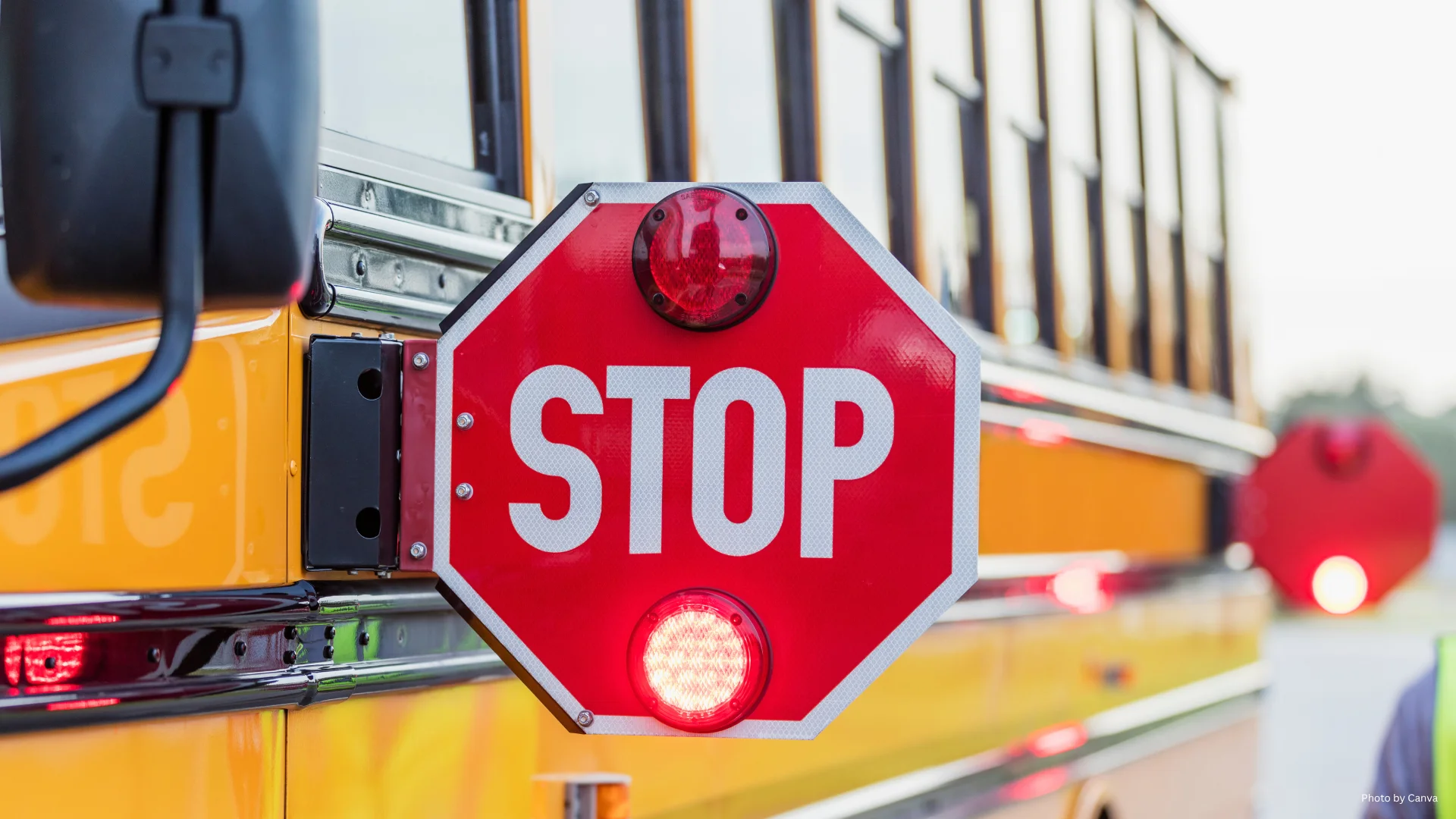
Newfield Central School District in Tompkins County placed three electric school buses into service in October 2024 after a transition that took more than two years. "We didn't hurry this process. It's taken us two and a half years to get here," Superintendent Eric Hartz said. Two drivers now operate the buses daily, while two or three others are training on them. Driver Bryon Hunter said the district's diesel buses typically get "about 5.5 to 6 miles per gallon," compared with the electric buses, which he said are operating at the equivalent of "16 to 17 miles per gallon." Business Administrator Perry Gorgen summarized the operating difference more directly: "The electric is still one-third the fuel price."
Newfield's three buses are part of a statewide fleet of 559 electric school buses operating in New York as of June 2026. That total ranks New York second nationally, according to the Electric School Bus Initiative's national adoption tracker. New York operates roughly 45,000 school buses overall, the figure the New York State Energy Research and Development Authority uses to describe the scale of the conversion. Four years after the mandate was enacted, about 1.2 percent of the statewide fleet is electric.
The enacted state budget gave districts more time to complete that conversion. The deadline requiring school districts to purchase or lease only zero-emission buses moved from July 1, 2027 to July 1, 2032. The deadline for operating an entirely zero-emission fleet moved from 2035 to 2040. The extension changes the timetable, but not the size of the fleet, the cost of replacing buses or the amount of state incentive funding available to districts.
What the Budget Changed
The deadline extension was enacted through the Education, Labor and Family Assistance portion of the state budget, bill S.9006-C, rather than through separate legislation. Districts monitoring a standalone delay bill in the Senate Rules Committee therefore saw the mandate changed through the budget before that measure advanced. Education Law section 3638 now states that "no later than July first, two thousand thirty-two, every school district shall: (i) only purchase or lease zero-emission school buses when purchasing or leasing new buses." The requirement for a fully zero-emission operating fleet now takes effect "no later than July first, two thousand forty."
Upstate lawmakers who supported the extension argued that the original schedule was financially and operationally unrealistic. "Since being enacted in 2022, I've heard from school officials across our region that the electric bus mandate is unrealistic," Senator Dan Stec of Queensbury said, describing the ELFA provision as a measure that "provides a needed pause on the looming 2027 deadline." Assemblyman Robert Smullen, whose district includes parts of the Mohawk Valley and Adirondacks, called the requirement a "'green' mandate" that "makes upstate residents foot the bill for downstate climate goals," adding that "a delay is better than nothing." The American Lung Association opposed the extension, arguing that "rather than eliminating public health protection for our kids, lawmakers should be looking to do more, not less."
The Calculation the Delay Does Not Change
The central challenge remains the gap between 559 electric buses and a statewide fleet of roughly 45,000. Replacing the remaining 44,441 buses by the July 2040 operating deadline would require approximately 3,175 zero-emission buses to enter service each year for fourteen consecutive years. By comparison, the first four years following enactment of the mandate produced an average of fewer than 150 electric buses per year.
State incentive funding covers only part of that transition. The 2022 Clean Air, Clean Water and Green Jobs Environmental Bond Act allocated $500 million for electric school buses. An additional $200 million announced in August 2024 brought the New York School Bus Incentive Program to $700 million. A new Type C bus, the conventional full-size school bus used by many districts, qualifies for a base voucher of $147,000. At that base amount, $700 million would support roughly 4,760 buses, about one-tenth of the statewide fleet. Because many qualifying buses receive additional incentive payments, the actual number of vehicles supported by the fund would be lower.
Those supplemental incentives can materially change a district's local cost. Districts on the state's priority list can receive an additional $21,000 to $39,000 depending on bus type. Scrapping an older diesel bus instead of reselling it can add $47,500 to $65,000 to the incentive. Vehicle-to-grid capability adds $7,000 to $13,000, while a wheelchair lift adds $8,000. Districts choosing to repower an existing chassis rather than purchase a new bus can receive $105,000 for a Type A bus or $135,000 for a Type C. For districts with relatively new diesel fleets, repowering may warrant comparison with full replacement.
Charging Infrastructure Can Become the Larger Capital Question
Charging incentives are smaller and depend partly on planning. A non-priority district can receive $25,000 for charging infrastructure, increasing to $55,000 if it submits a fleet electrification plan. A priority district can receive $35,000, or $65,000 with an approved plan. Both bus and charging vouchers are distributed on a first-come, first-served basis. The bus incentive program opened November 29, 2023, and the charging program opened March 5, 2024. Districts that delay applications until the 2032 purchase deadline approaches will enter the queue years after early applicants.
Newfield funded its charging work through a federal Environmental Protection Agency grant that, according to the district's account, reached only 21 districts statewide. The grant covered infrastructure inside the building, but not the entire site. That distinction is significant for capital planning because transformers, electrical service upgrades and equipment pads can become major project costs and may not be fully covered by available incentives. Districts that have managed a capital project closeout already know how quickly uncovered infrastructure costs can become a local obligation.
The Waiver Process Was Written for the Original Deadline
The State Education Department issued its extension waiver framework on February 6, 2026 and a broader zero-emission busing FAQ on March 16, 2026, both before the enacted budget moved the purchase deadline. That guidance stated that "Initial Zero Emission Busing Extension Waiver Applications submitted to NYSED prior to March 1, 2027, will be reviewed" during that cycle. Approved waivers would apply to the 2027-28 and 2028-29 school years, with the application window reopening annually from July 1 through March 1. The guidance also clarified an important compliance issue: the purchase order date, not the vehicle delivery date, determines whether a bus purchase complies with the mandate.
Emergency waiver requests are handled directly by the State Education Department's pupil transportation office through [email protected] or by phone at (518) 474-6541. The Department's pupil transportation news page remains the primary place for districts to monitor changes to waiver procedures and implementation guidance.
Where Districts Should Look in Their Own Numbers
School districts have been filing an annual zero-emission progress report since the 2024-25 school year, while the Commissioner has reported to state leaders since October 1, 2024. That reporting creates a starting point for local planning. Three figures are particularly important: the number of buses in the fleet by model year, the amount budgeted for vehicle purchases and whether the district has completed a fleet electrification plan. That final step can increase a non-priority district's charging voucher from $25,000 to $55,000.
The fleet's model-year schedule may be more consequential than the statutory deadline itself. A district replacing buses on a twelve-year cycle could purchase its final diesel bus in 2031 and ordinarily expect to operate it until 2043, three years beyond the zero-emission operating deadline. Without additional relief, that would require early retirement of the bus or another form of state-approved accommodation. Taxpayers who have examined how a school tax bill breaks down will find vehicle purchases reflected in the same capital and debt-service pressures that ultimately affect local spending plans.
Newfield's experience illustrates both the potential operating savings and the length of the transition. Its three electric buses took approximately two and a half years to move from planning to daily service, while drivers report fuel-equivalent performance of 16 to 17 miles per gallon compared with 5.5 to 6 miles per gallon for diesel. New York's next round of district progress reports will be the first produced under the 2032 purchase deadline. Those reports will also measure a statewide transition that still requires replacement of approximately 44,441 buses before the 2040 operating deadline.

Comments (0)
No comments yet — be the first to share your thoughts.
Leave a comment