

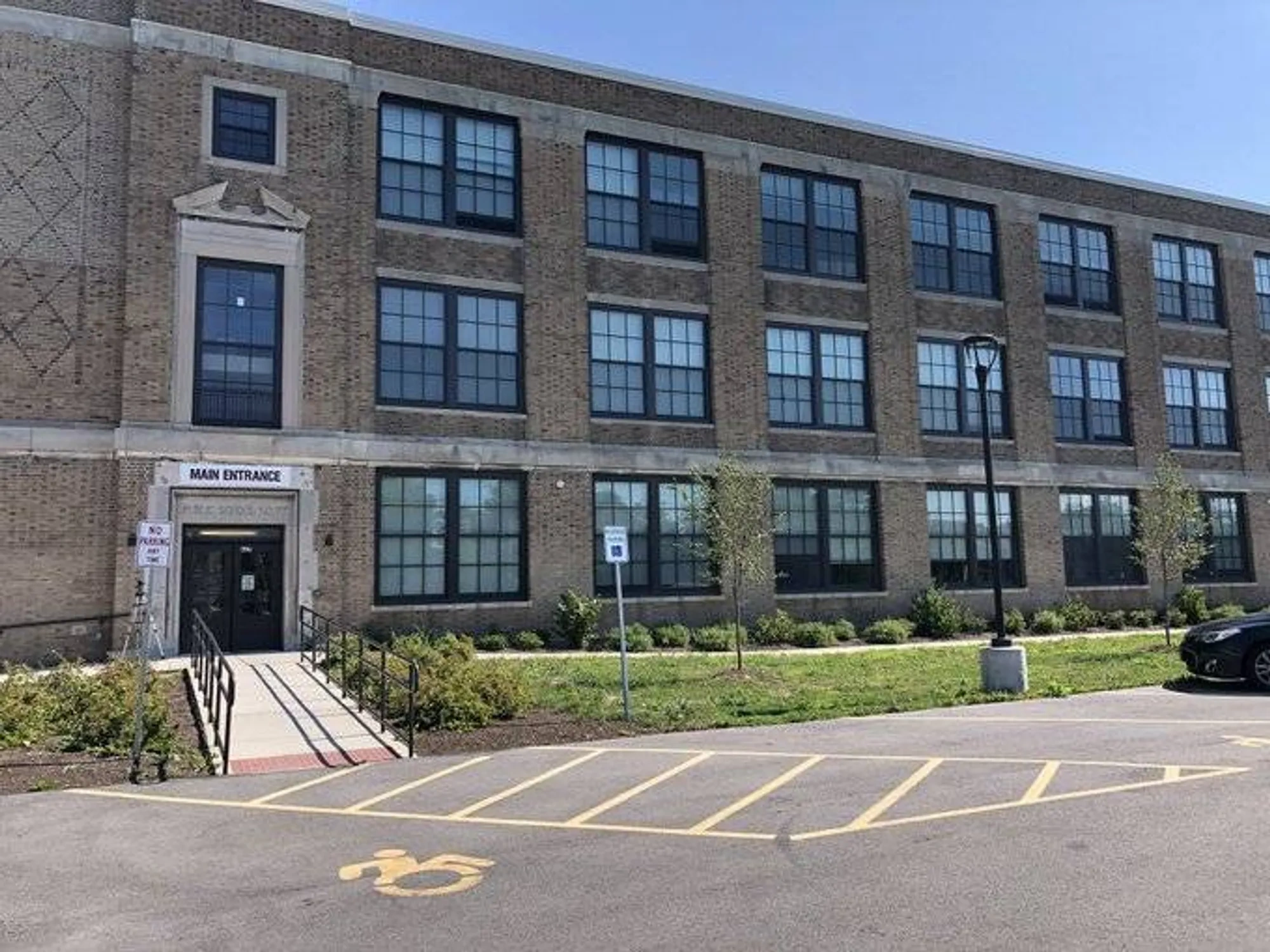
The speakers' list at McKinley High School on Wednesday night (Oct. 21) ran past 30 names, and the Riverside High School students near the top of it had barely stepped away from the microphone when Buffalo's interim superintendent, Dr. Ebony Prophet-Bullock, interrupted her own public comment period. "The air in the room is heavy. The emotion in the room is heavy," she said, according to Buffalo Toronto Public Media. "We heard you. We're pulling it. We will not be voting on it today."
The resolution she withdrew would have closed or repurposed a slate of Buffalo Public Schools buildings starting in the 2027-28 school year, a plan the district says would touch about 2,300 students, eliminate 108 full-time positions including up to 73 teaching jobs, and save roughly $24 million a year. Nothing on the ledger moved between Tuesday's forum and Wednesday's retreat. A night earlier, Chief Financial Officer James Barnes told a crowd at PS 156 Frederick Law Olmsted that the district had lost $157 million in cash over three years, BTPM reported, and warned that leaving that unaddressed would hurt students and employees more than the closures would.
The next date on the calendar is a public forum on Monday, Oct. 26, from 5:30 to 7:30 p.m. at West Hertel School No. 94. It is a listening session, and no new date for a board vote was announced, which leaves families in the state's second-largest school district waiting on a plan that has been rewritten several times in three weeks.
A plan that kept moving
The first version arrived late on a Friday, Oct. 2, when Prophet-Bullock informed the Board of Education that eight schools had been identified for change. Three would close permanently, PS 59 Dr. Charles R. Drew Science, PS 131 Academy School @ 86 and PS 366 Research Laboratory High School, while five more would be repurposed, among them PS 33 Bilingual Center, PS 82 Ronald Peoples School of Scholars, PS 208 Riverside Academy, PS 309 East High School and PS 90 Early Childhood Center. A district spokesperson, in a written message to BTPM, noted that Rochester and other districts had recently closed schools in their own restructurings.
The district has posted its own video walkthrough of the proposal, published the day of the pulled vote.
Revisions followed in waves. Research Laboratory and Leonardo da Vinci high schools, first slated to merge inside the Riverside building, would instead share it and keep separate identities. A transportation scenario that once cut 18 bus assignments was scaled back to eight, for an estimated $1 million in savings. Late Monday night and into Tuesday, PS 17 was added to the list, with a plan reported by WIVB to turn the building into administrative space, and Prophet-Bullock acknowledged to reporters that its inclusion "came out of the blue."
How many schools were actually on the table depends on which outlet a parent happened to read on Wednesday. The district's Oct. 2 announcement said eight, the PS 17 addition made it nine, WBEN described the pulled resolution as closing or merging 10, and WGRZ framed it as six closures plus several relocations.
Dr. Cameron Hall, the principal of PS 17 and a former student there, told the board on Tuesday that roughly 44 percent of his students have disabilities. "Many of our students are nonverbal, but they recognize our faces when they get off the bus," he said. "I know the numbers matter, but so do the families in which we serve."
Buffalo Common Council Member David Rivera aimed at the process rather than any single building. "It brings a sense of lack of confidence in a process, when revisions happen and there isn't enough time to look at the revisions to consider the data, and then tomorrow the school board is going to vote on something that's going to impact the lives of hundreds and hundreds of students," he said. Prophet-Bullock answered that the board already had what it needed. "I think that we have given the board enough analysis, enough data, enough information, and it's not new," she said. "We've been talking about closing schools for years."
What the room asked for
Buffalo Teachers Federation President Rich Nigro was among the first speakers on Wednesday, and he asked the board to wait, recalling the disruption left by earlier rounds of closures and mergers. "This is not ripping off a Band-Aid; it's pulling out stitches, stitches that are holding communities together," he said.
East Community High School Principal Tracy Cotter reached further back, to the Kensington Expressway and the scar its construction left across Buffalo's East Side, and asked the board to study which neighborhoods would absorb this round. "If we can calculate how many dollars will be saved, then surely we can calculate who will be asked to pay the human price," she said.
The students at the microphone were not a single bloc. Kelani Hickey, a Da Vinci student, thanked district leaders for the revision that would let her school keep its name and culture inside a shared building. "We are not against change. We simply want change that benefits our education without taking away the identity of our school," she said. Letitia Sadile, a Riverside senior, asked why her school had to give up its home so that arrangement could work. "Why can't we find a solution where everyone has a place where nobody has to lose their family to make room for someone else?"
Camille Cyrus, a senior at East High, told BTPM afterward that her worries ran to safety, bus routes and whether families would get real support. "They're not thinking about the future of the students and of the seniors and juniors that are working hard to now have to figure out what school they're going to go to so they can get their education," she said.
Board member Stephon Wright, speaking with WBEN after the meeting, pushed back on some of the opposition he had heard. "Some constituents I've seen and heard from didn't even review the plan, so I'm encouraging those who come out Monday to review the plan," he said.
The money underneath the vote
In January, the district dropped a committee recommendation to close PS 3 and PS 90 for the current school year, and then-Superintendent Pascal Mubenga and board President Kathy Evans-Brown announced that no schools would close, WIVB reported. District leaders then met with the Buffalo Fiscal Stability Authority, the state-created control board, which according to WBEN made clear it would still hold the district to its fund balance targets.
The workaround landed in the $1.2 billion budget the board passed unanimously for 2026-27. It drew about $66 million from savings against an $80 million deficit and cut 51 central office positions, according to WIVB. It also ended the Virtual Pathways Program and consolidated 35 general education classrooms, pushing average class size from 19 to 21 students. At the first town hall this month, Prophet-Bullock told families that the same budget marks the last year the district can rely heavily on reserves and names closures in 2027-28 as the remaining lever, WGRZ reported.
District officials have said that without the closures next year's deficit could reach $100 million, and the broader four-year plan carries another 74 job cuts through 2030, according to Spectrum News. Set against a gap that size, the projected $24 million a year in savings would cover about a quarter. Board member Erik Bohen told WIVB on the day the plan was released, "We are in financial distress, the district is, and in order to come out of this we have to close schools." Larry Scott, another board member, told WBEN the morning after the pulled vote, "to be blunt, we have to close schools."
Delay carries a bill of its own, by the superintendent's account. Before Wednesday's meeting she said a postponement would compress the time available for student placements, building moves and other logistics, potentially raising costs, though she did not attach a dollar figure to that warning.
Rochester went first
Seventy-five miles east, Rochester has already lived through this. In October 2023, its school board voted 5-2 to approve a realignment that ProPublica counted as closing 11 of the district's 45 schools. The district had reported buildings sized for more than 37,000 students holding about 21,000. Then-board President Cynthia Elliot was blunt at a community forum before that vote. "We have low enrollment that's essentially it," she said, according to WHEC, adding that projections showed enrollment falling as low as 14,000 by the early 2030s.
The Rochester realignment did not end the question there. Last December, the district held a public hearing on closing Northwest Middle School over what its former interim superintendent called persistently low enrollment, and few people came, WHEC reported.
The same pressure runs through districts well beyond the two biggest upstate cities. Statewide enrollment has fallen roughly 12 percent over 15 years and is projected to keep sliding through 2031, a trend we measured against New York's record per-student spending this summer. The New York State School Boards Association reports that 70 percent of districts now seek hold harmless protection against Foundation Aid reductions, up from 35 percent. We laid out that figure in our guide to reading your own district's per-pupil number. Hold harmless keeps state aid from shrinking along with a district's enrollment, while the boilers, bus contracts and debt payments attached to half-full buildings stay on the books.
Buffalo's own record now includes a closure plan shelved in January, a budget built on reserves in May, an eight-school proposal in October and a pulled vote on the 21st. On Wednesday, Prophet-Bullock framed the pause as a board decision. "We all understand what we must do, but as a Board, as a 10-member team, we just want to take some of the air out of the room," she said, according to WBEN. "We want to bring temperatures down."
She also conceded the district had fallen short in explaining its revisions to the people living with them. "We're not doing enough, and we will do better," she said. The forum at West Hertel is Monday evening, and the vote has no date.


Comments (0)
No comments yet — be the first to share your thoughts.
Leave a comment