

New York City is providing its youngest students with an unusual opportunity: a break from the technology products that dominate their lives.
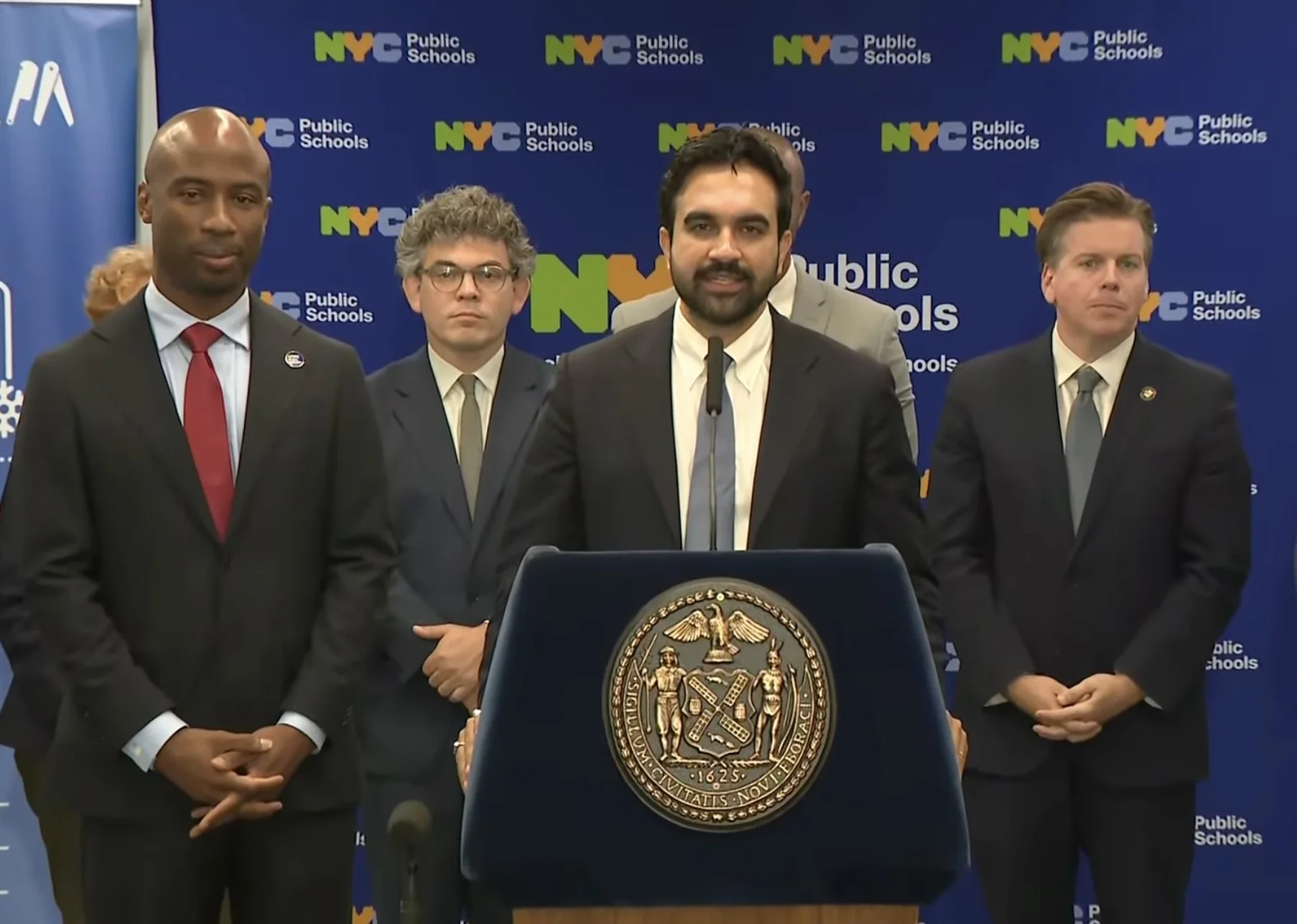
Mayor Zohran Mamdani announced Wednesday that the nation’s largest public school system will impose a one-year moratorium on student-facing generative artificial intelligence from 2-K through eighth grade. The policy takes effect for the 2026-27 school year and will reach nearly 600,000 children, roughly two-thirds of the city’s public school enrollment.
The decision is more precise than a citywide ban on artificial intelligence. High school students will encounter AI through structured literacy instruction and a small number of monitored classroom pilots. Teachers may continue using approved tools for lesson planning, scheduling and certain administrative work, but they cannot delegate the grading of student assignments to AI.
Companion chatbots designed to simulate friendship, counseling or emotional support will be prohibited across every grade level.
“Children need teachers and human connection in order to learn and grow,” Mamdani said during the announcement. “They need to develop skills alongside their peers, build relationships with educators and wrestle with tough problems on their own.”
The administration is not arguing that students can be permanently insulated from artificial intelligence. It is changing who carries the burden of proof. Instead of requiring families and educators to demonstrate that an AI product is harmful after it enters a classroom, vendors and school officials will have to establish that its educational value justifies its use.
Generative AI is increasingly embedded inside instructional software rather than presented as a separate chatbot. A writing platform may offer automated feedback, a mathematics program may generate hints, and a learning-management system may summarize student work. Mamdani said the city will halt the current use of about 40 educational tools while officials conduct their review.
For elementary and middle schools, the immediate rule is absolutely clear: student-facing generative AI is paused unless a specific exception is approved. Potential exceptions include assistive technology for students with disabilities, language support for multilingual learners and specialized instruction such as computer science.
The city is coupling its AI restrictions with a broader reassessment of classroom screens. Individual device use will be prohibited before third grade, while the Department of Education will recommend daily instructional screen limits of 30 minutes for grades three through five and 45 minutes for grades six through eight, according to ABC7 New York.
Those limits suggest that City Hall’s concern extends beyond students using chatbots to produce essays. The policy is also asking whether classrooms have accepted more software, devices and automated interactions without demanding enough evidence that they improve learning.
“The tech industry wants us to believe that AI-powered early education is not only inevitable, but necessary,” Mamdani said. “We do not see it that way.”
High schools will operate under a different model. Students are expected to receive AI literacy instruction twice during the school year, with lessons addressing bias, ethics, critical thinking, risks and the technology’s possible effects on employment. Up to five classes in a small number of high school classrooms may also test vetted programs under usage limits and data-privacy requirements.
The approved pilots are intended to keep the student responsible for the central intellectual work. Reported examples include Quill for English-language support, Edia for mathematics, Brisk Teaching for guided study practice, and Playlab and Intel AI-Ready Schools for work across subjects.
Younger students will be protected from routine generative AI use while foundational reading, writing, mathematical and social skills are still developing. Older students will be taught how to examine the technology before they are expected to navigate it in college or the workplace.
The moratorium also reverses the direction of the city’s earlier AI policy. New York City blocked access to ChatGPT on school devices and networks in 2023, then abandoned that restriction as officials moved toward guided classroom use. A framework issued in March 2026 allowed AI for activities including research, exploration and creative projects, but it drew criticism from parents and educators who believed the rules gave schools too much permission and too little protection.
Principals were told in July to pause software purchases while the administration completed the new policy. More than half of the City Council had also urged City Hall and the Department of Education to stop the expansion of AI in classrooms.
The city will now assemble educators, parents, elected officials, union representatives and experts to study the effects of the technology and recommend what should follow the moratorium. A task force report is expected in April 2027, leaving the administration several months to translate its findings into rules for the following school year.
For school leaders, the operational questions will arrive quickly. Districts and principals will need to identify which existing platforms contain generative features, determine whether those features can be disabled, communicate exceptions to special education and multilingual-learning teams, and ensure that teachers understand the line between planning support and automated evaluation.
Families will need clarity too. The classroom restriction does not automatically control what students can access on personal devices after school, and generative features are now built into search engines, phones and common productivity software. Enforcement will therefore depend on more than blocking a list of websites. Schools will have to teach students what counts as AI use and explain why certain forms of assistance are restricted.
The one-year pause is ultimately a test of educational judgment, not merely a rejection of new software. New York City is allowing high school students to study and cautiously test AI while reserving foundational learning for teachers, classmates and the productive difficulty of solving a problem without an automated answer. By next spring, the task force will have to show whether the city used that time to develop a durable standard rather than simply delaying the same debate for another school year.


Comments (0)
No comments yet — be the first to share your thoughts.
Leave a comment