
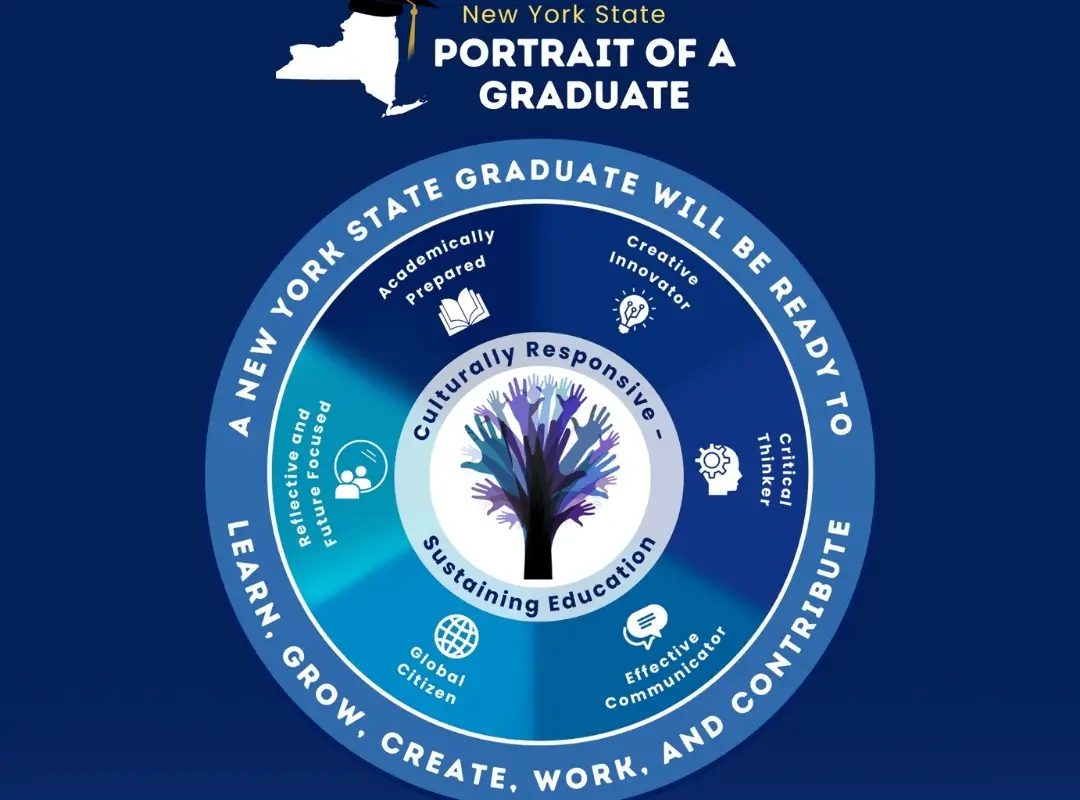
The New York State Education Department (SED) and the Office of Teacher and Leader Development (OTLD) have released a cutting-edge series of crosswalks that serve as a practical roadmap for schools. These documents align the New York State Portrait of a Graduate with the state’s Teaching Standards, the Professional Standards for Educational Leaders (PSELs), and the Culturally Responsive-Sustaining Education (CR-SE) Framework. For the modern educator, this means the "Portrait" is no longer just an aspirational concept; it is now a measurable set of professional behaviors that bridge the gap between classroom instruction and long-term student success.
If you have spent any time in a school district office lately, you have likely seen the Portrait of a Graduate poster. It usually features a smiling student surrounded by buzzwords like "Global Citizen," "Effective Communicator," and "Resilient Learner." For a long time, these were seen as nice-to-have ideals, lofty goals that lived in the stratosphere while teachers stayed grounded in the day-to-day grit of lesson plans and state assessments.
However, the Office of Teacher and Leader Development (OTLD) just changed the game. By releasing a series of rigorous crosswalks, the SED has effectively built a bridge from those lofty goals straight down into the classroom. These resources align the student outcomes we want (the Portrait) with the professional standards teachers and leaders are already held to (NYS Teaching Standards and PSELs).
Think of it as the ultimate synchronization of the educational GPS. Instead of having five different apps open to find your way, the SED has integrated them into one dashboard. This "Playbook" guide will break down how to use these crosswalks to turn systemic "coherence" from a buzzword into a reality.
1. The Anchor: Understanding the New York State Teaching Standards
At the heart of this release is the realization that a student cannot become a "Critical Thinker" if the teaching standards do not explicitly support the pedagogy of inquiry. The new crosswalks map the Portrait of a Graduate characteristics directly onto the NYS Teaching Standards.
For example, when a teacher is working on Standard IV (Instructional Delivery), the crosswalk highlights how specific "High-Leverage Practices" from TeachingWorks directly cultivate the "Effective Communicator" trait in students. This is about showing them that the work they are already doing, when aligned correctly, is exactly what builds a successful graduate.
According to the NYS Education Department, these resources are designed to ensure that educator preparation and actual classroom practice are speaking the same language. This alignment is crucial for veteran teachers who might feel "initiative fatigue." By showing how the new Portrait fits into the existing Teaching Standards, the SED is providing a sense of relief: the target hasn't moved, it has simply become clearer.
2. The Leadership Lens: PSELs and the Portrait
For school administrators, the release of the Professional Standards for Educational Leaders (PSELs – NYS Version) crosswalk is the real "golden ticket." Leading a school is often a balancing act between operational management and instructional leadership. The PSELs crosswalk allows principals to evaluate their own leadership through the lens of student outcomes.
If a school leader wants their graduates to be "Socially-Emotionally Competent," they can now look at PSEL Standard 5 (Community of Care and Support for Students) to see the exact leadership behaviors required to foster that environment. It turns the Portrait into a rubric for leadership.
"Leadership is not just about keeping the building running; it’s about creating the conditions where the Portrait of a Graduate can actually come to life," notes research from the Wallace Foundation on the importance of PSELs.
3. Integrating the CR-SE Framework
Perhaps the most vital connection in these new documents is the alignment with the Culturally Responsive-Sustaining Education (CR-SE) Framework. For a graduate to be a "Global Citizen," they must first be educated in an environment that affirms their identity and challenges systemic bias.
The crosswalks demonstrate that CR-SE isn't a "sidebar" to education; it is the foundation. By linking the CR-SE pillars (like Welcoming and Affirming Environments) to the Portrait of a Graduate, the SED is making it clear that equity is a prerequisite for excellence. Educators can now see how specific culturally responsive practices are the direct drivers of the "Empowered Learner" student profile.
4. Practical Implementation: How to Use the Crosswalks Today
So, how do you actually use these documents in a Tuesday morning faculty meeting? Here is a simple "Playbook" approach:
Audit Your PD: Take your current Professional Development calendar and "crosswalk" it. Are your workshops helping teachers meet the standards that lead to the Portrait?
Refining Observations: During "walk-throughs," look for the High-Leverage Practices mentioned in the OTLD resources. Are students being given the chance to practice being "Innovative Problem Solvers"?
Parent Engagement: Use the crosswalks to explain to parents how the school is preparing their children for the real world. Show them that "Resilience" isn't just a word; it's baked into the teaching standards.
The TeachingWorks site provides a deeper look at these practices, which the NYSED has now officially woven into the fabric of the state’s expectations. By focusing on these high-leverage moves, teachers can maximize their impact without burning out.
5. Why Coherence Matters
We have all seen educational trends come and go like New York weather. The reason the OTLD focused on "coherence" is to prevent the "silo effect." When the Office of Higher Education, the Office of P-12 Education, and local districts are all using the same crosswalks, the transition for students from Pre-K to college and career becomes a seamless handoff rather than a series of hurdles.
This systemic alignment ensures that a student in Buffalo and a student in Brooklyn are both being prepared with the same high standards, supported by leaders who are evaluated on the same core principles. It provides a universal language for New York's educational community.
6. The "Human" Element of the Portrait
While the data and the standards are essential, the "warmth" of this new resource lies in its focus on the student as a whole person. The Portrait of a Graduate reminds us that we are not just raising test-takers; we are raising future neighbors, colleagues, and leaders. The fact that the SED has put such weight behind these "soft skills" by tying them to "hard standards" is a massive win for holistic education.
It’s a bit like learning to cook. The Teaching Standards are your ingredients, the PSELs are your kitchen management, and the CR-SE Framework is the seasoning. But the Portrait of a Graduate? That’s the actual meal. Without the crosswalks, we were often just staring at a list of ingredients and wondering why the dinner wasn't ready yet.
Moving with Clarity
Whether you are an educator in a bustling Manhattan high school or a leader in a quiet suburban district, these crosswalks provide the clarity needed to navigate the complexities of modern schooling.
By leaning into these alignments, we can move away from "teaching to the test" and move toward "teaching for the future."



Comments (0)
No comments yet — be the first to share your thoughts.
Leave a comment