
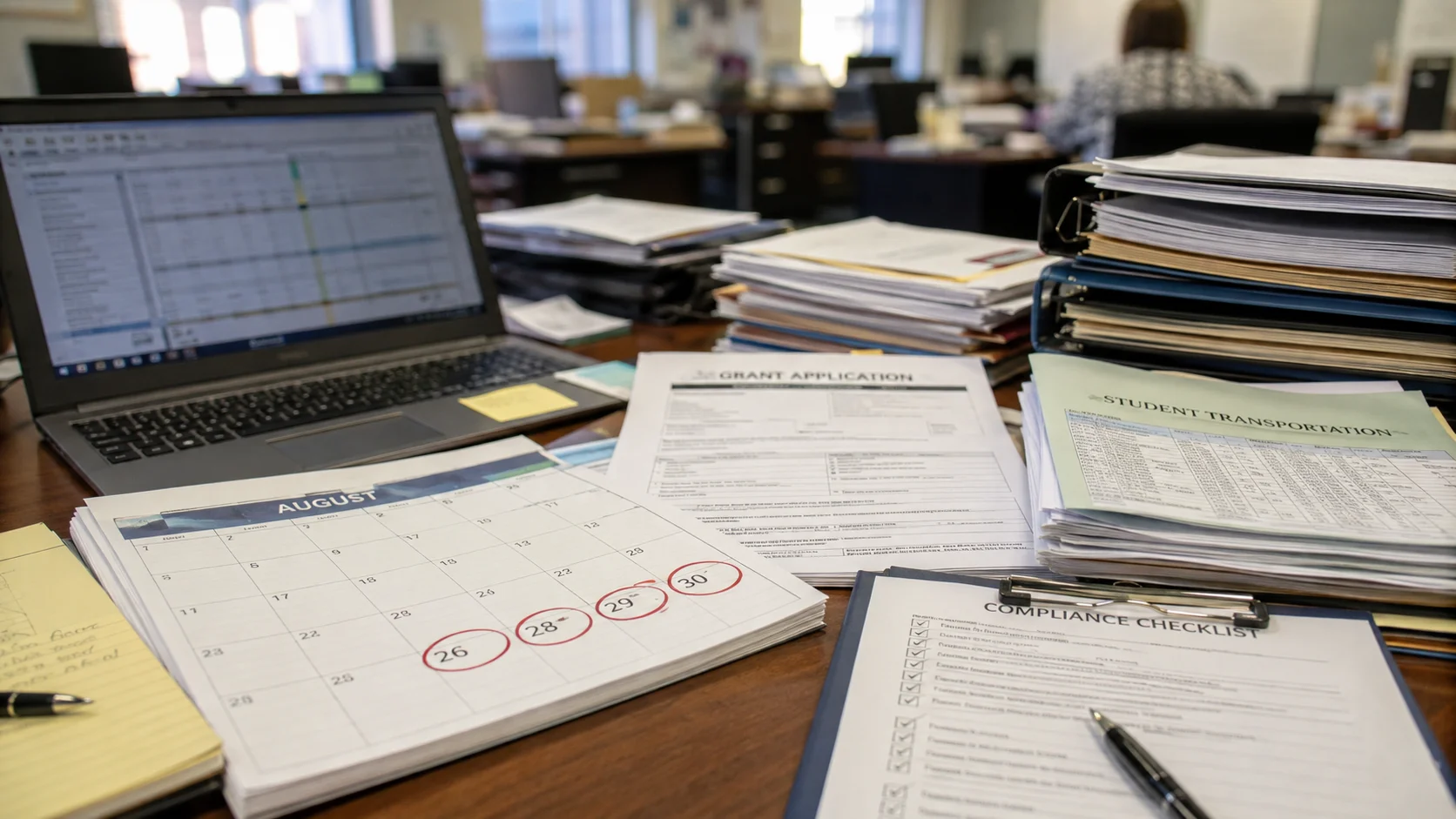
New York school business offices have moved past the first late-summer reporting cutoff, but the calendar is not getting lighter. The next concentrated compliance window arrives at the end of August, when federal program applications, budget amendments, School Improvement Grants and required grant postings converge just as districts are finalizing payroll, transportation, food service and opening-day operations.
The most important date now is August 31, 2026. For many districts, that is not one deadline but several. The 2026-27 Consolidated Application for ESSA-Funded Programs is due, certain 2025-26 ESSA allocation reductions must be reconciled, eligible Target Districts face School Improvement Grant deadlines, and Smart Start grantees must have Year 5 artifacts posted to their websites. A narrower My Brother's Keeper Indigenous Education Grant deadline arrives three days earlier, on August 28.
For business officials, the practical issue is less about remembering dates than making sure the program, fiscal and submission pieces agree. An application can be complete in the Business Portal while a required budget form is still sitting in an office. An approved grant can still create trouble if the final allocation no longer matches the district's spending plan. The closing days of August are where those seams become visible.
August 31 is an ESSA application deadline and a fiscal reconciliation deadline
NYSED's 2026-27 Consolidated Application for ESSA-Funded Programs is due by August 31. Signed budget documents must also be postmarked no later than August 31. The application is submitted through the NYSED Business Portal, and only the chief school officer or another administrator with the required rights can certify and submit it for final review.
There is also a form change that deserves attention before anyone assumes last year's packet can simply be reused. NYSED says the Grants Finance Office updated the FS-10 certification language for 2026-27 and warns that applications using the wrong form will be returned to the local educational agency. The signed original FS-10 budget and two hard copies must still be mailed to NYSED even though the application itself is completed online.
The same date also matters for districts still cleaning up 2025-26 federal allocations. NYSED's final allocation guidance says districts whose 2025-26 Title I Part A, Title I Part D, Title II Part A or Title IV allocation decreased must align the approved budget with the amount actually available. If a required FS-10A is not submitted by August 31, NYSED says final expenditures for 2025-26 will be reduced to the available amount when the FS-10F is processed.
That makes the end-of-month review a genuine federal funds reconciliation, not just an application deadline. Districts should compare final allocations with approved FS-10 budgets, identify outstanding FS-10As, confirm available 2024-25 carryover, test Title I carryover against the 15 percent limit where applicable, and make sure the expenditure plan can be supported when the final report is filed. Those checks belong in the same conversation as the 2026-27 application because a district can be closing one grant year while opening the next.
The 2026-27 application includes consultation and collaboration documentation, including forms related to private-school participation. The business office does not have to own every programmatic conversation, but it should know whether the documentation supporting federal expenditures exists before the superintendent certifies the application.
Two School Improvement Grant programs also converge on August 31
For eligible Target Districts, the 2026-27 School Improvement Grant calendar creates another August 31 deadline. NYSED lists both SIG Coaching for Excellence and SIG Instructional Systems as due on or before the end of the month.
The Instructional Systems requirements show why these grants need a business-office check even when the program is driven by instructional staff. NYSED says the full application must be finalized in the Business Portal by August 31, with no extensions. The district must upload a signed FS-10, and the original FS-10 signed in blue ink plus two hard copies must be sent by postal mail. Participating schools also must have filled any vacancy created by moving a teacher into the instructional-coach role with a certified teacher by August 31 and must have weekly collaborative planning time embedded in the school day.
Coaching for Excellence follows a similar calendar for eligible schools in the CSI and ATSI support models. The coach had to be identified earlier in the process, while any resulting teaching vacancy and the required collaborative planning structure must be resolved by August 31 before the application is finalized.
The risk here is administrative fragmentation. Human resources may know whether the vacancy was filled, the instructional office may know whether the coach meets program requirements, and the business office may control the FS-10. None of those pieces proves the application is complete by itself. Districts should verify the Business Portal status and the fiscal paperwork against the staffing conditions before the deadline passes.
August 28 matters for a smaller group of districts
The New York State My Brother's Keeper Indigenous Education Grant has an August 28 deadline for eligible public school districts that are contracted with NYSED's Office of Indigenous Education for tuition, operating costs or transportation. The 2026-30 program is designed for districts working with New York State Tribal Nations and requires a signed memorandum of agreement with a participating Tribe.
The submission has two clocks. NYSED says one original of the full proposal must be postmarked by August 28, while an electronic copy of the complete application must be received by 5 p.m. that day. For eligible districts, that makes this a week-ending control item rather than something to leave for the broader August 31 review.
Smart Start and Smart Schools are separate checks
Two similarly named state initiatives can easily blur together in an August compliance calendar. Smart Start grantees have a real August 31 obligation: NYSED's grant calendar requires all Year 5 artifacts to be posted to the district website by that date. The Year 5 annual report follows on September 30.
Smart Schools, by contrast, is not an August 31 grant deadline. NYSED updated its Approved Plans, Data and SSIP Status information in August, which makes this a useful time for districts with remaining Smart Schools Bond Act allocations to reconcile local project records against State approval status. The important distinction is that an allocation is not the same thing as an approved investment plan or a completed project.
For technology and security projects, that status check should include the approved plan amount, remaining allocation, procurement status, reimbursement documentation and any amendment that returned money to the district's available balance. Districts using Smart Schools funding for high-tech security should also make sure the administrative record behind the project is as current as the equipment itself.
The next deadlines are later, but the files should start now
Not every operational item needs to be forced into the August 31 bucket. NYSED's revised Transportation Compliance Form is due twice each year, on November 15 and May 15. The form covers bus safety drills and the active roster of school bus drivers, monitors and attendants. Districts do not need to file it in August, but opening day is the cleanest point to establish the roster that will eventually support the November submission.
The same principle applies in food service. NYSED's 2026-27 Child Nutrition training schedule remains active, and its Learning Management System can document Professional Standards hours for food-service personnel. TheStandardNY's recent review of universal free-meal controls explains why training records, reimbursement claims, direct certification and food-service accounting remain important even when students are not charged for meals.
Capital projects and building access no longer need another general explainer either. TheStandardNY has already detailed the new SAMS Rebuild closeout process, while the Comptroller's summer access audits have established a separate opening-day reason to reconcile badges and electronic credentials. The more useful August task is to bring those existing controls into the same status meeting as grants, transportation and federal reporting.
That meeting does not need to be elaborate. The superintendent or business office should be able to move department by department and establish what remains due before September, who is responsible for each submission, whether a second person has reviewed it, and where the evidence of completion will be stored. By the end of August, a district can have dozens of compliant individual processes and still be exposed if no one has checked whether they actually connect.
The calendar now points to August 28 and August 31. The operational test is whether the district can reach those dates with its applications, budgets, staffing conditions, public postings and supporting records telling the same story.



Comments (0)
No comments yet — be the first to share your thoughts.
Leave a comment