

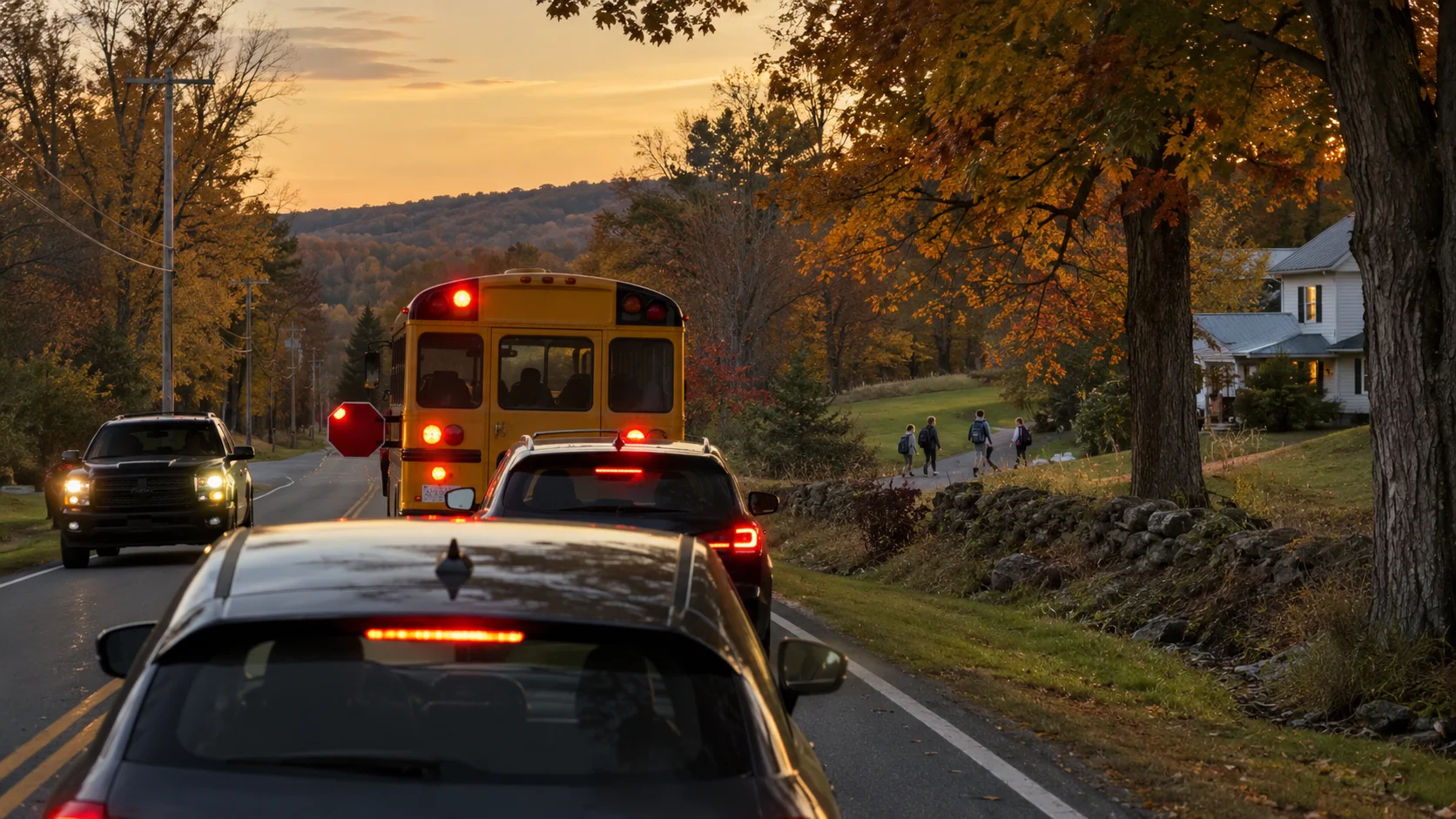
On Wednesday (Oct 21), state troopers in Jefferson County rode along with school buses on Indian River Central School District routes. They were watching for drivers who roll past a stopped bus while its red lights flash and children cross the road. Cecil Sisson, the district's transportation supervisor, told WWNY that drivers there pass stopped buses as often as five times a week. "These are children. These are adolescents," he said.
The ride-alongs were part of Operation Safe Stop, a statewide enforcement day run by police agencies and school districts. The New York Association for Pupil Transportation estimates that about 50,000 drivers illegally pass stopped school buses across New York every school day. "We're asking people to pack their patience. It could save a life," said Jennifer Jiron, the public information officer for State Police Troop D.
For parents, the enforcement day is a useful prompt to learn the rules behind the daily bus ride. State law sets who qualifies for a seat, where the bus may stop, how a family can challenge that stop, and what happens to the drivers who ignore the red lights.
Who Gets a Seat on the Bus
The baseline is Education Law 3635. It requires school districts to transport children in kindergarten through grade eight who live more than two miles from the school they legally attend, and high school students who live more than three miles away. The obligation runs up to fifteen miles, measured along "the nearest available route from home to school," according to the text of the statute.
City school districts are handled separately in the same section, under rules that turn on the size of the city. Families in a city district should check their own district's eligibility policy rather than assume the two-mile line applies to them.
Districts can do more than the minimum, but only with a vote. Busing for shorter distances, or beyond fifteen miles, requires approval from district voters, and the law then says it "shall be offered equally to all children in like circumstances." That clause matters when a neighbor's child gets a stop and yours does not, because the district has to treat families in the same situation the same way.
The mileage rules also cover children who attend private and parochial schools within the fifteen-mile limit, as long as a parent asks in time. The request must go to the school board in writing "not later than the first day of April preceding the next school year." A family planning a move to a nonpublic school in September 2027 therefore has until April 1, 2027 to get that letter in.
Missing the date does not end the conversation: Families who move into a district get thirty days after establishing residence. Children placed by their committee on special education at a nonpublic school fall under Education Law 4402, which requires suitable transportation up to fifty miles.
When the Walk Is the Problem
A child who lives inside the mileage line can still qualify for a bus when the walk itself is dangerous. Education Law 3635-b lets a school board create a child safety zone, a designated area including at least one residence, where students ride because their route to school crosses a hazard.
The board has to find that a hazardous zone exists and that "no reasonable, less costly alternatives to such transportation exist." Voters must then approve the spending, either at the annual district meeting or at a special meeting called for the purpose. The factors the board weighs include whether sidewalks exist, how much traffic moves along the route and how fast, and local crime statistics.
Those are things a parent can document. Photographs of a shoulder with no sidewalk, a count of cars during the morning walk, and the posted speed limit give a board the record it needs for a resolution. The spring budget vote is the natural moment to put the question on the ballot.
Where the Bus Stops, and How to Challenge It
Bus stop locations are where many transportation disputes begin, and the Commissioner of Education sets a high bar for overturning them. In a 2017 appeal from the Guilderland Central School District, a father asked the district to move his children's stop to a closer cul-de-sac. The Commissioner restated that "a board of education may exercise its discretion when designating pick-up and drop-off points," according to Decision No. 17,186.
That discretion holds "unless it is arbitrary, capricious, unreasonable or an abuse of discretion." The Guilderland appeal also failed on timing, because it came after the thirty-day window for appeals to the Commissioner under Education Law 310. A 2011 decision involving a New York City student described the balance districts are expected to strike, weighing "pupil safety and convenience, routing efficiency and costs" when they set a pick-up point.
The practical sequence follows from those rulings. Start in writing with the district's transportation director, and describe the specific hazard with photos and times of day. Ask the board to review a denial, then note the date of its final answer, since the thirty-day clock for an appeal to the Commissioner starts there.
The Drivers Who Do Not Stop
Under Vehicle and Traffic Law 1174, every driver meeting or overtaking a school bus "from either direction" must stop when its red lights are flashing. That covers oncoming traffic as well as the cars behind the bus. A first conviction carries a fine of $250 to $400 and up to thirty days in jail, while a third conviction within three years can reach $1,500 and 180 days.
The license consequences grew this year. Under the Department of Motor Vehicles point schedule that took effect in February, passing a stopped school bus now carries eight points, up from five. Drivers who reach eleven points within twenty-four months can face a hearing and the loss of their license.
Stop-arm cameras add a second track. Section 1174-a allows counties, cities, towns and villages to put cameras on buses by agreement with a school district, with owner fines of $250 for a first violation, $275 for a second and $300 after that. Camera tickets are not treated as a conviction and stay off the driving record, so they carry no points. Parents who want cameras on their district's buses can ask the board whether it has an agreement with the county.
The Afternoon Run Gets Darker After Nov 1
Clocks fall back one hour on Sunday, Nov 1, which moves sunset earlier and puts more afternoon drop-offs close to dusk for the rest of the fall. That week is a good time to walk the stop with younger children and practice crossing in front of the bus only after the driver signals. Agree, too, on where a parent or older sibling will wait. Families planning for winter will find the storm-day rules in our guide to snow days and emergency remote instruction.
John Middlestate, who manages transportation services for Indian River, said of Wednesday's enforcement that "it puts us a little bit more at ease." The operation lasted a day. The April 1 deadline, the thirty-day appeal window and the eight points on a driver's record stay in force all year.



Comments (0)
No comments yet — be the first to share your thoughts.
Leave a comment