
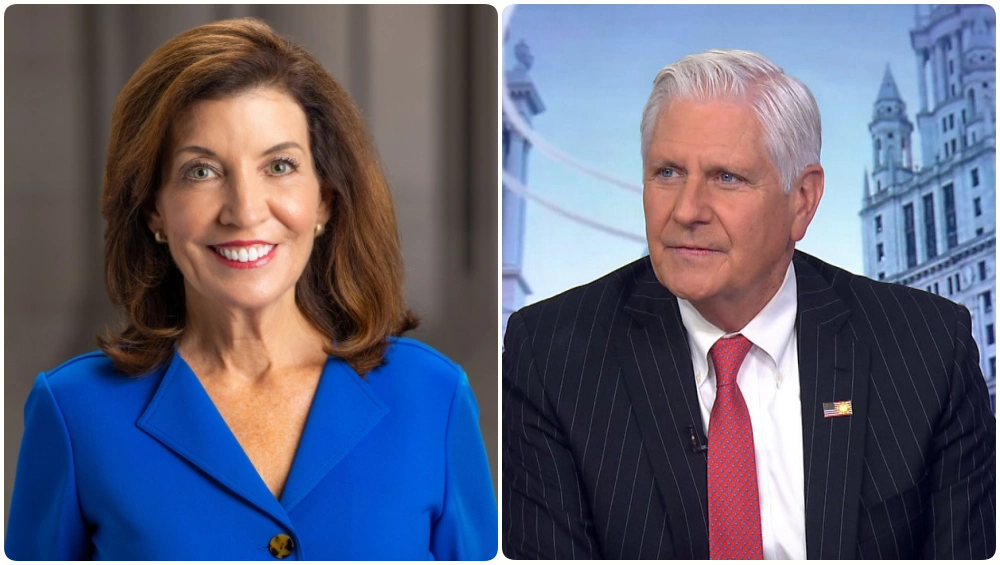
A New York parent who opens either campaign website looking for an education plan will not find a page by that name. Gov. Kathy Hochul's site sets out five one-line items under the heading "She's investing for our children's future," starting with banning cell phones in schools and ending with protecting kids online. Republican nominee Bruce Blakeman's homepage has no education section at all, and his school positions sit instead inside press-release PDFs posted to his campaign's news page between December 2025 and August 2026.
TheStandardNY reviewed both sites on Oct. 27, including every education-related release on Blakeman's press page, along with the governor's official announcements. The comparison covers five issues that reach classrooms from Buffalo to Montauk: the phone ban, free school meals, child care and pre-K, the new federal scholarship tax credit, and the state aid formula that funds most districts. Where a candidate has published nothing on an issue, this guide says so.
Hochul is running on a record, and her site claims the phone ban, universal free meals and statewide pre-K as delivered, while her official statements say she fully funded Foundation Aid. Blakeman has put in writing his support for universal child care and pre-K across the whole state, pressed for the scholarship opt-in months before Hochul made it, and pledged surplus dollars to school tax relief. His campaign has published no position on the phone ban, on universal school meals or on the Foundation Aid formula.
Two websites, two kinds of document
Hochul's campaign pages read like a résumé. The accomplishments page lists "Securing free school meals for every student," "Making universal childcare a reality" and "Delivering statewide universal pre-K" alongside the phone ban. The about page adds that she "banned cell phones during school hours." Neither page mentions Foundation Aid, the scholarship credit or a single education proposal for a second full term.
Blakeman's homepage biography touches schools once, in a line about his years as Nassau County executive saying he "stopped boys from playing in girls sports." The rest of his education record lives on the press page, which at the time of review listed releases through Aug. 12 and nothing after. The site therefore carries no response to anything that happened in schools this fall, including the governor's Oct. 9 decision on the scholarship credit he had spent the winter demanding.
The phone ban
Hochul signed the distraction-free schools law through the state budget in May 2025, and bell-to-bell restrictions took effect that September. At a New York City school on June 1, she released a survey of nearly 600 educators and said 80 percent reported students behaving better and more engaged, while 60 percent said bullying had dropped. Recalling the opposition from parents, school boards and teachers, she told the room, "We're doing it anyhow. We have no choice because our young people desperately need the adults to take the heat," according to the governor's transcript.
The same law required every district, charter school and BOCES to post an enforcement report with demographic discipline data by Sept. 1, 2026. TheStandardNY found those first reports scattered across district websites, in formats that cannot be compared, with no state office collecting them. Hochul's campaign site lists the ban as an accomplishment and does not address the reports.
Blakeman's campaign site contains no statement on the phone ban, for or against it. None of the education releases on his press page mentions the law, and he has not said in writing whether he would keep, change or repeal it.
Free school meals
Universal free breakfast and lunch became state law in the FY2026 budget. When Hochul pitched the program in March 2025, her office said it would cover more than 2.7 million students and extend free meals to nearly 300,000 children who did not already qualify. Her January executive budget proposed $395 million for the program's second year.
How much of that bill New York carries depends partly on Washington. State Comptroller Thomas P. DiNapoli warned on Oct. 15 that federal SNAP and Medicaid restrictions could shrink the student counts that set federal reimbursement, shifting more of each meal's cost to Albany. Neither campaign site addresses that exposure.
Blakeman has published no position on whether universal free meals should continue. His one school-food commitment came in a Jan. 14 release after federal rules again allowed whole milk in cafeterias. "As Governor, I will require state-funded schools and institutions to buy New York-produced milk whenever available," he said, calling the idea a Buy New York Dairy policy for publicly funded institutions.
Child care and pre-K
On this issue the two candidates' written words come closest. On Jan. 8, nearly two weeks before the governor released her budget, Blakeman said in a campaign statement: "Universal child care and pre-K help parents stay in the workforce and give children a strong start, and I support making those programs available to working moms and dads across New York State." His objection was geography. "What I do NOT support is an Albany scheme that asks suburban and upstate taxpayers to pay for a program which excludes their children," he said, citing advocates and fiscal watchdogs who estimated a universal system could cost more than $15 billion a year.
The budget Hochul signed on May 28 put $4.5 billion toward child care and pre-K, an increase of $1.7 billion that her office said would support care for up to nearly 100,000 additional children. It funds pre-K seats for every four-year-old in the state by the start of the 2028-29 school year, launches New York City's 2-Care program with the mayor, and backs counties building out a program called First 3. Her campaign now describes universal child care as something she is "making a reality."
Blakeman's press page shows no later statement on child care after the enacted budget added statewide pre-K and county programs to the plan he criticized in January. In February he pledged to demand accountability for state child care spending, and he has not published a cost estimate or a design of his own.
The scholarship tax credit
The federal scholarship tax credit lets a taxpayer give up to $1,700 to an approved scholarship organization starting Jan. 1, 2027, and claim it back dollar for dollar, but only in states whose governors opt in. Blakeman made this his sharpest education attack of the winter. In a Jan. 21 release, he cited analysts' estimates of $244 million to $488 million a year in scholarships. He also said, "Kathy Hochul is taking opportunities away from New York children, plain and simple," and argued that Catholic schools and yeshivas had the most to lose.
Hochul's office called her supportive in May, and on Oct. 9 she opted New York in. "I've been clear from the start that New York would participate in the federal scholarship tax credit program if, and only if, all schools and students, including those in our public schools, could benefit," her statement said. She added, "I'm not going to leave money on the table when it could help our kids," and wrote that business leaders had committed to use the program for public school students, though she named none of them.
Both candidates now stand on the same side of an opt-in that the state's teachers unions and the Democratic leaders of both legislative chambers opposed. Hochul's campaign site does not mention the credit, and Blakeman's has posted nothing since she adopted the position he demanded. The next test is administrative, since New York must send the IRS its list of approved scholarship organizations by Feb. 15.
Foundation Aid and the school budget
Foundation Aid is the formula that sends most state money to districts according to student need and local wealth, and it is the line every superintendent reads first in January. In her Oct. 9 statement, Hochul took credit for "increasing school funding by more than $10 billion and fully funding Foundation Aid for the first time." Her FY2027 executive budget proposed $39.3 billion in school aid, which her office called the highest level in state history, with a Foundation Aid increase for every district.
Her campaign website never mentions the formula, and neither campaign has published a plan for it beyond the current school year.
Blakeman has not taken a written position on the formula itself. His school-funding commitment came in a Feb. 17 release objecting to $1.5 billion in state money for New York City, which listed his pledges as governor. The first reads, "Return unused state surplus dollars to taxpayers, starting with school tax relief." The second reads, "Stop one-off bailouts that reward fiscal mismanagement and take money away from education, infrastructure, and essential services statewide." The release does not say whether school tax relief would come through larger state aid to districts or a separate property tax rebate, or how either would sit alongside the formula.
The rest of the written record
Each campaign has also staked out ground beyond those five issues. On Jan. 15, Blakeman stood with Asian American leaders to defend New York City's gifted and talented programs and specialized high schools such as Stuyvesant, Bronx Science, Brooklyn Tech and Brooklyn Latin, pledging to protect merit-based admissions. On June 26 he asked the state inspector general to investigate the June Biology and Earth Science Regents exams, which his release asserted had been generated with artificial intelligence and contained errors. On July 31, after Anthony Fauci appeared before a Senate committee, he wrote, "When I'm Governor, nothing will be more sacred than parents' rights when it comes to their kids."
Hochul's agenda as governor this year included a January proposal requiring the State Education Department to give districts best practices for teaching math, extending her earlier back-to-basics reading approach, along with new teacher recruitment initiatives. Her campaign site lists "Protecting kids online" among its school-age items and offers no further detail.
What the ballot leaves open
Read side by side, the two sites leave parents with gaps on both ledgers. Hochul's pages make no promise about the phone-ban enforcement data that districts post without state review, the federal pressure on meal funding, or Foundation Aid after this year. Blakeman's leave his view of the phone ban and universal meals unstated, attach no price to his child care pledge, and contain nothing written since mid-August.
Voters choose on Nov. 3. The next executive budget, where the winner's school commitments will first carry dollar figures, is due in January.
Comments (0)
No comments yet — be the first to share your thoughts.
Leave a comment