
When Jeff Bezos stepped in front of a CNBC camera this week and said the bottom half of American earners should pay zero federal income tax, he reached for a specific image to make his point: a nurse in Queens. "We shouldn't be asking this nurse in Queens to send money to Washington," he said. The statement lit up social media within hours. But across New York State, there is another group of workers just as deserving of that spotlight who rarely get it: the classroom aides, teacher assistants, lunch monitors, and school clericals who show up every single day to keep public schools functioning, and who are earning wages that tell a very different story about how we value public education.
Bezos framed his argument around earners making around $50,000 a year, calling it "absurd" to heavily tax workers at that income level. New York school support staff would likely agree, except many of them would be grateful to reach that number. The data on what these essential workers actually earn is discouraging, and it is a conversation every parent, school board member, and elected official across the state needs to have.
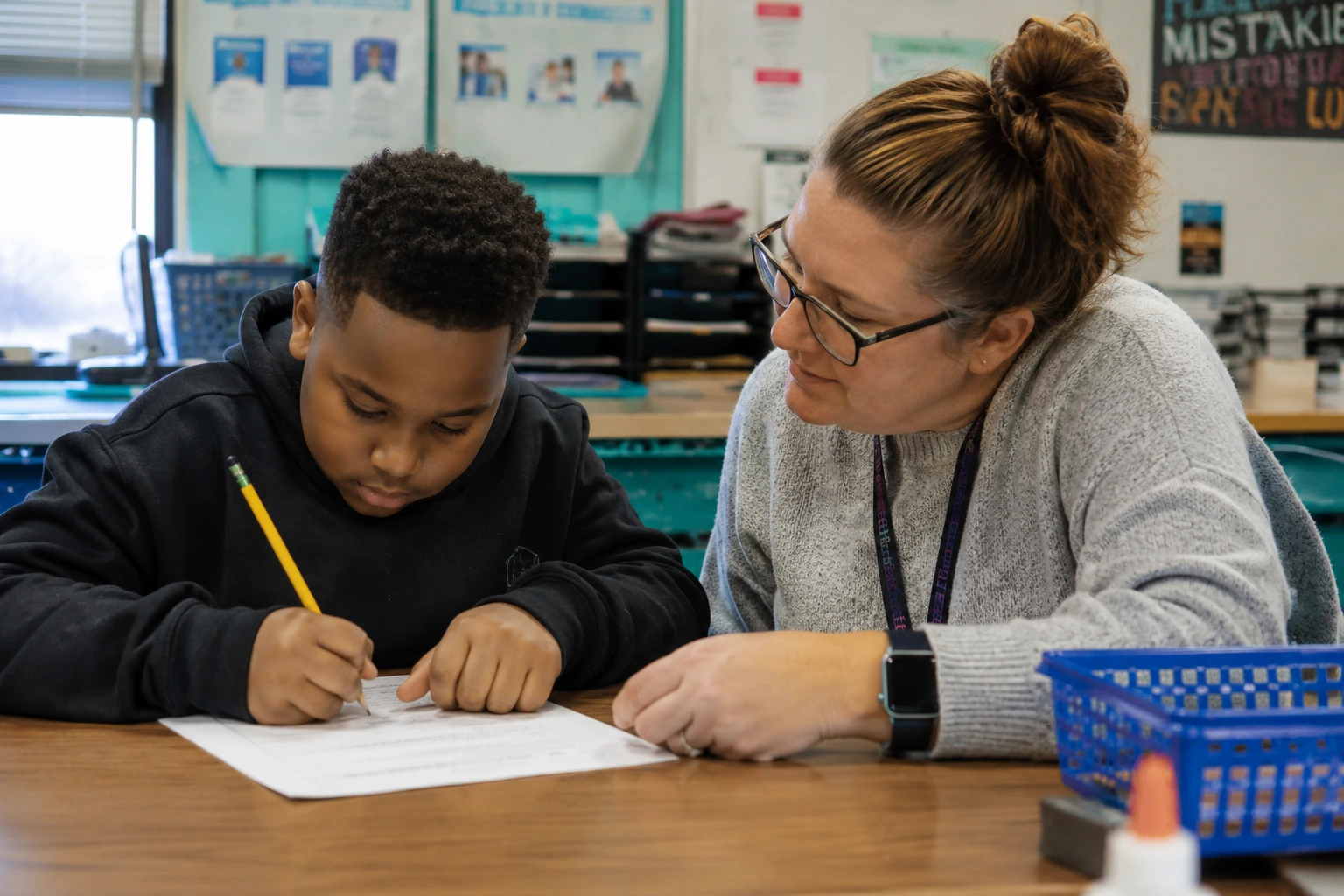
Before the numbers, it is worth being precise about who we are talking about. When most people think about school workers, they picture teachers. But behind every functional school building is a network of support roles that rarely make the evening news. Classroom aides work one-on-one with students who have Individualized Education Programs (IEPs), managing behavior, facilitating communication, and providing the kind of patient, direct attention that a single teacher in a room of 28 students simply cannot replicate. Teacher assistants co-facilitate instruction, prep materials, and often take the lead when certified teachers are pulled for meetings or evaluations. Lunch aides and cafeteria monitors manage hundreds of students daily in one of the most chaotic and under-supervised environments in any school. And school clericals, the secretaries and administrative assistants who run front offices, are often the first and last face a parent sees when something goes wrong with their child.
These are not peripheral jobs. They are the scaffolding of the school day, and in many cases, particularly in special education settings, they are the difference between a student accessing their education or not.
Let's start with teacher assistants, since they are arguably the most credentialed of the non-certified support roles. According to data from the National Center for Education Statistics, the median hourly wage for teaching assistants in New York State is $22.60, which translates to roughly $47,000 annually for a full-time schedule. But that median hides a painful spread. Entry-level aides in upstate districts commonly earn between $18 and $20 per hour. Many positions are part-time or school-year-only, meaning that $47,000 figure applies to a fraction of the workforce. Some aides in smaller upstate districts are working on contracts that cap their annual earnings well below $35,000.
Lunch aides and cafeteria monitors sit at the lower end of the scale. The average hourly pay for a school lunch aide in New York State hovers around $19.66 per hour, according to ZipRecruiter. For a position that is frequently part-time, limited to the school year, and comes with no remote-work option, that hourly rate can translate to an annual income well under $25,000 for many workers. School cafeteria workers statewide average around $37,721 annually, but the low end of that range dips below $32,000.
School secretaries and clerical staff, who manage student records, coordinate communication between administrators and families, handle special education paperwork, and function as de facto crisis coordinators on difficult days, earn a statewide average of roughly $47,682 in New York City but significantly less outside of it. Across the broader state, the average hourly rate for school secretaries tracked on Indeed is about $18.60 per hour. At full-time hours on a 10-month school-year calendar, that is not a livable wage in most parts of New York, let alone in the five boroughs or on Long Island.
Here is where the Bezos conversation becomes directly relevant to these workers. His income threshold for zero federal taxes was roughly $54,000. A significant portion of New York's school support staff earns below that line, in some cases well below it. And they are doing so in one of the most expensive states in the country.
The National Low Income Housing Coalition has calculated that a full-time worker needs to earn at least $28.17 an hour to afford a modest one-bedroom apartment in the U.S. Most school aides and lunch monitors do not come close to that figure. In New York City, the gap is worse: a 2025 study cited by CBS News found that a person needs to bring in over $150,000 to live comfortably in the city, while the median household income sits around $87,640. School lunch aides earning $19.66 an hour is not just below comfortable; It's below functional.
Even upstate, where costs are lower, a living wage analysis by Cornell University researchers found that the baseline income needed for a single adult with no children to cover essential expenses varies by region, but consistently outpaces what many support staff are actually earning. The current upstate minimum wage stands at $16 per hour, and as Spectrum News reported this month, advocates argue that number still falls far short of what workers actually need to cover housing and basic necessities without public assistance.
The salary inequity within New York's public schools is worth examining on its own. Data reported by the Empire Center for Public Policy in December 2025 found that the average compensation for full-time school employees in New York (outside of New York City) was $97,506 for the 2024-2025 fiscal year. Nearly one-third of all educators covered by the New York State Teachers' Retirement System earned six figures, and 90 people across the state earned more than $300,000. The highest-compensated superintendent in the data received total pay exceeding $662,000.
Meanwhile, a classroom aide working with a child who has autism in that same building might be taking home $32,000. There is no policy debate, union grievance, or budget presentation that makes that gap feel reasonable. These are people working in the same institution, toward the same mission, and the financial distance between them is staggering.
It is important to note that many certified teachers and principals are compensated appropriately for their credentials and workloads, and strong educator pay is essential to attracting qualified teachers to the profession. This is not an argument against teacher compensation. It is an argument that the workers supporting those teachers have been systematically left behind.
Part of what keeps this issue out of the headlines is that school support staff are often not covered by the same union structures that protect teachers. While the United Federation of Teachers negotiates aggressively for certified staff in New York City, paraprofessionals in many upstate and suburban districts operate under weaker contracts or fragmented representation. They are less likely to appear in news coverage of contract negotiations, less visible in budget discussions, and less likely to have the time, resources, or political infrastructure to advocate loudly for themselves.
Many of these workers are also women, and many are women of color, particularly in urban districts. The demographics of who holds paraprofessional and lunch aide positions in New York's public schools mirror the demographics of low-wage work more broadly: communities that have historically had less political power to demand better.
There is also a structural issue with how these positions are funded. School aid formulas in New York are notoriously complex, and while the state has made significant investments in education funding in recent years, much of that money flows toward instructional budgets and capital improvements rather than wage floors for support staff. Local districts, constrained by property tax caps and competing budget priorities, often treat support staff salaries as a line item to be minimized rather than a quality-of-education investment to be protected.
Bezos did not offer a legislative blueprint when he made his comments. He floated an idea and left the mechanics to others. But the conversation he started is useful, because it forces a direct question: if we agree that it is wrong to heavily tax someone earning $50,000 a year in a country as wealthy as ours, then what do we say about a system that asks a school classroom aide to perform essential, emotionally demanding, legally required work for $28,000 a year?
Advocates and education researchers have pointed to several concrete directions. First, New York's school funding formula should incorporate minimum wage floors for support staff, similar to how some states have established paraprofessional minimum pay requirements tied to regional cost-of-living data. Second, districts should be required to publicly disclose the full salary range of all school employees, not just administrators above the reporting threshold, so communities can make informed decisions at budget time. Third, CSEA and AFSCME locals that represent school support staff across the state need the political and organizational support to negotiate contracts that reflect what it actually costs to live in New York.
At the school board level, parents who show up to advocate for their child's IEP services should understand that the quality of that service is directly connected to whether the aide delivering it can afford to stay in the job. Paraprofessional turnover in New York districts is a documented problem, and it is not complicated to trace: when the pay is poverty-adjacent and the work is emotionally exhausting, people leave. And when they leave, it is the most vulnerable students who absorb the loss.
Bezos made a populist argument this week. Whether you agree with his broader tax philosophy or not, the underlying observation, that low-wage workers are being squeezed from every direction in the current economy, is one that lands close to home in New York's public schools every single day. The workers who make sure a child with a disability has the support their IEP guarantees, who make sure a cafeteria does not descend into chaos, who answer the phone when a frightened parent calls the front office in a panic, are among the most underpaid people in public service.
New York calls itself a leader in education. The state spends more per pupil than almost any other in the country. But spending per pupil is an average, and averages can hide a lot. The question is not just how much we spend, but who benefits from that spending and who is left behind in the salary structures we accept without question. The nurse in Queens that Bezos referenced deserves relief. So does the aide in Buffalo, the lunch monitor in Poughkeepsie, and the school secretary in Utica who has been holding that front office together for 15 years on a wage that has barely kept pace with inflation.
Their work is not invisible. It just has not been valued the way it should be. That is the standard New York has yet to meet.


Comments (0)
No comments yet — be the first to share your thoughts.
Leave a comment