
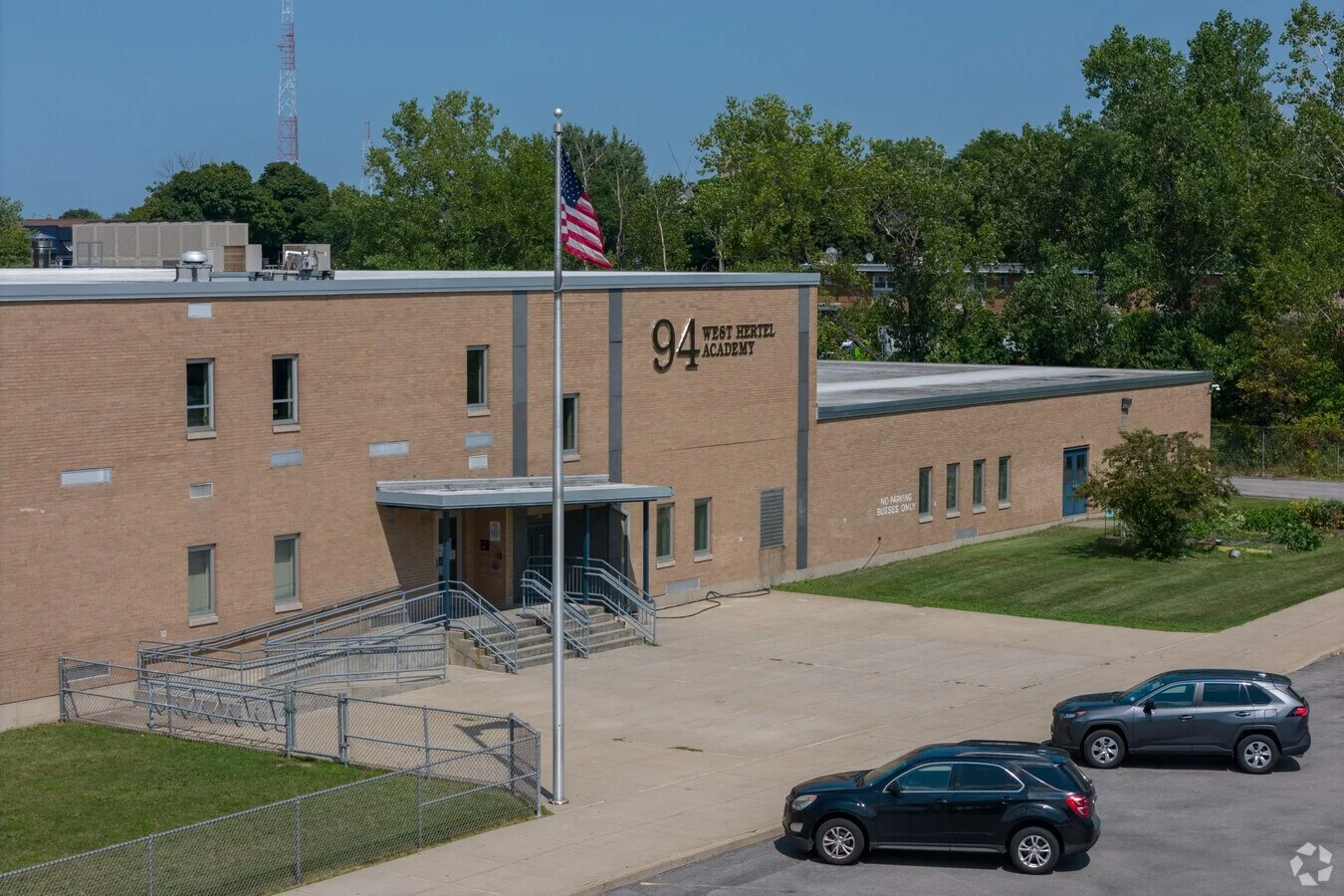
On Monday night (Oct 26), Buffalo families filled West Hertel Academy, School No. 94, for the district's fourth listening session on a plan to close and consolidate schools, after sessions on October 8, 15 and 20. A Riverside High School student named Ashly Kanku told a WKBW reporter, "It's just very sad." One speaker put the question the whole month had been circling: "When BPS decides which schools to close, are we looking at buildings or are we looking at children."
At the other end of the state, a smaller closure was moving under different rules. In a letter to families last week, Superintendent Fred Walsh wrote that "there are only 112 students enrolled at Global Commerce, a 39% decrease in enrollment over the last five years." That letter opened the process to shut the Urban Assembly School for Global Commerce in Harlem. If the city Education Department moves ahead, it has to post formal closure documents and hold a public hearing before the Panel for Educational Policy can vote in December, and those documents are due online by Friday.
The difference between those two scenes is written into state law, and it should be erased. Outside New York City, the statute that governs school closings, Education Law 402-a, does not require a district to study a closing, publish an impact statement, or hold a hearing before its board votes. The Commissioner of Education has ruled so twice. Albany should make those steps mandatory for every district before the next wave of enrollment-driven closures arrives.
The Law Most Upstate Families Assume They Have
Read quickly, Section 402-a looks protective. It asks boards to act "at least six months in advance of a proposed school closing," lists factors such as enrollment, building condition, staffing and whether nearby schools can absorb displaced students, and calls for newspaper notice "once a week for two weeks." It even sets a clock, providing that a hearing "shall be held within sixty days of the issuance of the educational impact statement."
The operative verb sits in the first sentence, where boards "are hereby authorized and recommended to establish an advisory committee on school building utilization." Everything that follows hangs on that committee. In 2005, parents in the Sullivan West Central School District challenged the closing of two elementary schools. The Commissioner of Education wrote that "Education Law §402-a is discretionary" and that its procedures apply "only where a board of education chooses to establish an advisory committee," concluding in Decision No. 15,318 that the district was not obligated to follow them.
The department repeated the point in 2011, when families appealed Corning's decision to close Lindley-Presho Elementary School and send its students to Erwin Valley Elementary. "The decision to establish an advisory committee rests solely with the board," that ruling said, adding that "the closing of school buildings are within the discretion of a board of education." Both appeals were dismissed, and the statute has not changed since.
What New York City Parents Get, and Why a Court Enforced It
New York City runs under a separate section, Education Law 2590-h, and its language is not optional. As a state court quoted it in 2010, impact statements must address "the current and projected pupil enrollment of the affected school" and "the impacts of the proposed school closing or significant change in school utilization to any affected students." They must be public "at least six months before the first day of school in the next school year," followed by a joint hearing "between 30 and 45 days following the filing."
Those requirements have teeth. In March 2010, in Mulgrew v. Board of Education, State Supreme Court Justice Joan B. Lobis voided the panel's votes to close 19 city schools, finding the impact statements boilerplate and the hearings not truly joint, and ordered the statements reissued in compliance with the law. A family in Harlem facing the loss of Global Commerce can point to a statute, a timeline and a precedent. A family in Buffalo, Rochester or a rural district in the Southern Tier can point to whatever its board chooses to offer.
Enrollment Is Falling Fastest Where the Rule Is Weakest
Buffalo's board has offered a good deal this fall, and it still came close to voting on a plan that families said they had not had time to read. As our reporting on the withdrawn Buffalo closure vote laid out, the proposal grew to nine schools affecting about 2,300 students and 108 full-time positions. The district lost $157 million in cash over three years, and officials warned of a deficit that could reach $100 million next year. PS 17, added to the list on October 20, reportedly serves about 44 percent students with disabilities.
Interim Superintendent Ebony Prophet-Bullock pulled the resolution at the October 21 meeting at McKinley High School. "We heard you. We're pulling it. We will not be voting on it today," she said, and then, of the district's communication with families, "We're not doing enough, and we will do better." Buffalo Teachers Federation President Rich Nigro described closures as "pulling out stitches, stitches that are holding communities together." On Monday she told WKBW, "I think it's fair to say there will be some modifications," and no new vote date has been set.
Every one of those listening sessions was a choice. Nothing in state law required Buffalo to hold them, to publish the enrollment and cost figures behind each building, or to wait for a hearing before voting. The same is true in Rochester, where, as that reporting noted, buildings sized for more than 37,000 students now hold about 21,000, and in the scores of smaller districts working through a statewide enrollment decline of roughly 12 percent over 15 years.
The city is hardly immune. K-12 enrollment in New York City has fallen by roughly 170,000 over a decade to about 790,000, and 224 schools now enroll 200 or fewer students, up from 165 in 2016, according to Chalkbeat. Chancellor Kamar Samuels has called severely under-enrolled schools a top priority without releasing a citywide plan, which means the Harlem proposal may be the first of many to run through the 2590-h process.
What Albany Should Write Into Law
The fix is a short bill. The Legislature should change "authorized and recommended" to "shall" in Section 402-a, so that every district proposing to close a building must produce a written impact statement, publish it, and hold a hearing before the board votes. The statute's existing list of factors is a reasonable floor, and lawmakers should add two that Buffalo's month exposed: how many students with disabilities attend the building, and what their transportation and services will look like at the receiving school.
The bill should also set a minimum gap between the final version of a closure plan and the vote. A recurring complaint at McKinley High School was about revisions landing days before the board was due to act. New York City's thirty-to-forty-five-day hearing window offers a tested model. A rural board closing one elementary school would need to do a few weeks of work it may already be doing informally.
Lawmakers have shown interest in the city's version of this problem. A 2023 Assembly bill, A1062, would have required New York City to place students with disabilities in new schools before a closure takes effect, and it was last amended and recommitted to the Education Committee in June 2024.
Boards will still close schools, and many of them should. Buffalo board member Larry Scott has said as much: "to be blunt, we have to close schools." The parents at West Hertel on Monday were asking for something narrower than a reprieve, which is the same written analysis, on the same calendar, that families in Harlem are entitled to by statute.


Comments (0)
No comments yet — be the first to share your thoughts.
Leave a comment