

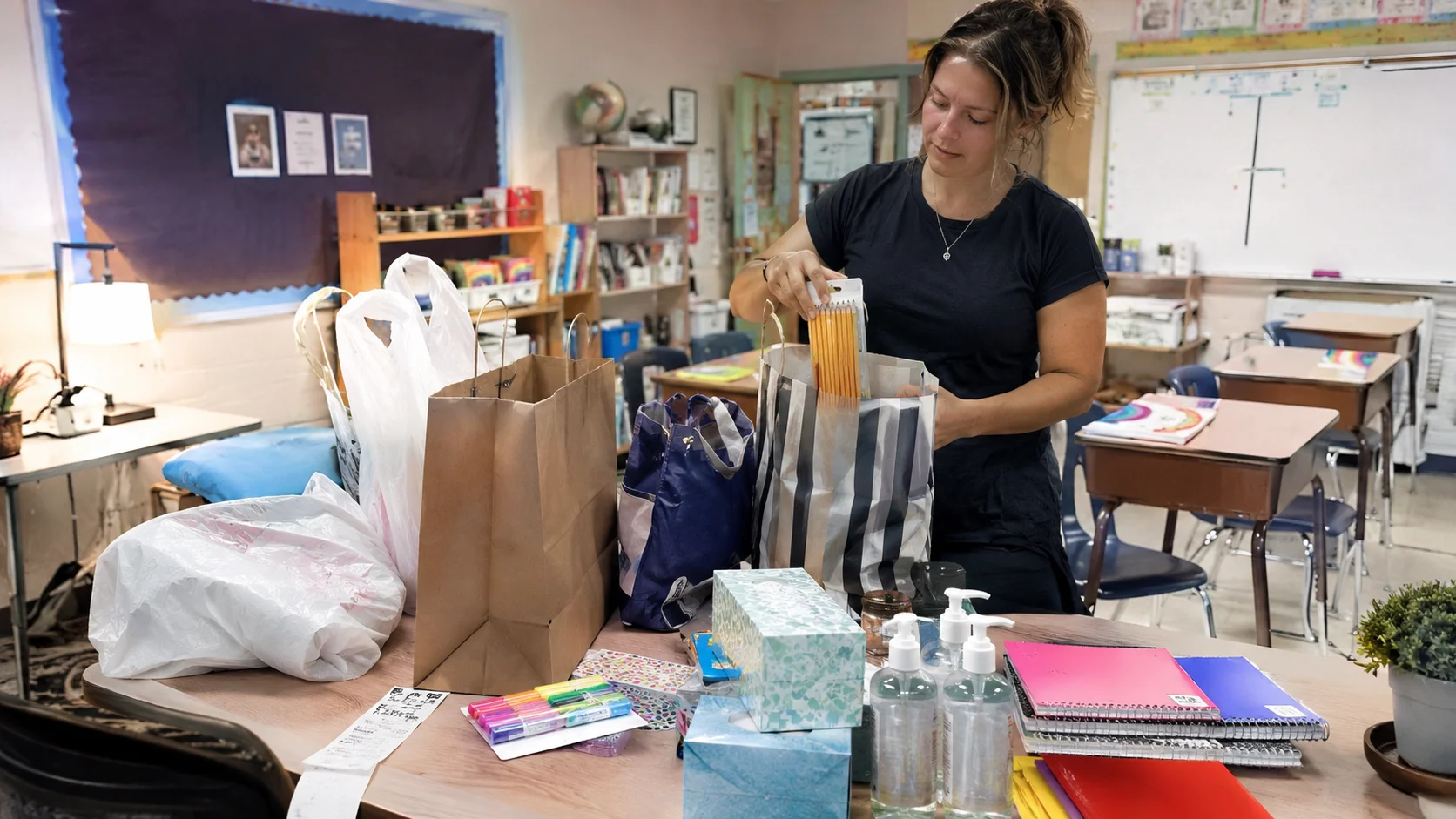
By November, most teachers have already bought the things the supply budget did not cover, from the dry erase markers that run out by Halloween to the headphones that let a student with sensory needs get through a test. A special education teacher in New York City described the list to the nonprofit AdoptAClassroom.org as "notebooks, highlighters, dry erase markers, classroom decorations, headphones, and educational subscriptions," and her inventory reads like most of the receipts sitting in teachers' kitchen drawers this fall.
For the 2026 tax year, those receipts can be worth more than they have been in a decade. The familiar educator expense deduction rises to $350, and a federal law signed in July 2025 adds a second, uncapped deduction for classroom spending above that line, available to educators who itemize. With December 31 now 47 days away, the purchases a teacher makes and documents between now and New Year's Eve will count on the return filed next spring.
The first change is the one most teachers already know in outline. The above-the-line educator expense deduction, which any eligible educator can take whether or not they itemize, climbs from $300 to $350 for taxable years beginning in 2026. The IRS set that figure in Revenue Procedure 2025-32, its annual inflation adjustment, which covers books, supplies, computer equipment and related software and services, other equipment, and supplementary materials used in the classroom. Two married educators filing jointly can each claim up to $350, for a combined $700, though neither spouse can use the other's unused room.
The second change is new. Section 70110 of the One Big Beautiful Bill Act, the federal tax and spending law enacted in July 2025, made permanent the 2018 suspension of most miscellaneous itemized deductions but carved out an exception for unreimbursed educator expenses. Beginning with the 2026 tax year, an educator who itemizes on Schedule A can deduct qualifying classroom costs above the $350 that goes on Schedule 1, and the itemized version carries no dollar cap and is not reduced by the old floor of 2 percent of adjusted gross income that applied before 2018.
The law also widened the door. The Senate Finance Committee's section-by-section summary of the provision adds interscholastic sports administrators and coaches who work at least 900 hours in a school year to the definition of eligible educator for the itemized deduction, and it covers instructional materials whether or not they are used inside a classroom. Coaches do not qualify for the $350 above-the-line deduction, so the itemized route is the only one open to them.
For classroom teachers, the baseline test has not moved. An eligible educator is a kindergarten through grade 12 teacher, instructor, counselor, principal or aide who works at least 900 hours during a school year in a school that provides elementary or secondary education under state law, which includes public, charter and private schools in New York. The hours test is measured by the school year, but the deduction follows the calendar year in which the money was spent, so a set of novels bought in March for the spring semester and a printer bought in October for the fall both land on the 2026 return.
The circle grew again in September, when the Supporting Early-Childhood Educators' Deductions Act, known as the SEED Act, rode into law on September 18 attached to a Russia and Iran sanctions package. It extends the above-the-line deduction to pre-K and early childhood educators, a group that has bought its own crayons and picture books for two decades without the write-off their kindergarten colleagues down the hall could claim. Early educators in Universal Pre-K classrooms and community-based programs should keep their 2026 receipts and confirm with a preparer how the final IRS instructions treat this year's spending.
Qualifying costs include books, classroom supplies, computer equipment and software, and supplementary materials, and tax professionals at the National Association of Tax Professionals note that professional development courses count as well. Physical education and health teachers face one carve-out, since only athletic supplies qualify for them under the above-the-line rule. Anything a district, a PTA, a grant or a crowdfunding campaign reimbursed is off the table, and so is spending already covered by tax-free money such as a Coverdell or 529 withdrawal.
Software and app subscriptions deserve a second look before the receipt goes in the folder. A tool that qualifies as a deduction can still create a problem at school if it collects student data without the district's approval, and New York's student privacy law requires that vetting, as TheStandardNY explained in its Education Law 2-d playbook for classroom apps.
Whether the new deduction helps at all depends on itemizing. It only pays off for teachers whose total itemized deductions exceed the standard deduction, and for 2026 the IRS has set that bar at $16,100 for single filers, $24,150 for heads of household and $32,200 for married couples filing jointly. A renter with no mortgage and modest charitable giving will usually stay on the standard deduction and should simply claim the $350.
The math shifts for homeowners, and it shifts most in a state with New York's property tax bills. The same 2025 law raised the cap on the state and local tax deduction from $10,000 to $40,000, with the higher limit phasing back down for filers whose modified adjusted gross income falls between $500,000 and $600,000, a range few teaching households reach. A Westchester or Long Island teacher paying five figures in school and property taxes, plus state income tax and mortgage interest, can clear the standard deduction far more easily than under the old $10,000 cap, and every dollar of classroom spending above $350 then reduces taxable income directly.
Consider a single teacher in the Capital Region with $9,000 in property taxes, $5,500 in state and local income tax, $4,000 in mortgage interest and $1,400 in classroom purchases. Under the old rules, that teacher could claim $300 of supplies and would have been capped at $10,000 in state and local taxes. In 2026 the state and local taxes count in full, $350 of supplies goes on Schedule 1, and the remaining $1,050 joins $18,500 in other itemized deductions, for a Schedule A total of $19,550 that beats the $16,100 standard deduction by $3,450.
Itemizing on the federal return does not settle the state return, because New York computes its own itemized deductions on Form IT-196 under rules that have not tracked every federal change since 2018. Teachers who itemize federally should ask a preparer how the classroom spending carries over to the state side rather than assuming the two returns match.
The new deduction arrives against a record of steady out-of-pocket spending. In an American Federation of Teachers survey of 705 members conducted by Grow Progress from August 29 to September 2, 2025, 46 percent said they expected to spend up to $300 of their own money on classroom supplies during the 2025-26 school year, and another 30 percent expected to spend between $301 and $600, a pattern they reported for the year before as well.
AdoptAClassroom.org's 2025 Teacher Spending Survey of 3,700 K-12 teachers put the average at $895 for the 2024-25 school year, up 49 percent since 2015, against a median school-provided supply budget of $200 that 97 percent of respondents said did not cover their needs. Set against those numbers, the old cap covered a fraction of a typical year, and when it rose from $250 to $300 in 2022, Baltimore tax attorney Pauline Stavrou of Frost Tax Law told Education Week, "The amount is just so small, it's a joke."
The year-end work fits into an afternoon. Start by gathering every 2026 receipt, order confirmation and bank statement line for classroom purchases, then subtract anything a school, PTA or grant paid back, and note which items were athletic supplies if you teach physical education or health. Keep the records with your tax files, since the IRS does not require receipts to be attached to a return but will ask for them if it questions the deduction.
Next, run a rough itemizing estimate using your property tax bill, your year-to-date state and local income tax withholding, your mortgage interest and your charitable giving, and compare it with the standard deduction for your filing status. If the total lands close to the line, purchases you were already planning for January can be moved into December, where they count for 2026, while a teacher far below the line gains nothing by spending early and should stop at whatever the classroom needs.
Coaches and athletic directors who meet the 900-hour test should track their spending as carefully as classroom teachers this year, because 2026 is the first year the itemized deduction is open to them. Educators weighing other federal changes this fall, including the status of Public Service Loan Forgiveness and the SAVE plan switch, should fold the tax picture into the same review, since repayment plans tied to income move with adjusted gross income too.
The final 2026 Schedule A and its instructions will show the line where the new deduction lands. The rules themselves are fixed in the statute, and the window for spending that counts toward them closes on December 31.


Comments (0)
No comments yet — be the first to share your thoughts.
Leave a comment