

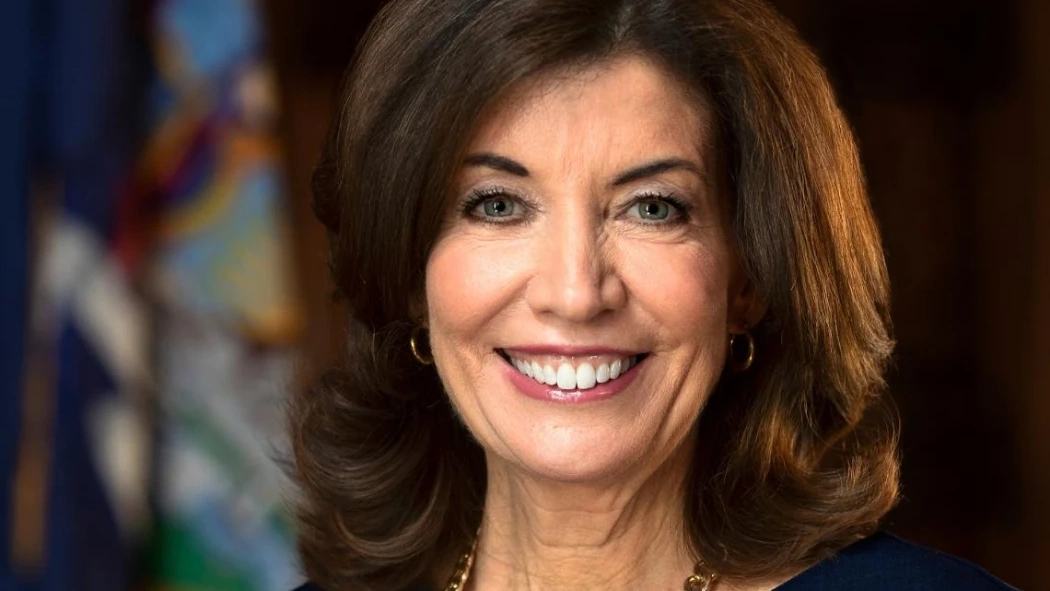
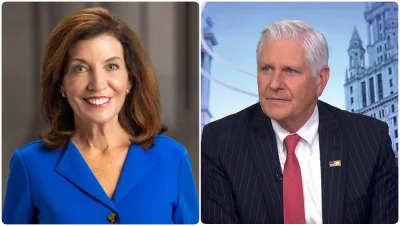
Bruce Blakeman cast his ballot Tuesday morning in the village of Atlantic Beach and told reporters he would beat Gov. Kathy Hochul by four points, 52 percent to 48. The Associated Press called the race for Hochul the moment polls closed at 9 p.m. By early Wednesday, with about 88 percent of the expected vote counted, the governor held 3.55 million votes to the Nassau County executive's 2.35 million, a margin of roughly 20 points.
Hochul spent part of her victory speech reciting a school record. Her administration, she said, had gotten to work "putting New York on the path to universal childcare, bringing free meals into our schools and taking the cell phones out." Lt. Gov.-elect Adrienne Adams, the former New York City Council speaker, completes the first all-woman executive ticket in state history.
For the more than 700 school districts between Montauk and Buffalo, Tuesday settled who writes the next state budget and left open what that budget can afford. Hochul returns to Albany with Democratic majorities in both legislative chambers, a Senate that Democrats say is now veto-proof, and a Congress that flipped to Democratic control overnight. Each result reaches a different line of a district's spending plan, and the first of them arrives before the new Legislature convenes.
The record voters kept
The budget Hochul signed in the spring sets the baseline every superintendent will measure the second term against. It carries $39.6 billion in total school aid, the highest in state history, including a $1 billion increase in Foundation Aid and $563 million more for universal prekindergarten. It also rewrote the formula, adding weights for students who are homeless or in foster care and boosting the one for English learners. Every district is now guaranteed at least a 2 percent annual increase.
That 2 percent floor matters most in districts that lean on Albany rather than on property taxes, from the Southern Tier to the North Country. In New York City, the new weights were expected to send $143 million more to schools, part of a Foundation Aid allocation of nearly $11 billion. "We appreciate that the education budget includes long overdue updates to the State's education funding formula, which has remained largely unchanged for almost two decades," Maria Odom, executive director of Advocates for Children of New York, told Chalkbeat in May.
The same budget put $4.5 billion toward child care and prekindergarten, with the stated goal of a full-day pre-K seat for every four-year-old in the state by the 2028-29 school year. It funds free breakfast and lunch for every K-12 student for a second year at $395 million, and it launched 2-Care, free care for two-year-olds in New York City, built with Mayor Zohran Mamdani. The bell-to-bell phone restriction entered its second school year in September.
The alternative, and who chose it
Blakeman, 71, ran with President Donald Trump's endorsement and an education pitch built around returning to basics. "We are failing our kids right now," he said in a campaign interview last month, arguing that classroom instruction should carry no point of view. As county executive he backed a ban on transgender women competing on women's teams at county facilities, one of the culture-war fights that made him a statewide name. His campaign never put a written position on the phone ban or universal school meals before the vote.
The vote split along schooling lines more sharply than along any line of education policy. In the Fox News Voter Analysis survey of the electorate, college graduates backed Hochul 68 percent to 31. Voters without a degree divided evenly, 50 to 50, and white men without a degree went for Blakeman by 65 to 35.
A supermajority aimed at its own governor
The more consequential result for schools may have come further down the ballot. "Tonight, New Yorkers have delivered an extraordinary victory in expanding our Democratic State Senate into a supermajority!" Senate Majority Leader Andrea Stewart-Cousins said in a statement late Tuesday, with several races still being counted. Democrats lost their two-thirds Senate majority in 2024 after dropping a single seat, and the Assembly has long cleared that threshold.
On Long Island, where the margins stayed narrow, Republicans won three of five closely watched Senate contests across Nassau and Suffolk in unofficial returns Wednesday morning. Democrats held the 6th District and flipped the 9th.
Two-thirds of both houses is enough to override a veto, though legislative leaders have rarely turned that power on a governor from their own party, and the friction between them is already on the record. On Oct. 9, Hochul opted New York into the federal scholarship tax credit, which lets donors claim up to $1,700 for gifts to private scholarship groups. Both of the state's major teachers unions objected, and so did Stewart-Cousins and Assembly Speaker Carl Heastie. "New York should opt out of the federal voucher program and continue investing in the public schools that educate the overwhelming majority of our children," Heastie said.
Hochul answered with a line she repeated on the trail: "I'm not going to leave money on the table when it could help our kids." Donations become eligible Jan. 1, and the state still has to send the IRS its list of approved scholarship organizations by Feb. 15. A Legislature that can override her now holds the budget pen during the same weeks that list is being assembled.
New York City's two-year clock
The city's schools enter Hochul's second term on a short leash that Albany chose deliberately. The spring budget extended mayoral control only through June 30, 2028, half the four years Hochul and Mamdani requested, and attached no changes to how the system is governed. Mamdani had campaigned on overhauling mayoral control and reversed course before taking office.
"We did not really hear anything on the campaign, and we're still not hearing anything now," said NeQuan McLean, president of the Community Education Council in Brooklyn's District 16, describing the mayor's K-12 priorities to Chalkbeat. "This has been one of the most disappointing sessions that I've seen." United Federation of Teachers President Michael Mulgrew put the next round in plainer terms: "Over the next two years, we will continue to work with Mayor Mamdani and the members of the state legislature to try to find ways to bring more parent and educator voices into policy decisions."
Lawmakers also loosened the class size law through a bill state Sen. John Liu introduced in June, under which 70 percent of city classes must meet the caps this school year, rising 10 points a year to full compliance in 2029-30. City Hall said the delay would save about $500 million. "The legal timetable will be extended by two years, empowering the Mamdani administration to at long last bring all NYC class sizes down to state and national norms of teacher/student ratios," Liu said. Hochul thanked Mamdani from the stage Tuesday night for backing her campaign. The 2028 renewal fight will test how far that alliance carries with a Legislature holding more leverage than it had a year ago.
Washington changes hands
Democrats won control of both the House and the Senate, according to the Associated Press, which puts Brooklyn's Hakeem Jeffries in line to become speaker, and New York seats helped deliver the House. In the Hudson Valley's 17th District, Republican Rep. Mike Lawler called Democrat Cait Conley to concede Tuesday night, though the AP had not yet called the race, and the open North Country seat Elise Stefanik held remained close in early returns.
For schools, the new majority buys hearings and budget leverage more than reversals. The Trump administration has shifted special education to Health and Human Services and civil rights enforcement to the Justice Department, and Trump keeps his veto through January 2029. Rep. Bobby Scott of Virginia, who is seeking the House education gavel, has said a spending fight could force the president to "decide whether [to] shut down the federal government or bring the people back to the Department of Education."
Albany's own books set the ceiling on any of it. In July, State Comptroller Thomas DiNapoli projected budget gaps totaling nearly $32 billion over the next three fiscal years, with school aid and Medicaid as the largest drivers of spending growth. He warned that federal changes to health and nutrition programs add uncertainty. DiNapoli, reelected Tuesday to his fifth full term, has urged the state to build its reserves.
What arrives first
The calendar now runs on deadlines rather than promises. Scholarship donations open Jan. 1, the new Congress is sworn in the same week, and the governor's executive budget follows later in January with the first second-term figures for Foundation Aid, pre-K seats and free meals. The state's scholarship organization list is due to the IRS on Feb. 15, and city schools are already being measured against the 70 percent class size target this year.
District budget votes come in May, when residents from Hicksville to Horseheads decide local tax levies built on whatever Albany sends. Mayoral control expires June 30, 2028, and the pledge of a pre-K seat for every four-year-old falls due that September.
Comments (0)
No comments yet — be the first to share your thoughts.
Leave a comment