

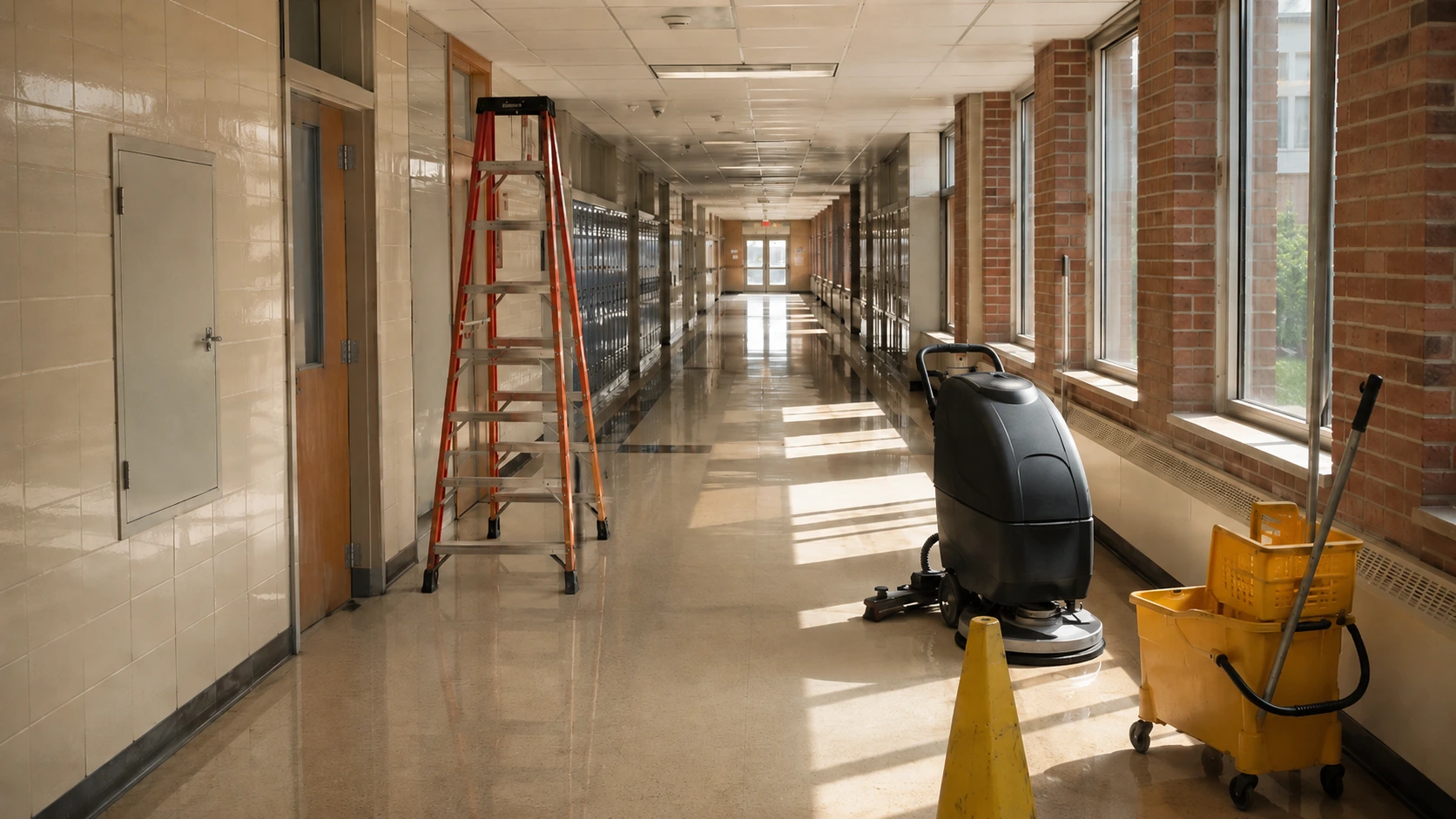
Drive past a New York public school in the summer and it reads as abandoned. No buses idling at the curb, no clot of students at the doors, no bells. What the quiet hides is that the parking lot has quietly refilled, not with families but with contractors' trucks, custodial crews, business-office staff, and administrators, and that the ten weeks between the last bell of June and the first of September are the operational heart of a school district's entire year. The classrooms are empty precisely so the rest of the machine can run at full speed. Understanding what happens during summer break is one of the more useful things a parent or taxpayer can do, because almost every decision that shapes the coming September gets made while nobody is watching.
The Fiscal Year Ends, and the Real Accounting Begins
A New York school district's fiscal year runs from July 1 to June 30, which means summer opens with an ending. The moment the calendar close on the prior year, the business office begins the painstaking work of closing the books: reconciling every account, settling outstanding purchase orders, moving unspent encumbrances, and assembling the district's official Annual Financial Report, known as the ST-3, which is filed with both the State Education Department and the Office of the State Comptroller. This is not busywork. It is the raw material for everything that follows, including the state aid the district receives.
Then the outside scrutiny arrives. New York requires every district employing eight or more teachers to undergo an annual external audit by an independent certified public accountant, conducted to government auditing standards rather than the lighter touch a small business might expect. Over the summer, auditors test the district's controls and records, and in the fall they present their findings and a management letter directly to the full board of education. If the audit reveals problems, the district must adopt a corrective action plan within 90 days, approved by the board and filed with both the state and the Comptroller. The audited financial statements themselves are due to the state by October 15 for most districts, and filing late can delay a district's state aid payments, a penalty with real teeth. Districts that spend above a federal threshold face an additional, more demanding Single Audit of their federal dollars. For families who want to understand how any of this connects to what actually reaches a classroom, it helps to see how the dollars are structured in the first place, which we mapped in our look at where New York school money actually goes. All of this determines the health of the coming year's school district budget long before a single student returns.
The Summer Construction Season
The other reason the lot fills with trucks is that an empty building is the only kind you can tear apart. Major capital projects, new roofs, boiler replacements, window and facade work, science-lab renovations, accessibility upgrades, and the security vestibules and door-hardening that districts have prioritized in recent years, are compressed into the summer window because the work is disruptive, dusty, and often impossible to do around children. That compression is brutal on schedules, which is why the planning starts a year or more ahead.
Behind the visible work sits a paperwork machine most residents never see. A significant project generally has to be authorized by district voters, then reviewed by the State Education Department's Office of Facilities Planning, which acts as the code-enforcement authority for public schools and must approve the plans and issue a building permit before any work starts. The state later reimburses a share of eligible costs through building aid, a formula that quietly shapes which projects districts choose to pursue and when. The stakes of getting the timing right are high, because a project that misses its summer runway can bleed into the school year or lose a construction season entirely. Summer is also when districts finally attack the backlog of deferred maintenance, the unglamorous list of aging systems that never rises to emergency status during the year but cannot be ignored forever.
The Inspections You Never See
Summer is inspection season, governed by a stack of mandates with hard deadlines. Under the federal Asbestos Hazard Emergency Response Act, every school must be reinspected for asbestos-containing materials every three years by a state-certified inspector, with lighter visual surveillance every six months in between, and the summer lull is a natural time to handle it. New York layers on its own Building Condition Survey, a comprehensive facilities inspection required every five years, with annual visual inspections in the interim, plus fire-safety inspections tied to each building's certificate of occupancy and periodic lead-in-water testing. Woven through all of it is the least glamorous and most visible summer ritual of all: the deep clean, when custodial teams strip and refinish acres of floors, scrub every surface, and reset a building that ten months of children thoroughly wore down.
Rebuilding the Academic Machine
While the physical plant gets rebuilt, so does the instructional one. Summer is when curriculum teams do the heavy intellectual lifting the school year leaves no room for. Curriculum planning means aligning courses to New York's Next Generation Learning Standards, writing and revising the curriculum maps that pace a year of instruction, evaluating and adopting new textbooks and materials, and, increasingly, preparing for the state's sweeping graduation overhaul. Districts are now planning for phased mandates including personal finance instruction beginning in 2026-2027 and climate education the year after, part of the broader shift toward proficiency that we unpacked in our explainer on how New York is rewriting what a diploma means. That work does not happen by itself in September; it is built in July.
Summer is also the season of the master schedule, the diabolical logic puzzle of fitting thousands of student requests, a finite roster of teachers, a fixed number of rooms, and stubborn constraints like single-section courses into a grid that works for everyone at once. A good building schedule is invisible when it succeeds and catastrophic when it fails, and administrators spend weeks assembling and testing it before students ever see a class list. Alongside it runs professional development. New York requires teachers and leaders who hold professional certificates to complete 100 hours of Continuing Teacher and Leader Education across each five-year cycle, and summer institutes, workshops, and training days are when much of that learning, and the rollout of any new curriculum, actually gets delivered.
Staffing the Fall
Personnel work peaks in summer for a simple reason: July 1 is a common retirement date, and the vacancies it creates have to be filled before the doors open. Human-resources offices run hiring searches, verify certification through the state's TEACH system, complete fingerprinting and background clearances, and build the substitute rosters a district cannot function without. New teachers are onboarded and paired with mentors, coaching and committee assignments are set, and the quiet reshuffling of who teaches what, and where, is finalized while the building is calm enough to think.
Governance Does Not Take a Vacation
The board of education keeps working too, and its summer calendar carries real weight. In July, most boards hold their annual organizational meeting, the formal start of the fiscal year, where they appoint the district clerk, treasurer, and other officers, designate banks and official newspapers, and set the committee structure for the year. Having passed a budget in the May public vote, the board also turns to the machinery of paying for it, adopting the tax levy and issuing the tax warrant that authorizes collection, with the resulting bills reaching homeowners in late summer or early fall depending on the district and its STAR exemptions. Much of the policy that governs a school year, from codes of conduct to program decisions, moves through these lower-profile summer meetings, at exactly the moment most families have stopped paying attention.
The Kids Who Are Still There
For all the talk of an empty building, plenty of children never leave. Summer school and credit-recovery programs run for students who need to make up coursework, Regents exam administrations and retakes fill parts of the calendar, and districts operate extended school year services for students whose individualized education programs require instruction to continue through the summer so that hard-won progress does not slide. Those programs come with their own logistics, from transportation routing to meals, meaning a meaningful slice of the district's staff and buses are running all summer for the students who count on them most.
The Countdown to Day One
By August, every thread weaves together into a reopening. The technology department images and updates thousands of devices, refreshes the network, and hardens systems against the cyberattacks that increasingly target schools. Warehouses receive and distribute the supplies, furniture, and materials ordered months earlier. Transportation finalizes bus routes for the new enrollment and, where needed, takes delivery of new buses purchased with state transportation aid. Food-service staff prepare kitchens and menus, data teams certify the year-end student records the state requires and prepare fall enrollment reporting, and safety teams review drill and emergency plans. Then comes the final custodial push, the new-teacher orientation week, and a building that spent the summer being audited, rebuilt, inspected, scheduled, and restocked opens its doors as though none of it ever happened.
That is the quiet magic trick of the school year. The season that looks like nothing is the season that decides almost everything, and the calm empty hallway in July is not a pause in the work. It is the work. Families who grasp that see their schools more clearly, and are far better positioned to ask the right questions in the fall about the budget that was closed, the projects that were built, and the plans that were laid while the building only looked empty.


Comments (0)
No comments yet — be the first to share your thoughts.
Leave a comment