

Ask a parent who graduated from a New York public school twenty years ago to describe what their kid's classroom looks like now, and you will usually get a version of the same answer: the building is the same, the bell schedule is the same, and somehow almost nothing else is. That instinct is correct, and it is not nostalgia talking. Four separate, largely uncoordinated policy shifts, each moving on its own legislative or regulatory track, have converged on the same school year, and together they are rewriting how children learn to read, whether their phones are in their pockets, how their district's budget survives a shrinking roster, and what a diploma will eventually require them to prove. None of these four changes were bundled into a single bill. None of them made a unified announcement. That is precisely why so many families feel like they are catching up to a system that moved without telling them.
The Reading Rewrite
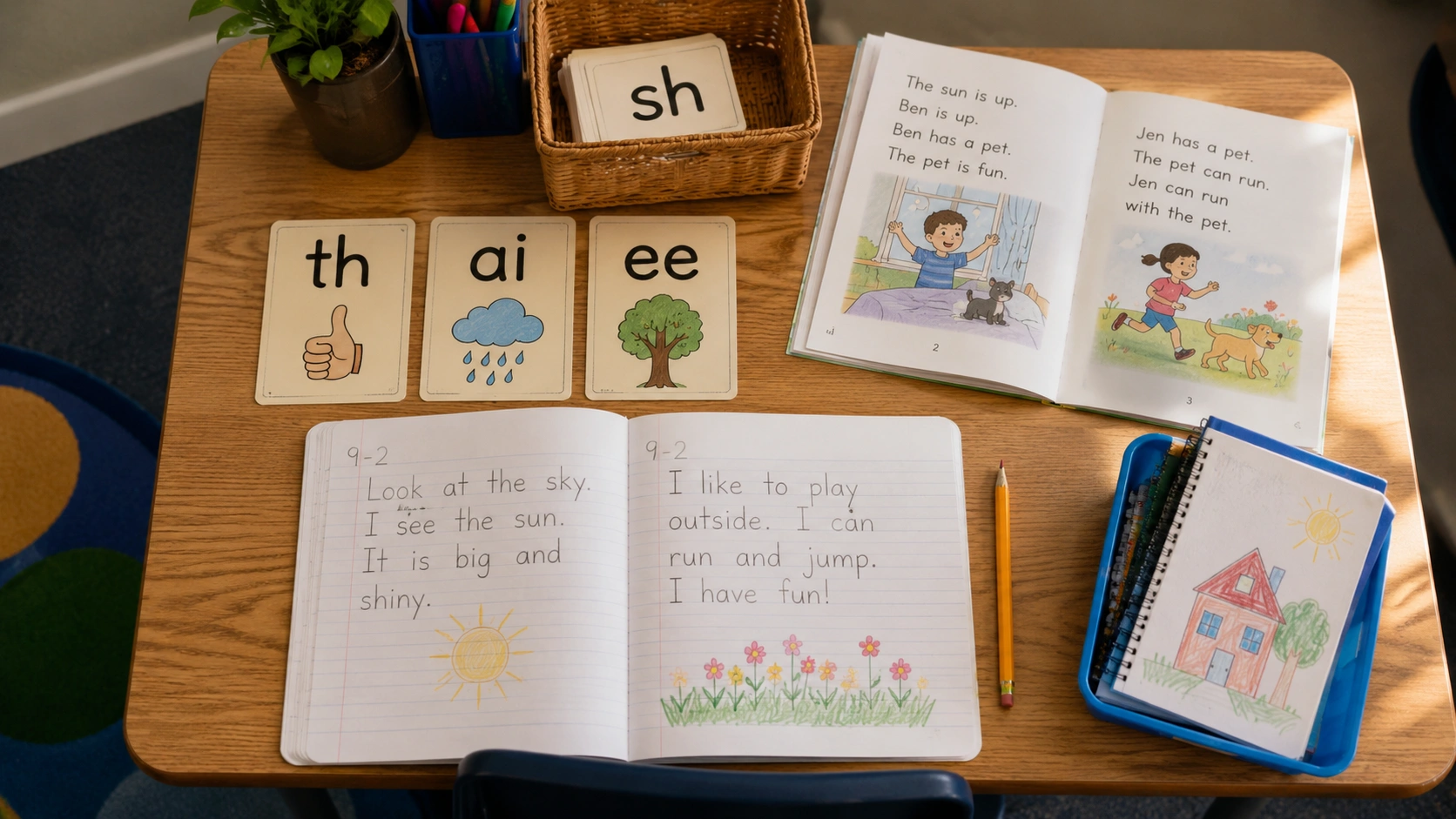
In 2024, forty six percent of New York third graders scored below basic proficiency in reading, a number Governor Kathy Hochul called embarrassing when she compared the state's results to Connecticut and New Jersey, both of which had already abandoned the instructional approach New York was still using. That approach, commonly known as balanced literacy, leaned on context clues and repeated exposure rather than direct instruction in how letters correspond to sounds. Hochul's response was the Back to Basics reading law, folded into the FY 2025 state budget, which required every school district to certify by September 2025 that its curriculum, instructional strategies, and teacher training aligned with the Science of Reading, the decades of cognitive research showing that reading must be explicitly taught rather than absorbed.
The law came with real money behind it, ten million dollars to train twenty thousand teachers, but it did not come with real teeth. Districts were asked to certify their own compliance, and as of a May 2026 New York Focus analysis, more than 130 districts statewide were still reporting the use of discredited balanced literacy curricula, including materials like Fountas and Pinnell that researchers have specifically flagged as misaligned with the evidence. Assemblymember Robert Carroll's Right to Read Act, which would mandate teacher training and require districts to select from a state-approved curriculum list rather than police themselves, remains stalled in committee. Deputy director Jeff Smink of EdTrust-New York put the stakes plainly: if hundreds of thousands of children are not getting evidence-based instruction, that is a crisis, not a compliance footnote. This year's budget quietly extended the same framework to elementary math instruction, giving districts until September 2027 to align. For families, the practical shift is at the kitchen table. The old habit of prompting a child to guess a word from a picture is now working against what the state is trying to build. The new expectation is sounding out words syllable by syllable, and if your district is one of the 130 still holding out, that gap between home and classroom instruction is worth raising at the next school board meeting.
The Silence in the Hallways
New York is now the largest state in the country to require bell-to-bell smartphone restrictions in every K-12 public school, a law that took effect statewide for the 2025-2026 school year and was backed by $13.5 million to help districts buy storage pouches and lockers. The policy is genuinely strict: no personal internet-enabled device, on or off, anywhere on school grounds, from the first bell to the last, including lunch and passing periods, with narrow exemptions for medical monitoring, IEP requirements, translation needs, and family emergencies. More than 400 districts submitted compliance plans ahead of the August 1 deadline, and NYSUT president Melinda Person, whose union represents the teachers enforcing the policy daily, described the shift as one that restored connection rather than removed it.
What the first full year actually produced is more layered than either side's talking points suggest. School climate and student well being improved in measurable, independently verified ways. A consistent, statewide lift in test scores has not yet materialized, at least not in year one. That is not a failure of the policy so much as a reminder that a calmer classroom and a stronger one are related but not identical goals.
The Enrollment Math Nobody Wants to Do
New York's public school enrollment has fallen to roughly 2.4 million students, the lowest figure since the early 1950s, and the decline is not confined to any one region. It shows up in rural districts like York Central, outside Rochester, which has watched its student body shrink from around 1,100 in the 1990s to 619 today, and it shows up in New York City, which lost about 22,000 students between the 2024-25 and 2025-26 school years alone. Because Foundation Aid, the state's core school funding formula, has historically guaranteed that no district's allocation falls below what it received the prior year, a provision known as hold harmless, shrinking districts have continued receiving dollars tied to rosters that no longer exist. Hochul tried to eliminate that provision in 2024 budget talks, calling it nonsensical to keep paying for empty seats, then reversed course that December after pushback from rural districts already stretched thin by fixed costs like heating and transportation that do not shrink along with enrollment.
The tension that leaves behind is real and it cuts in more than one direction. In New York City, Chancellor Kamar Samuels extended a pandemic-era hold harmless policy through the 2026-27 school year, a decision that has already cost the city 1.6 billion dollars over six years according to the Citizens Budget Commission, even as the alternative, mid-year clawbacks that force programs to close mid-semester, is its own kind of harm to students. Meanwhile in Mount Vernon, flagged by the state comptroller as facing the worst fiscal stress of any district in New York, three schools are closing, and PTA president Erica Peterson has been blunt about what that signals to a community already struggling to attract new families. This year's enacted budget brought the total Foundation Aid allocation to 27.4 billion dollars, a guaranteed two percent increase for every district, and new funding weights for homeless and foster care students, but it left the deeper hold harmless debate unresolved for another year. Readers who want the full mechanics of how New York actually calculates what a district receives, and why the same dollar figure can mean very different things in a growing suburb versus a shrinking rural town, can find that breakdown in The Standard's explainer on where New York school money actually goes.
The Diploma That Is Being Rewritten
The fourth shift is the slowest moving and arguably the most consequential. New York is in the early years of replacing seat time, the decades-old practice of awarding academic credit for hours spent in a classroom, with a competency-based diploma built around demonstrated readiness. The framework is anchored in the Portrait of a Graduate, adopted by the Board of Regents in July 2025, and the state has been explicit that the goal is not to lower the bar but to change how students prove they have cleared it. Career and technical education is central to that redesign, with districts building out integrated pathways in fields like advanced manufacturing, healthcare support, and skilled trades that let students earn industry credentials alongside a standard diploma, an approach that pairs directly with the kind of no-degree, high-wage careers our network partner Sonic Boom New York has been tracking closely. Nothing changes for a student currently enrolled in high school. The first cohort to see new credit requirements enters ninth grade in 2027, and full statewide implementation targets the class entering in 2029-2030. The Standard has covered the mechanics of that transition in detail, including exactly which cohort sees what change and when, in our companion explainer on the end of seat time.
The Standard's Take
What connects these four stories is not ideology. It is timing. A reading law with real funding but no enforcement mechanism. A phone ban with strong early results and an open question about academics. A funding formula straining under demographic change nobody in Albany fully planned for. A diploma overhaul that will not finish arriving until a child born this year reaches ninth grade. Each of these, on its own, would be a manageable story for a district to absorb over a normal budget cycle. Landing together, in the same two or three years, they add up to something closer to a structural reset of what New York public education actually is. The families who navigate it best will not be the ones waiting for a single announcement that ties it all together. There will not be one. They will be the ones asking pointed questions at the next school board meeting, reading the district newsletter past the first paragraph, and treating this moment as what it actually is: not a series of unrelated updates, but a single, quiet, multi-year rebuild of the system their kids are standing inside of right now.



Comments (0)
No comments yet — be the first to share your thoughts.
Leave a comment