

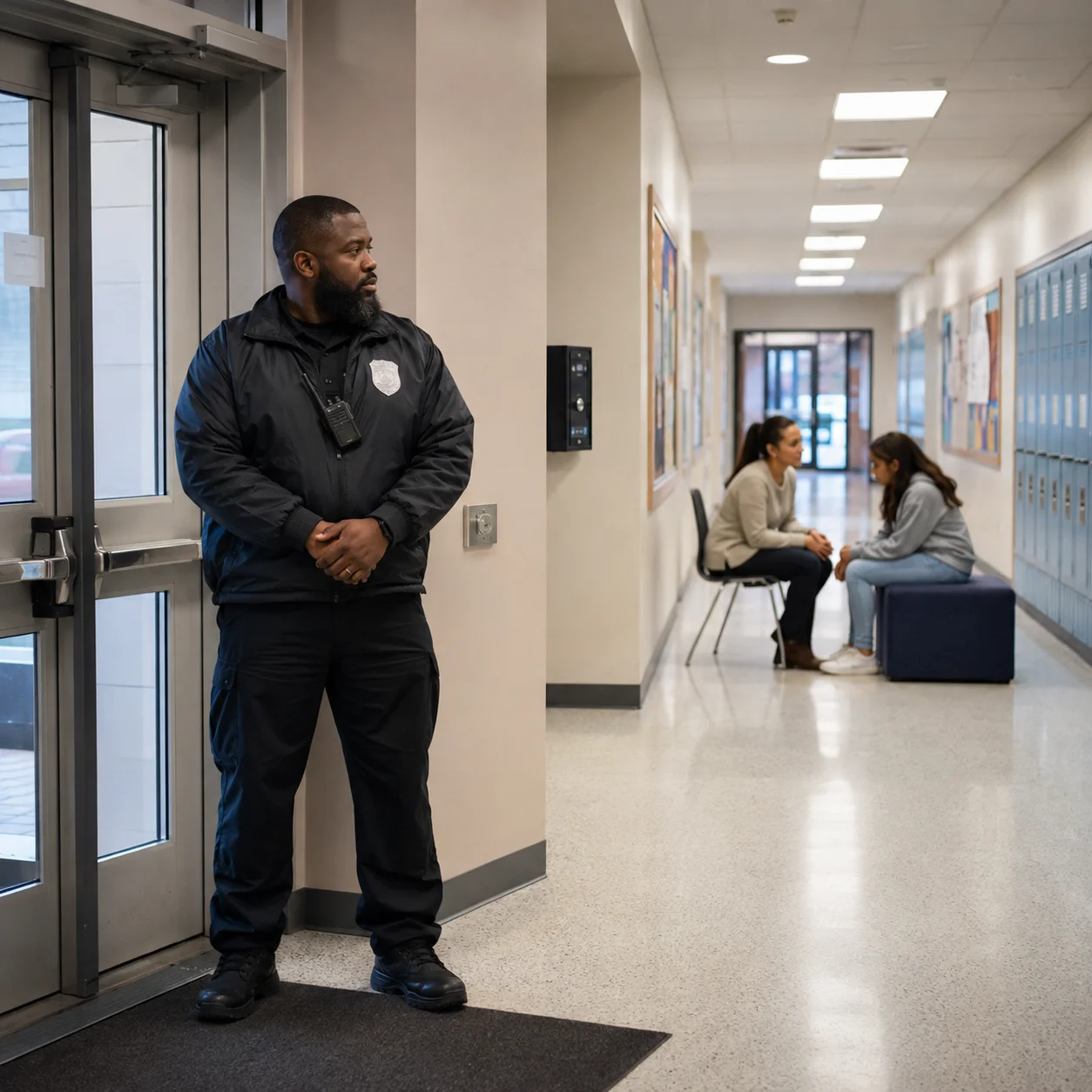
There is a particular kind of reassurance that comes from hearing a school door lock behind you.
The click is immediate. Concrete. It tells parents that visitors cannot simply wander into the building. Cameras are watching the entrances. Staff members carry identification badges. Emergency plans have been written, drills have been scheduled, and someone somewhere has considered what should happen if the unthinkable arrives before dismissal.
These precautions matter. Schools should have secure entrances, functioning communication systems, trained personnel, updated emergency plans, and the ability to respond quickly when danger appears. The argument for prevention is not an argument against physical security. It is an argument against confusing the perimeter with the entire problem.
New York communities have invested heavily in cameras, vestibules, electronic locks, alarms, school resource officers, security guards, radios, surveillance systems, and emergency notification technology. Yet a camera can record a student being isolated without understanding why. A reinforced door can slow an intruder, but it cannot recognize a child unraveling behind it. A metal detector may find an object. It cannot identify the fear, humiliation, rage, desperation, or disconnection that caused someone to carry it.
If we are serious about school safety, prevention cannot remain the soft, underfunded side of a hard-security strategy. It must be treated as security itself.
Hardware Is Visible. Prevention Is Easy to Overlook.
Physical improvements are attractive to decision-makers because they can be photographed, counted, installed, inspected, and announced. A district can point to a new vestibule or camera system and show taxpayers exactly what their money purchased.
Prevention is less theatrical.
It may look like a school counselor noticing that a previously engaged student has stopped speaking. It may be a social worker helping a family facing eviction. It may be an attendance team discovering that repeated absences are connected to anxiety rather than defiance. It may be a teacher reporting a disturbing change in behavior, followed by a multidisciplinary team that investigates carefully instead of reacting impulsively.
None of those interventions produces a ribbon-cutting photograph. All of them may prevent a crisis.
This creates a dangerous budgeting imbalance. Districts can become very good at preparing for the final stage of an emergency while devoting fewer resources to the months of warning signs that may precede it.
A complete school security strategy must answer two separate questions: How will we respond when danger reaches the building, and how will we reduce the likelihood that danger develops in the first place?
New York's Safety Data Requires More Than a Security Response
A 2026 review by the New York State Comptroller's Office examined seven years of School Safety and Educational Climate data. The report reviewed violent and disruptive incidents, bullying, cyberbullying, threats, weapons possession, drug-related incidents, and other conditions affecting school climate.
The findings resist a simple headline. Some serious incident rates appear low, but reporting definitions have changed, regional patterns differ, and the Comptroller's Office warned that official data may not capture the full picture. The report also noted that the state's incident-reporting system does not measure whether students actually feel safe at school.
That distinction matters.
A building can report few serious incidents and still contain intimidation, isolation, chronic conflict, untreated trauma, online harassment, or students who do not trust adults enough to report what they know. Safety is not merely the absence of a formally recorded assault. It is the presence of a climate in which students believe that adults will notice, listen, intervene, and protect them.
The Comptroller's review found that 34.9 percent of public schools reported no bullying or cyberbullying incidents in the 2023-24 school year. That figure should not automatically be read as proof that more than one-third of schools were free of bullying. It may reflect genuine differences among schools, but it also raises questions about awareness, definitions, reporting practices, and whether students believe disclosure will help.
Incident totals tell us what entered a reporting system. They do not tell us everything that remained hidden.
A Trusted Adult May Be One of the Most Important Safety Tools
Students often see trouble before adults do. They hear threats, witness escalating conflicts, notice social-media posts, recognize abrupt personality changes, and know when a classmate appears frightened, fixated, humiliated, or detached.
The problem is not always that young people lack information. The problem is that they may not know what to do with it.
Will reporting make the situation worse? Will adults dismiss the concern? Will the student be labeled a snitch? Will the school respond with automatic punishment rather than a careful investigation? Will confidentiality be protected?
A district may purchase the most advanced anonymous reporting platform available, but the platform will fail if students do not trust the people receiving the report. Technology can open the channel. Relationships determine whether students use it.
That is why student connectedness belongs in every school safety plan. Every student should be able to identify at least one adult in the building who knows them, notices their absence, recognizes changes in their behavior, and can respond without humiliating them.
This is not sentimental education policy. It is operational intelligence.
Threat Assessment Should Lead to Management, Not Just Identification
Schools across the country increasingly use behavioral threat assessment and management teams to evaluate concerning behavior. Properly implemented, these teams bring together administrators, mental-health professionals, educators, and, when necessary, law enforcement or other specialists.
The purpose is not to predict the future with certainty. It is to gather information, distinguish transient statements from credible threats, determine the level of concern, and build an appropriate intervention plan.
Recent RAND research on behavioral threat assessment and management found that the practice has become widespread, but implementation remains inconsistent. RAND reported that schools generally use individualized supports and interventions rather than relying exclusively on suspension, expulsion, or law-enforcement referrals. School leaders also reported positive effects on safety, including reductions in violence and self-harm.
That work is encouraging, but the word management deserves more attention.
Identifying a concern is only the beginning. A team is of limited value if it determines that a student needs counseling, substance-use treatment, family support, conflict mediation, academic intervention, or psychiatric care but those services are unavailable.
A separate RAND study on school violence prevention emphasized that threat-management teams need a broad range of intervention options. Those options may include restrictions or law-enforcement involvement in serious cases, but they also include counseling, mental-health treatment, behavioral support, and assistance addressing the underlying causes of concerning behavior.
In plain language, a team cannot manage a threat with a meeting alone.
Counselors and Social Workers Are Part of the Safety Infrastructure
School mental-health professionals are too often discussed as supplemental staff whose value begins after a student asks for help. Their role is much larger.
Counselors, psychologists, and social workers help schools understand patterns that other systems may miss. They recognize when academic decline is connected to grief, when aggression is masking fear, when absences reflect family instability, and when a disciplinary problem may actually be a mental-health emergency.
They also help distinguish between behavior that is disruptive and behavior that signals a more serious risk. Without their expertise, schools may either underestimate danger or overreact to conduct that calls for support rather than exclusion.
This is why school mental health cannot be separated from safety planning. A district that adds cameras while leaving clinicians with overwhelming caseloads is strengthening its ability to observe problems without necessarily strengthening its ability to resolve them.
New York should encourage every district to publish not only its physical-security improvements, but also its capacity for prevention. How quickly can a student access a counselor? How many schools share one social worker? What happens after a student is identified as being in crisis? Are outside providers available? Who follows up with the family? How is the plan monitored?
Those are security questions.
Bullying Prevention Is Not a Poster Campaign
Schools frequently mark anti-bullying initiatives with assemblies, slogans, themed weeks, and hallway posters. These activities may help establish expectations, but they are not a complete bullying prevention system.
Effective prevention requires adults to understand where bullying occurs, how students communicate, which groups feel least protected, whether reporting procedures work, and how consistently staff respond. It requires supervision in the unscripted parts of the day: buses, cafeterias, locker rooms, hallways, dismissal areas, extracurricular spaces, and online environments that follow students home.
It also requires schools to examine whether discipline ends the behavior or merely relocates it.
A student who is repeatedly humiliated may not become violent, and schools should never stigmatize victims or assume that mistreatment produces dangerousness. Still, unresolved bullying can damage attendance, achievement, mental health, trust, and a student's willingness to seek adult help. That alone makes it a safety issue worthy of sustained intervention.
Attendance Teams May Be Prevention Teams
Chronic absence is usually framed as an academic problem. It is also a warning system.
A sudden pattern of missed days may reflect depression, family conflict, transportation problems, housing instability, fear of another student, substance use, an unsafe route to school, or a child who no longer feels connected to the building.
An attendance office that merely generates letters is processing absence. An interdisciplinary team that asks why the student has disappeared is practicing prevention.
New York districts should integrate chronic absenteeism work into their broader safety and student-support systems. Attendance staff, administrators, nurses, counselors, teachers, and family liaisons should be able to share relevant information through lawful, clearly defined procedures. Patterns should trigger outreach before a student becomes academically lost or emotionally unreachable.
Families Cannot Be Brought In Only After a Crisis
Schools sometimes treat family engagement as a communications function: newsletters, parent portals, automated calls, and meeting invitations. Prevention requires a deeper partnership.
Parents and caregivers may see behavior that the school does not. Schools may observe changes that families have not noticed. Neither side has the whole picture.
Families need clear guidance about whom to contact, what kinds of concerns should be reported, what happens after a report is made, and how confidentiality is handled. They also need honest communication when a student requires additional support.
RAND's 2025 threat-assessment research found that schools often consult parents during the process, but only a minority directly involve them in intervention planning. That gap deserves attention. Families should not control every safety decision, particularly when other students may be at risk, but they should be treated as meaningful partners whenever circumstances permit.
Strong family engagement is not a courtesy added after professionals finish their work. It is often part of the information and support required to make that work effective.
Prevention Must Be Measured
District leaders should resist the temptation to describe prevention in vague language. Programs should have owners, timelines, staffing levels, referral procedures, training requirements, and measurable outcomes.
Boards of education should ask direct questions:
How many safety concerns were reported, and through which channels? How quickly were they reviewed? Did the multidisciplinary team have access to appropriate services? How many students received follow-up support? What patterns are appearing in attendance, bullying, discipline, self-harm, substance use, and school-climate surveys? Do students know how to report concerns? Do staff members know what happens after they submit one?
These questions do not require districts to release confidential student information. They require leaders to determine whether the system works.
Schools should also use climate surveys, focus groups, and other tools that measure whether students and staff feel safe. Official incident data remains important, but the absence of a report cannot be treated as proof of the absence of a problem.
The Choice Between Security and Support Is a False One
Public discussions often force school safety into competing camps. One side calls for stronger buildings and faster emergency response. The other emphasizes relationships, mental-health services, restorative practices, and student support.
Responsible districts need both.
A secure entrance cannot substitute for a counselor. A counselor cannot substitute for a functioning lock. A threat-assessment team cannot substitute for emergency planning. A police response cannot substitute for months of missed intervention. A restorative conversation cannot replace immediate protective action when a credible danger exists.
The real question is not which approach wins. It is whether districts have built a coherent comprehensive school safety system in which physical protection, reporting, assessment, intervention, family partnership, mental-health care, and emergency response reinforce one another.
That system will cost money. Prevention requires trained professionals, manageable caseloads, time for teams to meet, partnerships with outside providers, reliable data, staff development, and follow-up. It may be less visible than a new bank of monitors in a security office, but invisibility should not be confused with ineffectiveness.
A Safer School Is a School That Notices Earlier
Parents are right to expect locked doors. Teachers are right to expect emergency plans. Students are right to expect adults who can act decisively when danger appears.
They are also entitled to something more ambitious: a school capable of noticing distress before it becomes destruction.
New York has spent years improving how schools respond to emergencies. The next stage of the work must be to strengthen how schools recognize isolation, investigate warnings, interrupt bullying, reconnect absent students, support families, and provide help before a crisis becomes a security event.
The strongest school safety system is not merely the one that can lock down fastest.
It is the one that sees trouble coming, understands what it is looking at, and has enough people, trust, and resources to intervene while there is still time.

Comments (0)
No comments yet — be the first to share your thoughts.
Leave a comment