

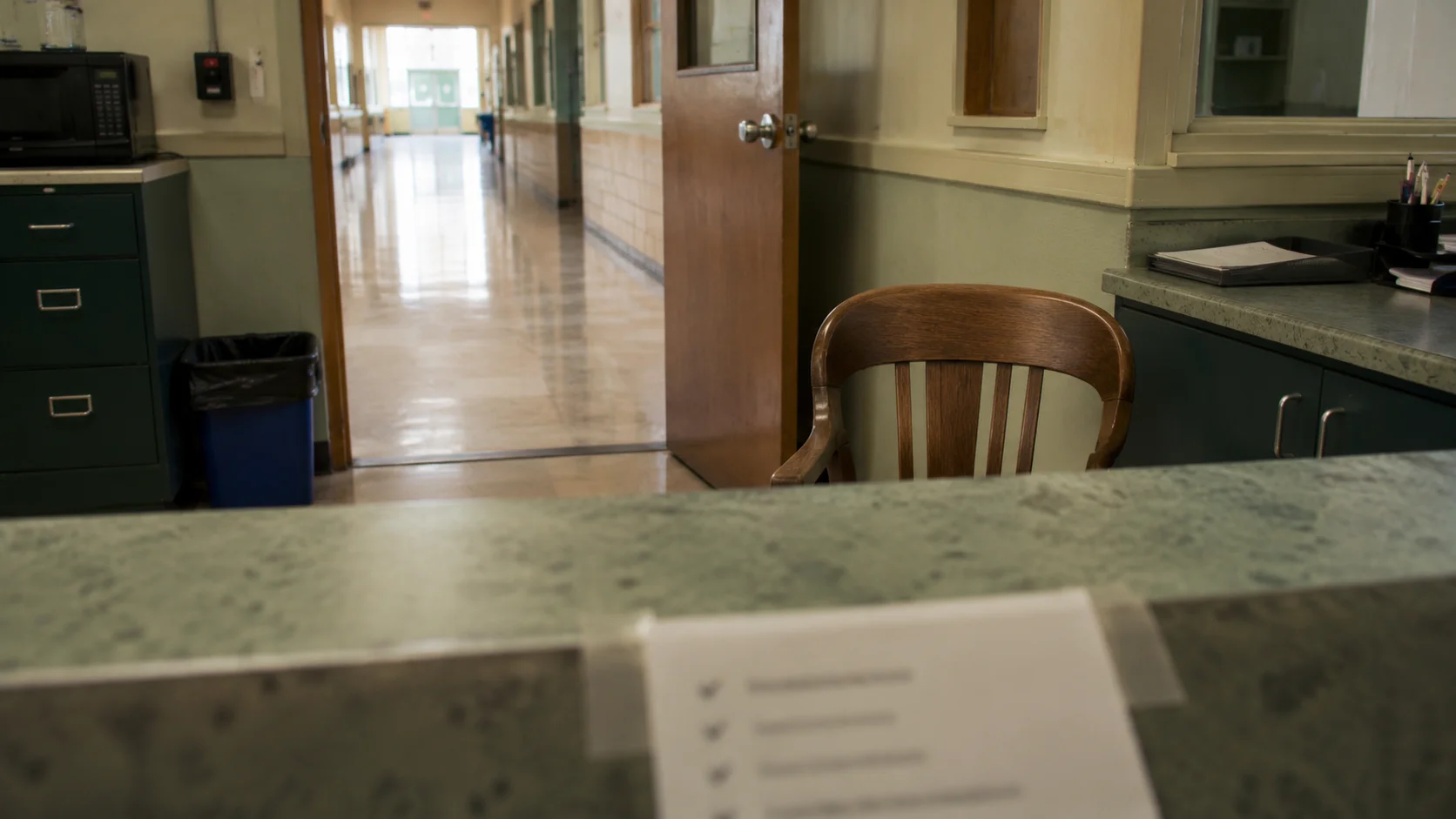
The counter at a district registrar's office usually holds a laminated list of what a family has to produce before a child can start school: two proofs of residency, a birth certificate, an immunization record and a transcript from the last district. For a family that spent August moving between a cousin's apartment in Amsterdam and a motel off the Thruway, that laminated list looks like a closed door.
It's not one! A student who does not have a fixed, regular and adequate nighttime residence has the right to be enrolled immediately, without proof of residency, without immunization records, without school records and without any of the other documents the counter asks for. The rule sits in two places at once, at 42 U.S.C. 11432(g)(3)(C) and at New York Education Law 3209, and the state's own guidance to districts spells it out in those words.
New York identified enough students in this situation last year to fill a mid-sized city. What most families never learn is that the law attaches a set of enforceable obligations to that identification, and that the obligations start the day a parent says the words out loud.
What Counts, and It Is Broader Than a Shelter
The federal definition turns on the adequacy of where a child sleeps, not on whether a family has entered a shelter system. Students living doubled up with relatives or friends because of a loss of housing or economic hardship are covered, and that category is consistently the largest one in New York. So are students in emergency or transitional shelters, in motels, hotels, trailer parks and campgrounds, in cars, parks, abandoned buildings, bus stations and train stations, and students abandoned in hospitals.
Advocates for Children of New York counted more than 154,000 New York City public school students in temporary housing during the 2024 to 2025 school year, close to one in every seven. About 65,000 of them spent time in city shelters. More than 82,000 were doubled up, which is the population least likely to think of itself as covered by a homelessness statute and most likely to be turned away at a registrar's counter.
The Documents a District Cannot Ask For First
The enrollment protection is unusually blunt for an education statute. A district must enroll the student immediately, even when the family cannot produce residency documents, immunization records or a transcript, and missing an application deadline while homeless does not bar enrollment either. The state guidance cites 42 U.S.C. 11432(g)(3)(C) alongside New York Education Law 3209(2)(f)(2) for exactly that proposition.
Immunization is the one that surprises parents most, because it is the one requirement schools otherwise enforce with a stopwatch. A child in temporary housing enrolls first, and the district's liaison then helps the family obtain the records or the shots. The sequence is the protection. Reversing it, which some counters still do out of habit, is what the law was written to stop.
The School of Origin, and the Bus That Comes With It
A student may stay in the school they attended before losing housing, called the school of origin, or enroll in the school serving the area where they are now staying. When a parent designates the school of origin, the district has to decide whether that placement serves the student's best interest using student-centered factors, a standard written into Education Law 3209(4)(iii).
Transportation follows the placement rather than the address. Under 42 U.S.C. 11432(g)(1)(J)(iii) and Education Law 3209(4), a district must transport the student to school, and to academic and extracurricular activities, while the family is in temporary housing. The obligation does not stop the moment a lease is signed. A student who becomes permanently housed and stays enrolled keeps that transportation through the end of the school year.
For a family placed forty minutes from the school where a child has friends, a counselor and a full IEP file, that single provision is the difference between continuity and a fourth school in two years.
Every District Has a Liaison, and Most Families Never Hear the Word
Federal law requires every local educational agency to designate a liaison for students experiencing homelessness. The liaison's job, in the state's description, is to coordinate services so that these students enroll and have the opportunity to succeed academically, and to serve as the primary contact between families and school staff. Districts must also set aside a portion of their Title I, Part A money for services supporting enrollment, attendance and academic success for these students.
Asking for the liaison by title changes the conversation, because the liaison holds authority the front desk does not. Families who cannot get a name from the district office can call the New York State Technical and Education Assistance Center for Homeless Students at 800-388-2014, or reach the state coordinator for homeless education, Melanie Faby, at 518-473-0295.
When the District Says No, the Student Still Starts Monday
Disagreements happen, most often over whether a family's living situation qualifies or whether the school of origin is the right placement. New York answers the question of what happens in the meantime without ambiguity. Under Education Law 3209(5)(a), the student enrolls in the school the parent chose and attends it while the family and the district work out the disagreement.
A child does not sit at home during an eligibility review. Parents who are told otherwise should put the request in writing, name the statute and ask for the district's written decision, which is the document any appeal will turn on.
The Map Moved, and the Rights Did Not
The statewide picture shifted in a way that makes this a Utica and Rensselaer County story rather than a New York City one. Comptroller Thomas DiNapoli's office reported in July that New York's homeless population fell nearly 8 percent between January 2024 and January 2025, to 145,560 people, the largest decline of any state, after a period in which the count had doubled between January 2022 and January 2024.
Underneath that decline, homelessness rose in 17 of the state's 25 regional Continuums of Care, and in 11 of them it rose by more than 10 percent. Columbia and Greene counties saw an increase of 58.9 percent. Troy and Rensselaer County saw 55.2 percent. Schenectady saw 41.7 percent. Children make up 31.7 percent of New York's homeless population, roughly double the national share.
"While the number of homeless declined, there's a lot of work left to do," DiNapoli said, calling for coordinated work across the public, private and nonprofit sectors on family homelessness. The districts absorbing those increases are small ones upstate, where a registrar may handle one such enrollment a year and where a parent citing 3209 by number is doing the district a favor.
The Money Behind the Mandate
In March, the State Education Department announced $8.1 million in first-year federal grants to support students experiencing homelessness, part of $24.5 million over three years running from September 1, 2025 through August 31, 2028. The awards went to 32 recipients covering 66 school districts and five charter schools, including seven consortiums led by districts or BOCES, and the department put the number of students reached at roughly 137,000. Award tiers scale with how many homeless students a district has identified over three years, from up to $175,000 a year for districts identifying 100 to 500 students to $2.5 million for those above 50,000.
"Children experiencing housing insecurity bear challenges through no fault of their own, yet these hardships too often create barriers that negatively affect their educational journey," Board of Regents Chancellor Lester W. Young, Jr. said in announcing the awards. Commissioner Betty A. Rosa put it in plainer terms: "No child should receive a substandard education because of where they sleep at night, and it is our moral imperative to ensure every student across the state has the support necessary to succeed."
The funding stream those grants come from is federal, and it has been the subject of elimination proposals in Washington since 2025. The enrollment rights themselves are not grant-funded. They are statute, they apply in every district in New York regardless of what any budget does, and they are the same in a district spending $36,293 per student as in one spending far less. A parent standing at a counter in September needs one sentence and one citation, and the counter has to move.


Comments (0)
No comments yet — be the first to share your thoughts.
Leave a comment