
Beacon’s ninth graders entered a dedicated personal finance class this week. In Cold Spring, Haldane is teaching the same required material through math and economics courses. Both districts are complying with New York’s new regulation, but their distinct approaches capture the central issue for the 2026-27 school year: Albany sets the rules, while more than 700 districts decide how those rules work in classrooms, budgets and bus garages.
New York schools are navigating major changes involving financial literacy, graduation requirements, state aid, prekindergarten, school meals, electric buses, federal scholarships and artificial intelligence. One change takes effect in January, halfway through the academic year. Here is what families, educators and district leaders need to know, including where local decisions still matter.
Personal finance is required, but New York did not create a required course
The Board of Regents amended section 100.2 of the Commissioner’s Regulations in March, making personal finance education mandatory for grades five through twelve. Instruction for kindergarten through fourth grade will follow in 2027-28. By the end of each grade band, schools must cover budgeting and money management, credit and debt, earning income, risk management, and saving and investing.
The regulation requires instruction, not a separate class or diploma credit. State Education Department guidance allows districts to integrate financial literacy into existing subjects, offer a stand-alone course, or use approved career and technical education programs. Districts can therefore choose very different schedules while remaining in compliance.
For the next three school years, every district and charter school must verify that the instruction occurred through the State Education Department’s Monitoring and Vendor Performance System. Districts using an embedded model must explain how the material is delivered.
The Council for Economic Education reports that 39 states require students to pass a full personal finance course for graduation. New York has not adopted that standard. Families seeking specifics should ask whether their district offers a semester course, integrates the lessons into another subject, or provides instruction through career and technical education. Climate education is scheduled to follow one year later, reaching grades five through twelve in 2027-28.
The final students required to pass Regents exams are already in school
Students scheduled to graduate in 2027 are the last cohort required to pass Regents exams to earn a diploma. The final administrations that count toward that requirement are scheduled for August 2027. Students who follow them will continue taking state exams in subjects including math, English and science because federal law still requires statewide testing. The major change is that a passing Regents score will no longer stand between those students and a diploma beginning in 2027-28.
New York adopted its replacement framework, the Portrait of a Graduate, in July 2025. The state is also moving from three diploma types to one diploma with seals and endorsements that recognize achievements beyond the baseline credential.
Important details remain unresolved. Chalkbeat reported in June that the Education Department had not yet published the credit requirements that will replace the exam-based graduation rules. That uncertainty affects counselors advising current ninth graders and families planning course schedules.
Some rural districts are moving ahead despite the state’s unfinished framework. Systems including Marion and Cassadaga Valley have been developing career pathways that could help students demonstrate readiness under the emerging model. Families should ask counselors which requirements apply to their child’s graduation cohort and whether the district has published a transition plan.
School aid approaches $40 billion as the Foundation Aid formula changes
New York’s enacted budget provides roughly $39 billion in school aid for the year, an increase of about $1.7 billion. Foundation Aid accounts for $27.4 billion, approximately $1 billion more than last year.
Three formula changes are especially significant: The state will give additional consideration to students in foster care or experiencing housing instability, increase the weighting for English language learners, and provide every district with a guaranteed minimum increase of 2 percent.
Enrollment has fallen about 12 percent over 15 years and is projected to decrease further. A district can serve fewer students than it did the previous year and still receive more state aid, a tension highlighted in a Citizens Budget Commission report.
The impact will vary by region. Long Island and Westchester districts rely more heavily on local property taxes, so changes in state aid may be less visible in their operating budgets. Upstate districts that depend more on state funding are likely to feel the new student weights and minimum increase more directly. District leaders should compare this year’s Foundation Aid calculation with last year’s, rather than focusing only on the total budget increase.
Prekindergarten funding was rebuilt around per-student payments
Beginning this year, New York will provide a district with the greater of $10,000 or its selected Foundation Aid amount for each eligible four-year-old enrolled in prekindergarten. The state also eliminated caps on the number of seats it will fund.
Universal Prekindergarten Aid was projected to increase by $561 million, or about 53 percent, from the previous year. New York City will receive an additional $205 million for its three-year-old program.
The state’s goal is full-day prekindergarten for every four-year-old by the beginning of the 2028-29 school year. Funding alone does not guarantee access because districts must choose to establish and operate programs. In many shrinking upstate districts, available classrooms and qualified staff may be a greater limitation than the reimbursement rate.
Parents should ask whether their district is adding seats, partnering with a community-based provider, or maintaining its existing capacity. District officials should evaluate staffing and space before treating the higher reimbursement as an automatic expansion opportunity.
Universal free meals enter their second year
New York schools served 396 million free meals during the first year of the state’s universal free school meals program. The enacted budget provides $395 million for a second year, an increase of $55 million.
When the program was announced, Governor Kathy Hochul’s office estimated that it saved families $450 million in grocery costs. The program covers every district, charter school and participating nonpublic school that takes part in the federal breakfast and lunch programs.
The state pays for students whose meals are not already covered by federal funding. For district business offices, the practical change in 2026-27 is that universal meals have moved from a new initiative into an ongoing operating responsibility. Families should review their district’s meal calendar and eligibility process, especially if they need accommodations for allergies or dietary restrictions.
The zero-emission school bus deadlines moved back five years
New York had planned to require districts to purchase or lease only zero-emission school buses beginning in July 2027, followed by complete fleet conversion by 2035. The education budget bill moved those deadlines to 2032 and 2040.
“School districts simply cannot afford the enormous costs associated with this mandate,” Assemblyman Steve Hawley said after the delay passed the Legislature. Upstate and rural districts had raised concerns about purchase prices, charging infrastructure, maintenance and reduced battery range in cold weather.
The delay gives districts more time, but it does not remove the long-term planning challenge. Environmental Advocates NY said more than 400 districts, or more than two-thirds statewide, had completed or were drafting fleet electrification plans. The American Lung Association and the New York League of Conservation Voters opposed the rollback.
Districts with approved transportation propositions must now decide whether to continue toward the earlier schedule or revise their fleet plans. Boards should examine bus replacement cycles, available grants, utility capacity and charging-site costs before committing to a timetable.
A federal school choice tax credit begins in January
The federal scholarship tax credit created by last year’s federal reconciliation law takes effect January 1, 2027, during the current school year. Taxpayers may claim a dollar-for-dollar federal credit of up to $1,700 for donations to approved scholarship-granting organizations.
Those organizations can provide scholarships for tuition, tutoring and other qualified expenses to students from households earning up to 300 percent of area median income. The program will not benefit New York families unless the state opts in and submits a list of approved organizations to the IRS.
Governor Hochul told a private gathering of Jewish education leaders in May that she intended to participate, potentially making New York one of the first states with a Democratic governor to join. Her office said it would review Treasury rules before making a final decision. State Education Commissioner Betty Rosa called the proposal a “travesty.” Twenty-seven states appeared on the IRS list in April.
New York families should not assume that scholarships are available yet. Eligibility, participating organizations and application deadlines depend on the state’s final decision and federal implementation guidance.
AI policies are developing district by district
The State Education Department has not issued a statewide K-12 framework for artificial intelligence, and proposed legislation in Albany has not advanced. As a result, districts are writing their own policies for generative artificial intelligence, student privacy, acceptable use and academic integrity.
New York City has adopted one of the most restrictive approaches. It imposed a one-year moratorium on student-facing generative AI for grades 2-K through eight, barred companion chatbots at every grade level, and introduced twice-yearly critical-thinking modules for high school students alongside a limited number of classroom pilots.
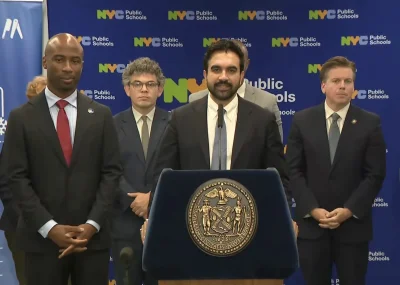
“We will embrace new technology, but only when it serves our students,” Mayor Zohran Mamdani said in announcing the policy, which covers roughly 600,000 children. Because New York City enrolls about one-third of the state’s public school students, its policy may influence districts that have not yet completed their own rules.
Other systems are developing local frameworks. Greenville Central School District consulted its school community, while Questar III superintendent Gladys Cruz has argued that locally developed policies may be more durable than rules attempting to anticipate every new tool.
Parents should ask schools whether students may use AI for brainstorming, editing or research, how teachers verify original work, and what information students may enter into AI systems. District policies should address data protection, disclosure of AI assistance and consequences for misuse.
Statewide phone restrictions continue
New York’s bell-to-bell restriction on smartphones and other internet-enabled personal devices entered its second year this fall. The rule applies to public school districts, charter schools and BOCES. Local policies determine how phones are stored, when they may be accessed and how schools handle medical or emergency exceptions.
The most useful question for families this month is how their district is delivering personal finance instruction. The answer determines whether students receive a full semester, lessons distributed across several subjects, or brief units inside an economics or math course. Districts must report their approach to Albany, but families can ask for the details now, along with the district’s plans for graduation changes, AI use and future transportation costs.

Comments (0)
No comments yet — be the first to share your thoughts.
Leave a comment