
For generations, a New York high school diploma has rested on a familiar formula: sit through the required courses, accumulate enough credits, pass the necessary Regents examinations. The formula is so deeply embedded in public education that it can feel less like a policy choice than a permanent feature of school itself. New York is now in the deliberate process of rewriting it, and a handful of small, rural districts are not waiting for the state to finish the paperwork.
Through its NY Inspires initiative, the State Education Department and the Board of Regents are moving the state toward a competency-based diploma, in which students would demonstrate what they know and can do through a broader collection of projects, performances, presentations and career-connected work rather than through seat time and standardized exams alone. Regents Chancellor Lester W. Young Jr. has described the effort as "a bold reimagining of what education can and should be", and department officials call it the most significant change to the state's graduation system in generations.
That is a large claim for a state education bureaucracy to make about itself. It also happens to be roughly accurate, which is part of what makes the rollout so unsettled. The framework is still being written. The rubrics, the transcripts, the assessments that would replace the old ones: all of it remains in development. Meanwhile, at the Rural Schools Association of New York State's 2026 summer conference in Lake Placid, held under the banner "Our Roots, Our Rise," two small districts stood up and described programs that already look like the future Albany is still drafting.
What NY Inspires actually changes
The conventional credit system treats time as one of education's central currencies. A student earns credit by completing an approved course, sitting for the required number of instructional hours and meeting local academic expectations. Knowledge matters, but it is packaged inside semesters and credit totals.
The competency model asks a different question. Instead of only whether a student completed a course, schools would also ask whether the student can demonstrate specific, transferable skills grounded in state learning standards and aligned with New York's Portrait of a Graduate, the attributes framework the Board of Regents formally adopted in July 2025. That evidence, gathered through internships, projects and other career-connected learning, could take the shape of portfolios, presentations or performances evaluated against common rubrics and collected over time rather than resting on one test administered in a narrow window.
Families should be careful not to overread how far along this actually is. Current students remain subject to existing requirements unless and until new regulations formally apply to their cohort. The state already moved once to loosen the exams: under a 2024 Regents decision, students entering ninth grade in 2024, 2025 or 2026 still must sit for Regents exams and meet current graduation requirements, but they no longer need to pass those exams to graduate. Students who started ninth grade in 2023 were the last cohort bound by the full old rules. The competency-based diploma now under development would go considerably further, and its own effective date is still being finalized through a phased regulatory process.
We covered the anxiety that first announcement produced in an earlier look at the transition, where one Regents member acknowledged how attached New Yorkers remain to the old exam system and a Brooklyn principal worried aloud that dropping the pass requirement, without a clear replacement in view, might do more harm than good before the state builds something sturdy enough to take its place.
The Portrait of a Graduate becomes more than a poster
Many districts already display a local graduate profile in strategic plans, board presentations or hallway posters: attributes like critical thinking, communication and global citizenship, hung on a wall and rarely tied to a specific assignment. The state's Office of Teacher and Leader Development recently tried to close that gap by publishing a set of crosswalks connecting the Portrait's student outcomes to the professional standards teachers and principals are already held to, a document we walked through for school leaders here.
NY Inspires is trying to do the same thing for students that the crosswalks do for teachers: give the Portrait's language actual consequences. If a district says its graduates should be strong communicators, students will eventually need assignments that require real speaking, writing and presenting. If future planning is a stated goal, districts will need structured career exploration, advisories and internships rather than a single unit tucked into senior year.
Two rural districts get there first
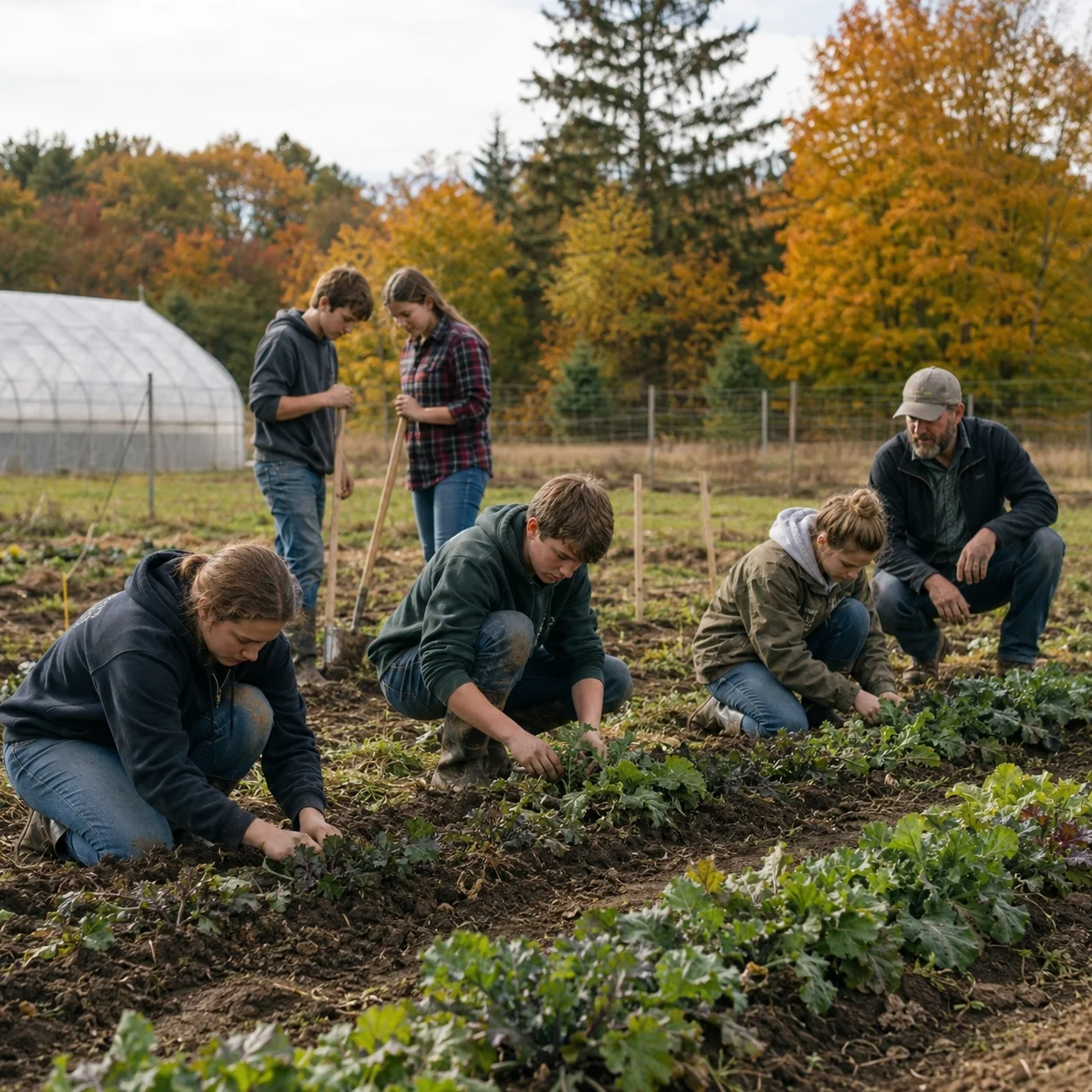
At the Lake Placid conference, Marion Central School District, working with Wayne-Finger Lakes BOCES, presented "An Alternative Pathway to Success," describing its new Agripath program: a full-day, hands-on freshman course of study built around agriculture and outdoor education that fulfills graduation requirements while pulling in students from neighboring Wayne County districts. Marion Principal Shane Dehn has said the goal is to give students across the county access to hands-on, career-focused learning starting in ninth grade, not just in the junior or senior year electives where career exposure traditionally gets squeezed in.
Cassadaga Valley Central School District, in rural Chautauqua County, presented "Keystone Pathways & Cougar Cafe: Reimagining Rural Graduation Through Purpose-Driven Learning," built around student-run enterprises and coursework organized by purpose rather than by period. Rather than treating career exposure as an add-on, the district has folded it into the core structure of the high school day.
Neither program waited for NY Inspires to finish. Both are, in effect, betting that the state's eventual framework will look something like what they have already built, and both suggest that the most consequential part of New York's graduation overhaul may not be the fate of any single exam. It may be the construction of an entirely different high school experience, built district by district before Albany finishes the rulebook.
The equity question cannot be postponed
The most persuasive argument for competency-based education is that students have different strengths and deserve multiple rigorous ways to demonstrate learning. The most serious concern is that districts have wildly different capacities to provide those ways.
A well-resourced suburban district may have staff dedicated to employer partnerships, a deep local business base and families who can help their kids get to an internship outside school hours. A small rural district may have strong community ties but face long travel distances and a thin bench of nearby employers, which is exactly why Marion needed a BOCES partner and a neighboring district's enrollment to make Agripath work at scale. An urban district may sit next to hospitals and major employers while still struggling to coordinate placements for thousands of students at once.
Even within a single building, access can vary. An internship that requires a family car is not an equitable pathway. A portfolio requirement without adequate technology, feedback time and instructional support becomes another barrier rather than an alternative route to a diploma. Students with disabilities, multilingual learners and students already working after school cannot be an afterthought in how these programs get designed.
BOCES becomes the connective tissue
New York's Boards of Cooperative Educational Services are well positioned to be the infrastructure that keeps this from becoming a story about wealthy districts pulling further ahead of rural school districts that lack the same partnerships. BOCES already let districts share career and technical programs, specialized services and regional expertise that would be prohibitively expensive for any single small district to build alone. Marion's partnership with its regional BOCES illustrates the model: no single 500-student district can realistically stand up separate, fully developed career pathways in agriculture, health care, manufacturing, technology and public service on its own. A cluster of districts working through a shared BOCES might actually manage it.
That collaboration raises its own practical questions, though. Districts still have to sort out who supervises students on-site, who handles transportation, how schedules across two buildings actually align and who is accountable when a placement falls short of academic or safety expectations.
Teachers will build this one assignment at a time
A competency-based diploma can be announced in Albany, but it gets built in classrooms. Teachers need time to redesign lessons, build performance tasks and calibrate scoring with colleagues so two students' portfolios mean the same thing. Schools already participating in New York's Performance-Based Learning and Assessment Network pilot have flagged extensive professional development needs: teacher training, administrative support, assessment redesign and sustained coaching, without which performance-based learning tends to stay a polished showcase rather than a reliable measure.
The state has been candid that implementation, not the announcement, will determine whether any of this works. That is the correct instinct. New York rarely lacks ambitious education frameworks. It has more often lacked the sustained funding and follow-through required to carry one from a Board of Regents slide deck into thousands of actual classrooms.
What happens to the Regents exams
For most families, the immediate question is whether Regents examinations are disappearing. Not yet, and not entirely. Students currently in the pipeline still sit for the exams and still need the credits; they simply do not need to pass every exam to graduate under the interim rules already in effect. The fuller competency-based framework, including what eventually replaces standardized testing as evidence of readiness, is still moving through a phased regulatory process, and NYSED has not finalized exactly which cohort will be first to graduate entirely outside the old system.
What parents should start asking
Families do not need to master assessment design, but they should start paying attention to how their own district is interpreting the state's direction. Has the district published a local Portrait of a Graduate. Are career and technical programs expanding, and through what BOCES or employer partnerships. How are internships selected, and is transportation actually provided, not just offered on paper. How will students with disabilities participate on equal footing.
The most revealing question may be the simplest one: what will students be able to do under the new system that they cannot do now. If the answer is a portfolio bolted onto an otherwise unchanged school day, the reform risks becoming paperwork. If the answer includes real research, technical training, public speaking and supervised work in the field, the high school experience could change substantially, and not only for students in Marion or Sinclairville.
The diploma is only as strong as what stands behind it
The early work coming out of Wayne and Chautauqua counties offers a preview of what NY Inspires could become statewide: a graduate with completed coursework and Regents scores, plus a portfolio, an internship, a capstone and a documented record of skills built across several settings and years. That is an appealing vision, particularly to employers and colleges who say, often and publicly, that they value communication, adaptability and problem-solving over a single test score.
But the credibility of the new diploma will depend entirely on whether these experiences are rigorous, funded and comparable across communities, not just impressive in the districts wealthy or well-organized enough to build them first. New York is right to ask whether classroom time is the best available measure of a student's readiness. It now has to answer the harder question of whether nearly 700 school districts, with wildly uneven resources, can build systems capable of judging that readiness fairly and consistently. Marion's Agripath and Cassadaga Valley's Keystone Pathways are early, promising answers. They are not yet proof that the state as a whole can do the same.


Comments (0)
No comments yet — be the first to share your thoughts.
Leave a comment