

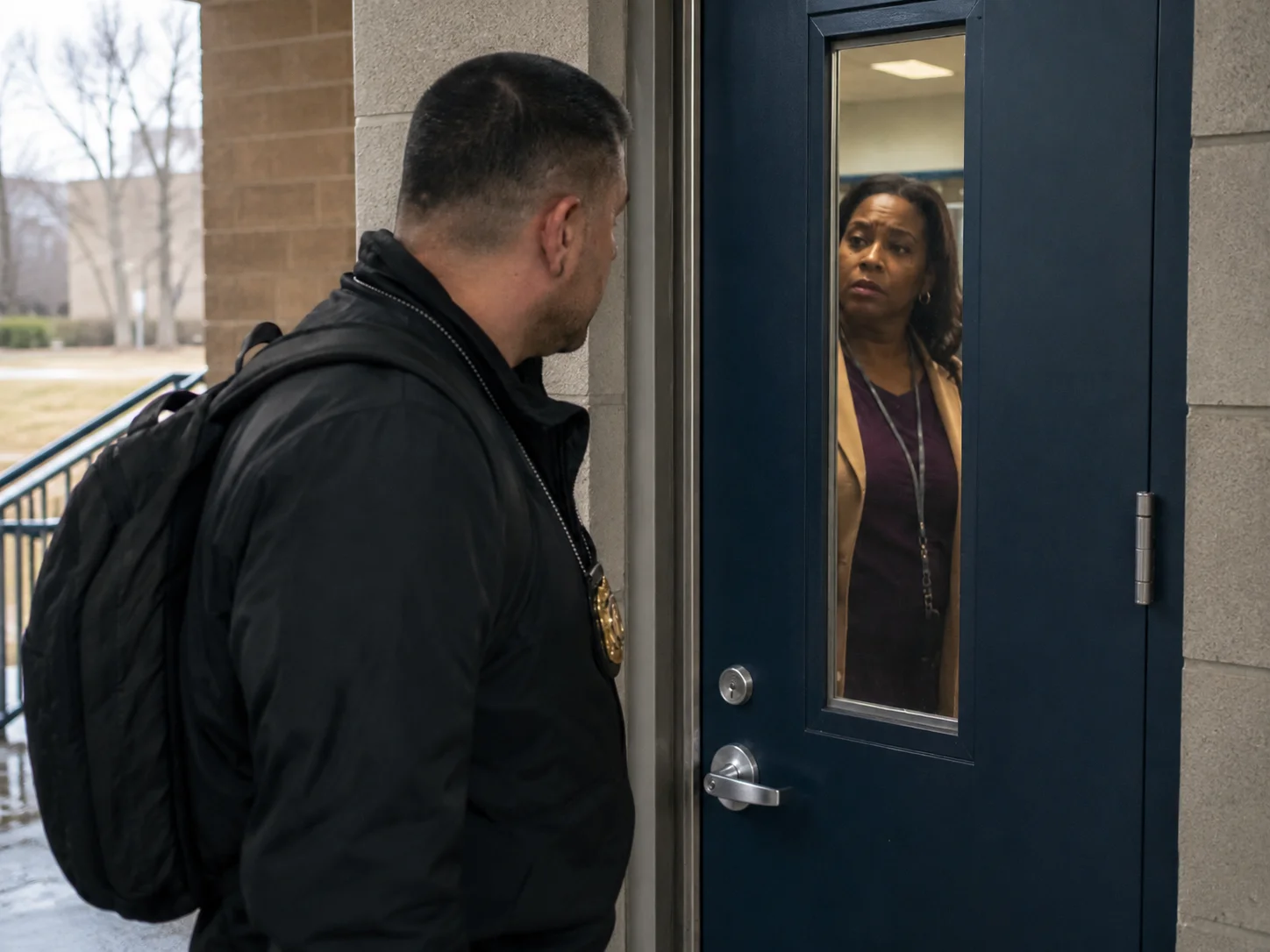
Somewhere in New York this fall, a school secretary is going to look at a clock that says 3:40 and at a seven-year-old who is still sitting in the front office, and she is going to have to decide what to do next. The mother has not called or picked up the phone when called. The number for the grandparent on file is three years old and disconnected.
That moment is not hypothetical, and as of this spring it is not improvised either. New York has written the answer into statute, in language most parents have never seen and a fair number of school employees have not read yet.
The law is Education Law 3201-b, added through this year's state budget and now on the books as part of the compulsory education article. It is one of the more sweeping state-level responses in the country to federal immigration enforcement at schools, and it is written with an unusual amount of specificity about what districts may and may not do. It is also on a clock. Districts, BOCES, and school-run universal pre-K programs have until Monday, September 21 to verify to the Commissioner of Education that they have written and implemented compliant procedures. That is forty-eight days from today, and it lands roughly two weeks after most New York schools have already opened their doors.
What the law actually says
Let's start with the floor. The statute declares that no child shall be denied a free public education regardless of immigration status, and it goes further than a restatement of Plyler v. Doe. It bars schools from refusing admission, delaying admission, deterring participation, or excluding a child on the basis of that child's actual or perceived citizenship status, or the status of anyone in a parental relationship to the child. It also bars enrollment procedures that have the intent or effect of disproportionately delaying non-citizen students. Effect, not just intent. That is the kind of drafting that survives a hearing.
Then it moves to information. School personnel may not ask about a student's or parent's citizenship, immigration status, nationality, or country of origin. They may not collect that information. They may not disclose it, or threaten to disclose it, or hand over personally identifiable information about a student or parent to an immigration authority. The list of what counts as personally identifiable is long and deliberate: name, Social Security number, physical description, addresses, phone number, financial information, medical information, place of employment. These student privacy protections apply to anyone who works on school property, which the statute defines to include volunteers, contractors, and school resource officers, and it defines school property to include the parking lot, the athletic field, and the bus.
There is one more line in that section worth stopping on, because it closes a door districts may not have realized was open. Immigration status, citizenship, nationality, and national origin cannot be designated as directory information. Directory information is the category schools are permitted to release without parental consent under federal privacy law. New York has now taken this off that menu entirely.
The warrant standard
The provision most people have heard about is the one requiring a warrant.
Under the statute, an immigration authority cannot be given access to non-public areas of a school without a judicial warrant signed by a federal judge appointed under Article III of the Constitution or a federal magistrate judge. The law then does something guidance documents usually cannot do: it names the paperwork that does not count. Civil immigration warrants, immigration detainers, notices to appear, and other non-judicial documents are explicitly declared insufficient. The statute even defines a civil immigration warrant as any immigration warrant not signed by one of those two kinds of judge.
This is the difference between a policy and a rule. A principal standing in a doorway at ten in the morning is not going to litigate the finer points of federal administrative process. She needs to know whether the document in front of her has a federal judge's signature on it. The law is written so that is the only question she has to answer.
The same standard governs custody. A school cannot release, transfer, escort, or otherwise deliver a student to immigration authorities solely because a parent has been arrested or detained, absent a judicial warrant or court order specifically authorizing it. Schools also cannot assist in locating, questioning, or detaining a student without one. And in a provision that reads like it was written in response to something that actually happened somewhere, school personnel may not use immigration officers as interpreters or translators.
The part parents should actually read
Now back to the front office at 3:40.
Buried in the verification subdivision is a set of minimum operational requirements that most coverage has skipped, probably because they read like housekeeping. They are not housekeeping. They are the piece of this law most likely to touch a real family on a real afternoon.
Every district's procedures must address what happens when school staff become aware that a parent will not be able to retrieve a student, whether because that parent has been detained by immigration authorities or simply because the child was not picked up as scheduled. Note the breadth there. The rule is written around detention, but the trigger includes any no-show pickup that leaves a child without a plan.
Two things are mandatory at minimum. First, the school shall not contact the Statewide Central Register for Child Abuse and Maltreatment unless it has made reasonable efforts to reach every known individual authorized to retrieve the student. Second, the school will keep the student on the premises until an authorized adult arrives.
Read that again if you have ever been the parent stuck in traffic. A call to the child abuse register is not a neutral administrative step. It opens a file. It can begin a chain of events that follows a family for years, and the New York families most exposed to that chain are the ones least equipped to fight it. The state has now told districts, in statute, that the register is a last resort and not a default, and that a child waits at school rather than going anywhere else.
Which means the single most useful thing a New York parent can do this month has nothing to do with immigration status at all. It is to open the school portal and fix the emergency contact list. Every name on it should be a person who would actually answer, actually come, and actually be recognized at the front desk. If there are two names on the card and one of them is a number you stopped using in 2022, the protection the law is trying to give your child does not have anywhere to land. This is worth a real conversation at home, the kind of twenty-minute family meeting where the calendar and the what-ifs get handled together rather than separately.
One person, one decision
The statute also requires each school to designate an individual responsible for reviewing and authorizing or denying requests from immigration authorities to enter school property or take custody of a student.
On paper this is sound. It puts the decision with someone trained rather than with whoever happens to be nearest the door. In practice it raises a question superintendents are already asking one another, which is what happens when that person is at a conference, out sick, or driving between buildings in a district that covers four hundred square miles. The law names a role. It does not name a backup. Any district writing procedures that stop at one name is writing a plan with a single point of failure, and the districts most likely to do exactly that are the small ones without a lawyer on retainer.
Which is the quiet inequity running underneath the whole thing. Wealthy districts had counsel drafting board policy within days of the model procedures going up. Everyone else got the same PDF and the same deadline. Same law, same date, wildly different capacity to meet it, and the students on the wrong side of that gap are disproportionately the students the law was written to protect.
The clock, and what happens if it runs out
The timeline is mechanical. The statute gave the Education Department forty-five days from the effective date to publish model procedures, which it did on July 23. Districts then have sixty days from publication to verify compliance, which puts the school district compliance deadline at Monday, September 21.
Labor Day falls on September 7 this year. Most New York schools open the following week. So the first two weeks of the school year, including the first days of a September when federal enforcement activity has been unusually visible, will run before the state has confirmation that districts are ready.
Here is the part nobody has a good answer for. The section sets a deadline and names no consequence for missing it. There is no fine in the text, no listed sanction, no stated process for what the Commissioner does with a district that simply does not file. New York has built plenty of compliance regimes that work fine on an honor system and plenty that do not. Which one this turns out to be will not be visible until late September, when it becomes possible to ask a straightforward question: how many of the state's roughly seven hundred districts actually certified, and what happened to the ones that did not.
That question is worth asking loudly, because unenforced protections have a way of becoming decorative. New York has spent the past two years in open legal conflict with the federal government over education policy, a fight now spanning more than a hundred separate lawsuits touching everything from the future of the Department of Education to birthright citizenship. A statute this detailed is not a symbolic gesture. It would be a shame to let it become one through paperwork attrition.
What to ask your district, and when
Districts are required to notify parents and persons in a parental relationship about the rights and protections the law provides. That notification is not optional and it is part of what each district must certify. If September arrives and nothing has come home in a backpack or an email, that absence is itself information.
Three questions are worth putting to a principal or a board member this month. Has the board adopted procedures under the new law, and on what date. Who is the designated district official for these requests, and who covers when that person is unavailable. When will the parent notification go out, and in which languages.
None of these are confrontational questions. They are the same questions a district should welcome, because a school that can answer them quickly is a school that has done the work. Attendance is the thing quietly at stake here. New York is already fighting a chronic absenteeism problem that splits hard along lines of race, disability, and housing status, and fear is an absence multiplier. Families who believe the front office is a reporting channel keep children home. Families who have been told clearly, in their own language, what a school will and will not do tend to send them.
That is finally the argument for taking this seriously as more than a compliance chore. The strongest version of parental rights in New York schools is not a document filed with Albany by a deadline. It is a parent who knows, without having to ask, that the person at the front desk is on their child's side. New York has written that down now. Forty-eight days from today, the state finds out who bothered to read it.


Comments (0)
No comments yet — be the first to share your thoughts.
Leave a comment