

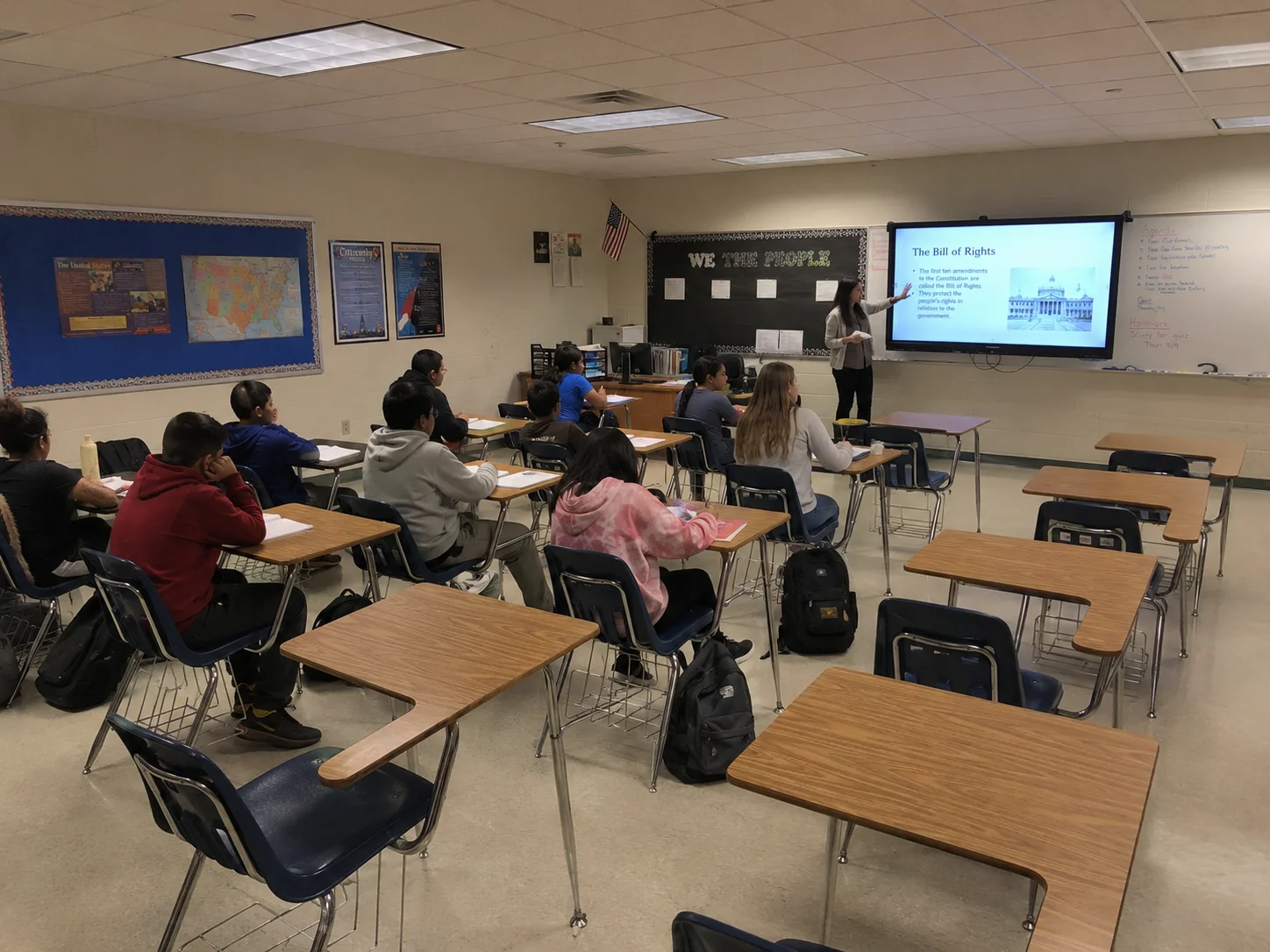
Ask a school principal in New York what is driving chronic absenteeism and you will likely hear about motivation, phones, and families that never reset their pre-pandemic routines. Ask a facilities director the same question, and you may hear something else entirely: the boiler, the vents, the mold behind a classroom wall. Two very different diagnoses, and a growing body of New York-specific research suggests both belong in the same conversation.
The state's attendance numbers have not recovered since the pandemic, and New York's own data puts the problem at roughly one in four students statewide, with the rate far higher in the state's largest districts. What has changed recently is the sophistication of the research explaining why. Studies ranging from a University at Albany analysis of two decades of building inspection records to a fresh 2026 statistical review of statewide facilities data are making the case that the condition of the building itself, not just the child or the household, helps determine whether a student shows up.
State Comptroller Thomas DiNapoli's October 2024 audit found that nearly one in three New York students were chronically absent during the 2022-23 school year, with high school rates running 7.6 percentage points above elementary and middle schools. The pattern was sharpest in the state's largest cities. Buffalo, Rochester, Syracuse, and Yonkers posted a combined high school chronic absenteeism rate of 64.2 percent, and charter high schools statewide reached 52.1 percent, both figures carrying the steepest increases of any school type since before the pandemic.
More recent figures suggest the state has clawed back some ground without closing the gap. The New York State Education Department now puts the statewide rate at roughly 27 percent, a number lawmakers in the state capital have started citing directly as they discuss new attendance legislation. That awareness accelerated this summer after officials linked the involvement of young offenders in a deadly Fourth of July shooting in Albany to long stretches of missed school, prompting a bipartisan push for a formal legislative task force on the issue. State Sen. Pat Fahy, whose district includes the shooting site, said attendance has not recovered since the pandemic, and that the disrupted post-pandemic environment has made it harder for schools to identify struggling students before they disappear from the classroom entirely.
In the Comptroller's 2022-23 data, chronic absenteeism ran far higher in high-need rural districts, at 33 percent, and high-need urban-suburban districts, at 40.9 percent, than in low-need districts, at 13.4 percent. Racial disparities are stark: Asian and Native Hawaiian or Pacific Islander high schoolers post rates near 21 to 25 percent, while Hispanic and Black high schoolers run above 43 and 46 percent respectively. EdTrust New York's analysis of the same school year found that 48 percent of Black students statewide were chronically absent, nearly one in two.
The pattern repeats for other groups the state is required to track. Students with disabilities face a chronic absenteeism rate roughly 50 percent higher than their peers without disabilities nationally, and a Manhattan Institute analysis of city data puts the gap even wider: 44.8 percent of students with disabilities were chronically absent in the 2023-24 school year, compared with 32 percent of students without. Students in temporary housing under the McKinney-Vento Act post the highest rate of any group tracked in the city, at 51.7 percent, a figure that climbs past 56 percent among twelfth graders in that category. Parents who have just received an IEP already know how many systems have to work correctly at once for a child with disabilities to have a good day at school, and unresolved evaluations or missing services are one more reason a struggling student stops coming in.
Before getting to buildings, it is worth sitting with the more familiar reasons, because they are still doing most of the work. The Comptroller's audit found that many parents and caretakers are not always aware their child has crossed into chronically absent territory until a school notifies them, and that the pandemic-era stretch of remote and hybrid instruction appears to have shifted some families' sense of how strict required attendance really is. Underneath that shift sit candid logistics: unreliable transportation to and from school, parents working long or irregular hours with little flexibility to manage a sick day or a missed bus, and health issues that recur often enough to add up to 18 missed days without ever looking, on any single morning, like truancy.
New York had initially set a goal of reducing chronic absenteeism to no more than 5 percent of students in every subgroup statewide. The state paused that goal for the 2022-23 and 2023-24 school years, citing the unusually high post-pandemic absentee rates as the reason a five-year-old target no longer made sense. That pause is a reasonable acknowledgment of a genuinely disrupted period, but it also means New York currently has no statewide numeric target for closing the gaps described above, at almost the same moment the building-level research below is adding a second, physical explanation to a list of reasons that was already long.
The Building Itself Can Be a Risk Factor
School buildings across the state are inspected roughly every five years under the Building Condition Survey, a state mandate that produces detailed, component-level data on everything from roofing to plumbing to climate control. Researchers have started mining that dataset against attendance and achievement records, and the results complicate the idea that absenteeism is purely a behavioral or family problem.
A 2024 University at Albany study tracked roughly 2,600 New York school buildings outside New York City from 2006 through 2019, following what happened to student outcomes as HVAC systems improved or deteriorated over time. The results were specific enough to act on. When a school's heating system moved from unsatisfactory to satisfactory condition, student absence improve by 3 percent and suspensions improve by 6 percent, alongside a modest but real gain in math performance. Ventilation improvements produced a 2 percent drop in absence and a 7 percent drop in suspensions. Full system reconstructions and replacements were tied to measurable math gains of 3 to 4 percent of a standard deviation, evidence the researchers say supports the idea that facility investment and academic recovery are not competing priorities but complementary ones.
The mechanism the researchers could actually measure was indoor air quality. Satisfactory ventilation systems raised the odds of a fair or good air quality rating by 12 percentage points in the same building inspections, with satisfactory heating and cooling systems producing similar, smaller gains. That matters because the same research found unsatisfactory HVAC conditions are not randomly distributed. Economically disadvantaged students, along with Black and Hispanic students, were consistently more likely to attend schools with inadequate heating and ventilation systems than their white peers, meaning the students already facing the steepest absenteeism gaps are also more likely sitting in the buildings least equipped to keep them healthy and comfortable enough to stay.
This is not a new finding. A 2010 study in the American Journal of Public Health linked 2005 building inspection data across Upstate New York to school-level absenteeism and found that schools reporting visible mold, high humidity, poor ventilation, or vermin had roughly two to three times the odds of high absenteeism compared with schools without those problems, and that six or more such issues nearly tripled the odds. The correlation were strongest in lower-income districts and among younger students, the population least equipped to advocate for a fix on its own.
A Second Study Complicates the Story
Not every finding points directly to building repairs, or the lack of them. A 2026 statistical review in the journal Engineering, Construction and Architectural Management looked at the same Building Condition Survey data, but this time next to the income and other economic conditions of each school's neighborhood. It found that a neighborhood's economic situation, on its own, explained about 40 percent of the differences in chronic absenteeism between schools. And more than half of the building problems that had seemed important on their own stopped looking important once researchers accounted for nine different measures of neighborhood hardship.
Put simply, run-down buildings and struggling neighborhoods tend to go hand in hand, so it is hard to say how much a child's absences come from the building itself versus everything happening around it. This does not cancel out the University at Albany findings, which followed the same buildings over time rather than comparing different buildings all at once. But it is a good reminder that fixing a boiler will not, by itself, solve every reason a kid misses school.
All of this research is landing at an odd moment in state policy. New York's Education Department has proposed eliminating the standalone chronic absenteeism accountability indicator starting with the 2025-26 school year, replacing it with a new attendance index that weights partial-year attendance more heavily rather than sorting students into a binary chronically-absent-or-not category. State officials frame the change as a more nuanced measurement. A Brookings Institution researcher has raised a fair question in response, noting that both metrics still mostly reflect a community's underlying poverty rate rather than anything a school is uniquely doing well or badly. Whatever its merits as a measurement tool, the timing is worth scrutinizing. The state is retiring its most widely understood absenteeism number at almost the exact moment lawmakers are convening a task force because they consider the problem urgent enough to legislate. Parents who want to track their own district's numbers through that transition should ask for both the old chronic absenteeism figure and the new index side by side this year, since the two will not always tell the same story.
What Parents Can Actually Do
New York counts a student as chronically absent at missing 10 percent of enrolled school days, which works out to about 18 days in a typical year, and that threshold includes excused and unexcused absences alike, though not suspensions. A student who is sick every few weeks all year can cross that line just as easily as a student skipping class on purpose, which is part of why the state's Every Student Present campaign urges families to treat any accumulating absence as worth a conversation with the school before it becomes a pattern.
If a child's absences seem tied to how the classroom feels rather than how the child feels about school, that is a legitimate time for inquiry. Parents can ask their district for the most recent school building conditions report filed under the state survey, since it is a public record, and ask specifically about the age and rating of the heating, cooling, and ventilation systems in their child's building. As this publication has reported separately, the air inside a building can carry a heavier pollutant load than the sidewalk outside it, and a pattern of headaches, congestion, or asthma flares that clear up on weekends and vacations is worth mentioning to a pediatrician and a school nurse, not just chalked up to a rough season.
For families already navigating a disability, a temporary housing situation, or an unresolved evaluation, absenteeism conversations should happen alongside the paperwork already in motion. And for anyone who wants a say in whether their district spends its next capital dollar on a new field or a new boiler, that decision gets made months before the vote at public school board meetings. Showing up to one of those may do more for a child's own attendance than any note sent home ever could.
None of this requires a family to become a facilities expert overnight. It requires asking a slightly different question than the one schools are used to hearing. Instead of only asking why a child does not want to go to school, it can help to ask what a child notices about the room itself: whether it is too cold to sit still in October, too warm to think clearly in June, or smells faintly musty on rainy weeks. Those details rarely make it into a truancy conversation, but they are exactly the kind of specifics a building architect or a district facilities office can act on, and exactly the kind of pattern that the research above suggests is worth taking seriously rather than dismissing as a child simply not liking school.
New York is not short on data about why its students are missing school. What it has been short on is treating the building itself as part of the answer. The boiler is not the whole story. But increasingly, the research says it is not exempt either.


Comments (0)
No comments yet — be the first to share your thoughts.
Leave a comment