

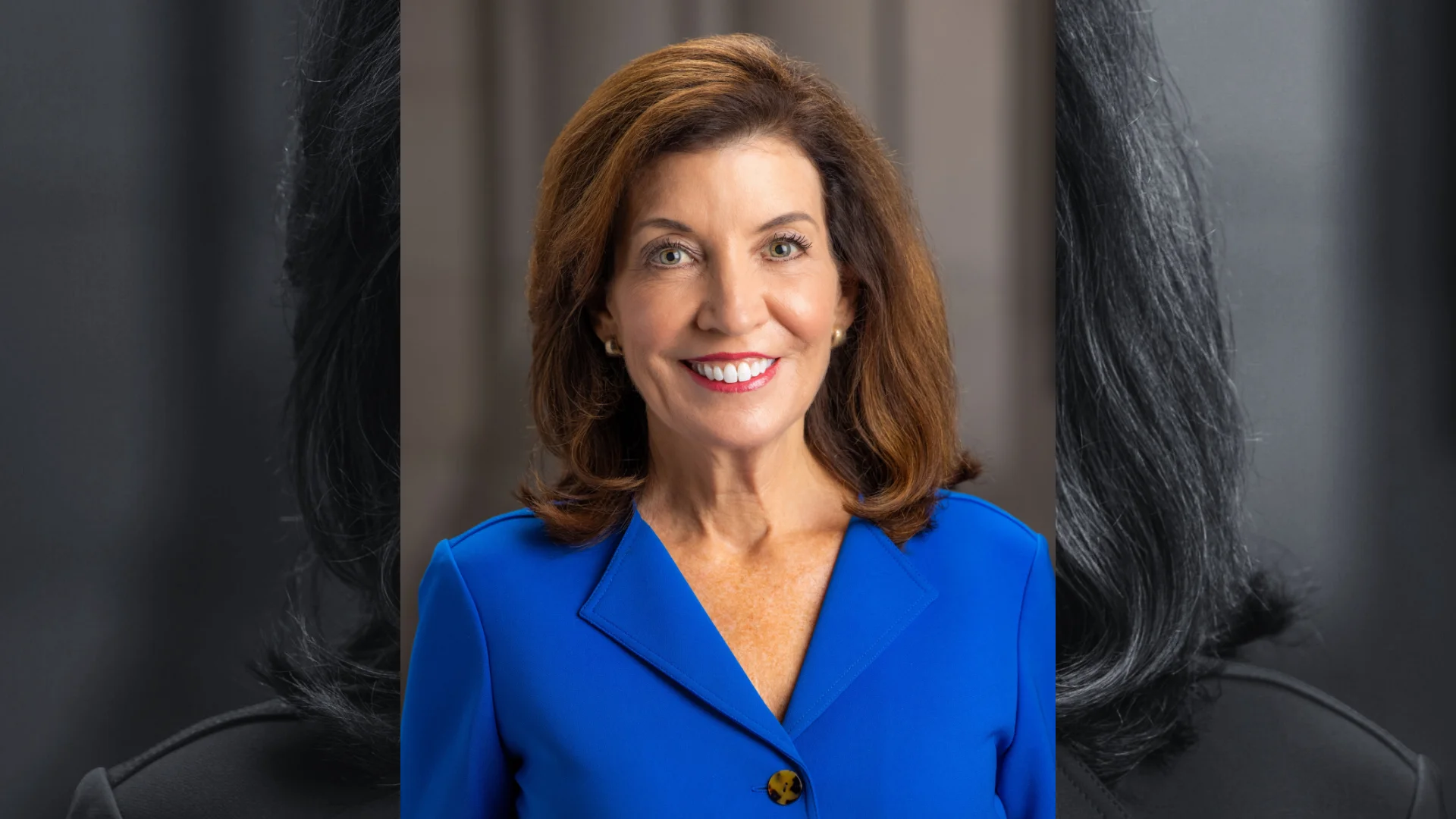
Three days after voters gave her a second term, Gov. Kathy Hochul stood beside New York City Mayor Zohran Mamdani at the SOMOS political conference in San Juan, Puerto Rico, on Friday (Nov 6) and was asked the question that will shape Albany's next budget: if universal child care costs more than the state has set aside, who pays? "I will work hard to manage within our existing resources," Hochul said, according to the New York Daily News. "But if we need more, we'll find a path."
Pressed on whether that path could run through higher income taxes on the wealthiest New Yorkers, the governor said she was "willing to do what has to happen" in what she called "extraordinary" circumstances. She added that New Yorkers would see "a very thoughtful approach to this," and said, "It is not ideological. It is pragmatic." The details, she suggested, would come in her State of the State address in January, the speech that sets up the executive budget she sends to lawmakers weeks later. For families outside New York City, the more useful news is what the state has already promised, because the commitments written into this year's budget reach every county, and the question Hochul answered on Friday is whether they will be paid for in full.
When Hochul announced agreement on the FY2027 state budget on May 7, her office said the deal would "increase funding by $1.7 billion bringing the total FY27 investment to $4.5 billion" for child care and early education, putting the state on what it called "a concrete path to universal, affordable child care" for up to 100,000 additional children. The centerpiece for school districts is universal pre-K statewide: the budget promises "high-quality Pre-K seats available for all four-year-olds in New York by the start of the 2028-29 school year," along with larger state grants to programs that already run.
That deadline matters most upstate and on Long Island, where coverage is uneven. When Hochul first laid out the plan in January, dozens of school districts still did not offer universal pre-K, and the proposal set per-child support at a minimum of $10,000 or the district's current Foundation Aid amount. A district that has never opened full pre-K classrooms has less than two school years to find space, hire certified teachers and decide whether to partner with community-based providers, and the state money behind that build-out is exactly the kind of spending Hochul's Friday remarks were meant to protect. For most districts outside the state's five largest cities, the budgets that would pay for new pre-K classrooms go to voters on the third Tuesday of May, in 2027 and again in 2028, so the planning for the first of those votes starts this winter.
The budget's other promises reach families with children too young for any school building. The Child Care Assistance Program, the state's subsidy for working families, was expanded to serve what the budget release called "tens of thousands of additional young New Yorkers," with family costs "capped at $15 a week for most families." A new program called First 3 is meant to "partner with counties to offer high-quality, affordable child care to children 0-3 regardless of income." An expanded Child and Dependent Care Tax Credit was projected to "help defray childcare expenses for 230,000 New York families," with an average benefit of $576. A new Office of Child Care and Early Education was created to run the rollout.
New York City gets its own piece of the plan. The budget committed the state to partner with the city on 2-Care, a program for 2-year-olds, and to "finally realize the promise of universal 3K access in New York City." According to the Daily News, the 2-year-old program now runs in five school districts across Manhattan, Brooklyn, Queens and the Bronx, with 10,000 more seats planned for next school year and citywide availability targeted for 2029. The state put in an initial $73 million this year, the paper reported, and that funding is set to grow to $425 million in the 2027-28 school year. Hochul said on Friday she would do "whatever it takes" to expand the program across the city.
That rising number is the reason the tax question surfaced at all. Child care seats are a recurring cost, not a one-time grant, and each phase of the plan is scheduled to cost more than the last. In January, when Hochul unveiled the roadmap alongside Mamdani, she framed it in plain household terms. "There's one thing that every family in New York can agree on, the cost of childcare is simply too high," she said at the time, calling the plan "a concrete roadmap that will transform the lives of working parents and kids across our state."
Legislative leaders heard Friday's remarks as an opening. Senate Majority Leader Andrea Stewart-Cousins told the Daily News that lawmakers have had a "very difficult time" getting tax increases past the governor, and that the coming year looks "very, very promising." "I think that she's trying to open to the realities of what we're facing," Stewart-Cousins said. "And so I'm looking forward to next year. I think it'll be very good." Assembly member-elect Diana Ayala described the pressure building on lawmakers from constituents. "As more and more people become boisterous about needing these type of funding streams," she said, "it forces all of us as electeds, right, to kind of rethink the way that we're doing things and to change that."
Mamdani, whose 2025 campaign made free child care a signature promise, tied the partnership directly to the election that just ended. Universal child care is "something that excited so many New Yorkers over the course of this recent election," the mayor said, adding that "the fruits of this partnership were ones that they could feel in their wallets." Hochul, who defeated Republican Bruce Blakeman in the Nov 3 election, also called a proposed pied-a-terre tax on luxury second homes a "creative" revenue stream, the only specific revenue idea she named.
The politics around the money are new; the stakes for families are not. Our post-election analysis of what the results mean for schools walked through the Legislature Hochul will work with in her second term, and child care was one of the education issues in our October side-by-side of the candidates' positions. With the campaign over, the debate moves from whether New York should build universal child care to how the state pays for the parts already promised, beginning with the pre-K seats the state has promised by September 2028.
Parents do not need to wait for January to use what exists now. Families who think they may qualify for child care assistance apply through their county department of social services, or through the city's Administration for Children's Services in New York City, and the $15 weekly cap applies to most families who are approved. Parents of children who will turn 4 in 2027 or 2028 can ask their district now whether it plans to open its own pre-K classrooms, contract with a community provider, or both, since that decision determines where those seats will be. Taxpayers will hear the revenue plan, if there is one, when Hochul delivers her State of the State in January, and the Legislature will decide what survives when the next budget is due on April 1.


Comments (0)
No comments yet — be the first to share your thoughts.
Leave a comment