

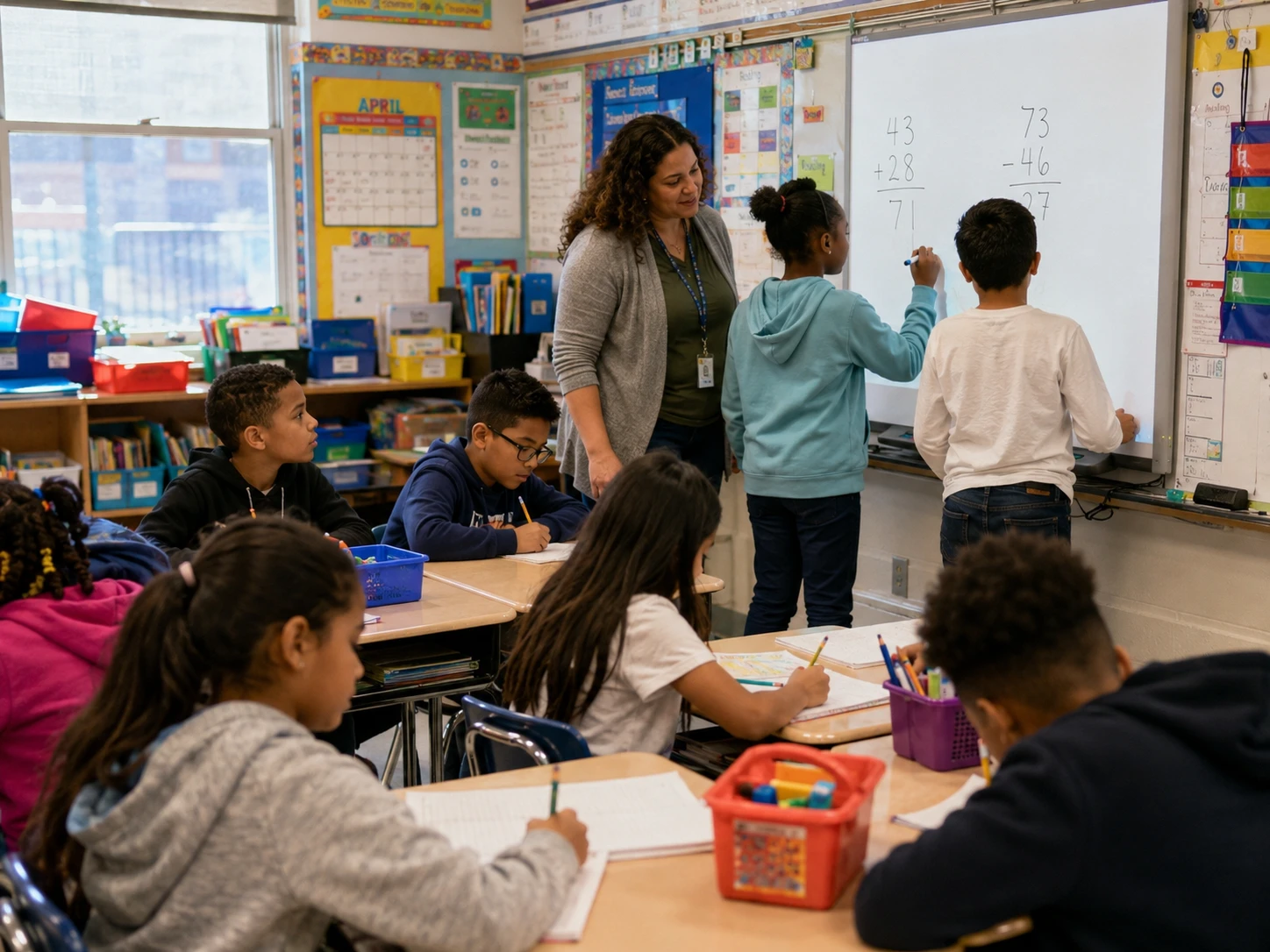
For years, whether your child learned math well in a New York City public school depended largely on which building they walked into every morning. Some schools used research-backed materials. Others relied on teachers writing their own lessons from scratch. The result was a patchwork system where the quality of elementary math instruction could vary wildly from one block to the next.
Mayor Zohran Mamdani has officially moved to change that. On May 22, 2026, Mamdani and Schools Chancellor Kamar Samuels announced a $17.3 million expansion of NYC Solves, the city's flagship math initiative, into elementary schools for the first time. It's one of his most significant K-12 moves since taking office, and it carries real consequences for students, teachers, and families across New York City.
NYC Solves is a citywide initiative designed to standardize math instruction by requiring schools to use materials from a curated list of city-approved, research-backed curriculums. Until now, the program had operated in high schools and was in the process of rolling out across middle schools. The new announcement marks the first time elementary school classrooms will be brought under the mandate.
Starting this fall, elementary schools in four districts will be required to make the shift. Those districts are Manhattan's District 5, which covers Harlem; the Bronx's Districts 11 and 12; and Queens' District 25. In total, the expansion is expected to reach more than 102,000 new students across both elementary and middle school levels. At the middle school level, NYC Solves is also expanding into 10 additional districts citywide.
Under the program's structure, local superintendents select a single curriculum from a pre-approved list for all schools within their district. The approved math curriculums include Illustrative Math, i-Ready, and Amplify Desmos, each of which is designed around evidence-based instructional practices. Once a curriculum is selected, teachers receive structured coaching and participate in professional development sessions throughout the school year to support the transition.
The honest answer involves both progress and urgency. The data coming out of the Adams era showed that standardized, high-quality curriculum can move the needle on student outcomes, and Mamdani made clear during his campaign that he intended to continue and expand that work.
In the 2024-2025 school year, NYC public school students in grades 3 through 8 saw a 3.5 percentage point increase in math proficiency, with just under 57 percent of students scoring at grade level. Third-grade math proficiency jumped by 8.4 points, one of the strongest single-grade gains recorded. Those numbers reflected the early rollout of NYC Solves alongside the more established NYC Reads literacy initiative.
But even with that progress, the ceiling is clearly visible. Slightly more than half of New York City students are considered proficient in math, which means nearly half are still not meeting grade-level standards. For English language learners, students in temporary housing, and kids in historically under-resourced districts, the gap is wider still. The administration is betting that bringing elementary school math instruction under the same standardized framework that drove high school and middle school gains is the logical next move.
As Chancellor Samuels put it in a statement announcing the expansion, "Every New York City Public Schools student deserves to be in a classroom that is both academically rigorous and deeply supportive, and expanding NYC Solves and Reads moves us closer to that goal." Samuels noted that as a former superintendent, he saw firsthand how these initiatives changed outcomes for students in his own communities.
The math overhaul does not stand alone. The same announcement confirmed that NYC Reads, the city's literacy initiative that has already been credited with driving a 7.2 percentage point jump in reading proficiency during the 2024-2025 school year, is now expanding to high schools. That expansion covers four high school districts and extends the program to 11 additional middle school districts, including District 75, which serves students with disabilities across the five boroughs.
Together, NYC Reads and NYC Solves represent a unified strategy: move every grade level, in every school, toward a model where instruction is grounded in evidence and teachers are supported with real coaching, not left to figure it out alone. If Mamdani holds to the timeline set by the Adams administration, both initiatives will be fully implemented in middle schools by the 2027-2028 school year.
The announcement itself was made during a spirited math competition between middle school students and a team of city officials at the Education Department's downtown Manhattan headquarters. The students won handily, a moment Mamdani leaned into, joking that the kids might one day have to teach city leaders how to play the game.
Not every element of the expansion has been received without question. Harlem's District 5 has selected i-Ready as its approved math curriculum, and that choice is drawing attention. i-Ready is one of the most widely used educational technology platforms in the country, but it has also generated significant backlash in districts across the United States. Critics have raised concerns about whether the platform's approach to skill-building adequately serves students with diverse learning needs, and whether its heavy reliance on screen-based instruction is appropriate for the youngest learners.
Advocates and educators in District 5 will be watching closely this fall to see whether the curriculum delivers results for Harlem's students the same way other approved options are expected to in the Bronx and Queens. The program's structure does give local superintendents latitude in choosing which approved option fits their district best, but once a selection is made, schools within that district are bound to it.
If your child attends an elementary school in Manhattan District 5, Bronx Districts 11 or 12, or Queens District 25, the transition to an approved NYC Solves curriculum will begin this fall. Here is what families should expect and consider.
First, the instructional approach will shift. If your child's teacher has previously been developing their own curriculum or using materials that were not on the city's approved list, that is changing. The goal is more consistency and a higher floor of quality, but transitions always carry adjustment periods, and some teachers will need time to build confidence with new materials.
Second, professional development is built into the model. The city's framework includes coaching and peer learning for teachers throughout the year. That matters because the quality of any curriculum depends almost entirely on how it is delivered, and teacher preparation is a central part of what made NYC Reads effective.
Third, parents should engage early. Ask your child's school which curriculum has been selected for your district, request information about how teachers are being trained, and follow test score data as it becomes available. The city's commitment to curriculum transparency is a meaningful improvement over the old anything-goes model, but it only works if families are paying attention.
This announcement lands at a complicated moment for New York City's schools. The same week Mamdani unveiled the math expansion, a state budget deal was finalized that extends mayoral control of city schools through June 2028, giving the administration the political runway it needs to see these initiatives through multiple school years. That continuity matters for a reform of this scale.
At the same time, the federal funding freeze covered in recent reporting on the White House's $2 billion education funding block continues to cast uncertainty over the resource environment. Programs that support teacher training, English learners, and after-school enrichment are precisely the kinds of wraparound supports that make curriculum reforms like NYC Solves more effective. What happens if those federal dollars do not arrive remains an open and urgent question.
For now, Mamdani's message is clear. "This administration is investing in what works," he said in the announcement. "Rigorous instruction, strong support for teachers, and a public school system that doesn't give up on anyone." The expansion of NYC Solves into elementary schools is the clearest signal yet of where that investment is headed. Whether it delivers at the same scale as the reading reforms that came before it is the question every parent in these four districts, and eventually every district in the city, will be watching closely.


Comments (0)
No comments yet — be the first to share your thoughts.
Leave a comment