
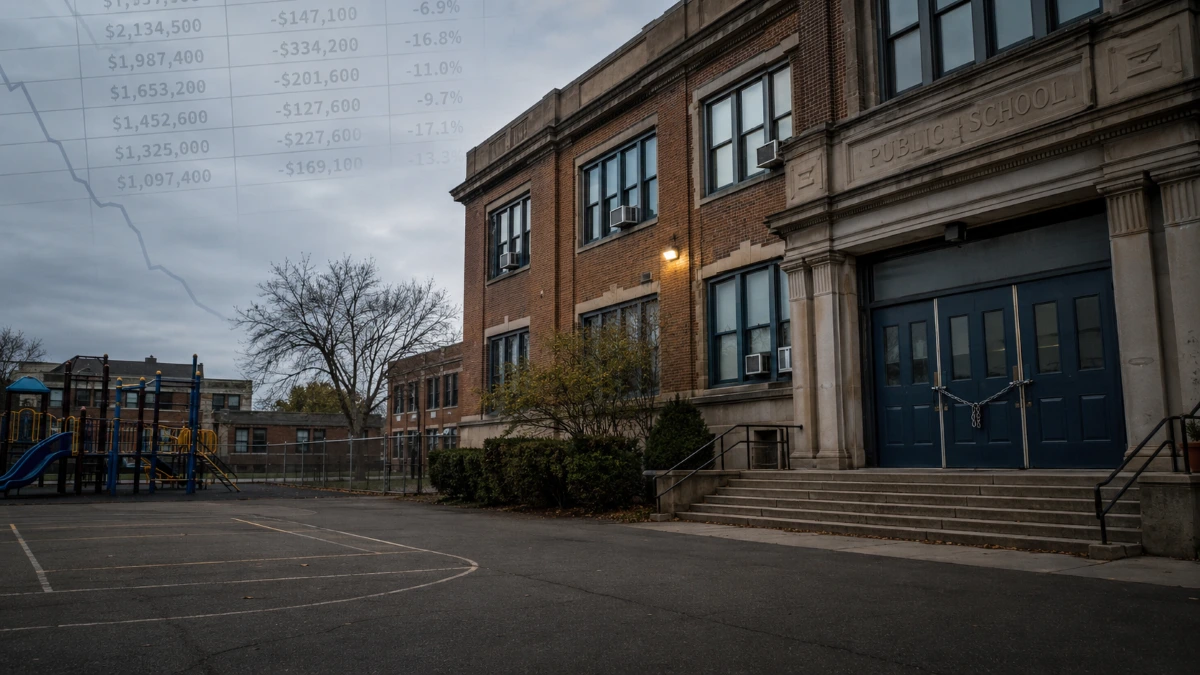
Congress approved the money. The president signed it. And yet, more than $2 billion in federal education funding is sitting in a locked box at the White House, going nowhere. For families and educators across New York State, that's not a budget headline. It's a real-world problem unfolding right now in classrooms, after-school programs, and teacher training rooms from Buffalo to Brooklyn.
Here's what's actually happening, why it matters, and what New Yorkers need to know.
This story starts with a little-known government procedure called apportionment. Before the U.S. Department of Education can send any congressionally approved funding to states, the Office of Management and Budget (OMB) must first "apportion" the money, essentially releasing it into the agency's spending accounts. In past administrations, this was routine, handled within six weeks of a budget being signed into law.
The Trump administration has taken a dramatically different approach. As of late May 2026, the OMB has apportioned little or no fiscal year 2026 funding for 33 of the Education Department's competitive grant programs, totaling more than $1.8 billion. On top of that, less than one quarter of the $790 million Congress approved for the Institute of Education Sciences (IES), the department's primary research arm, has been released. That brings the total figure withheld to well over $2 billion.
The Education Department has told reporters the administration is "reviewing every dollar it spends" rather than releasing funds on what it calls "autopilot." OMB has not responded to multiple press inquiries.
What makes this unusual isn't just the delay. It's the pattern. Every one of the 33 programs being withheld is a program the Trump administration has twice proposed eliminating entirely. Congress rejected those cuts both times. And now, rather than accept that outcome, the White House appears to be using the apportionment process to do through the back door what it couldn't accomplish through the front.
To understand the stakes, it helps to look at what happened just last year. In the summer of 2025, the Trump administration withheld nearly $7 billion in federal K-12 education funding that Congress had already approved for the 2025-2026 school year. That freeze was separate from the current $2 billion situation, but the two are deeply connected, because they target many of the same programs.
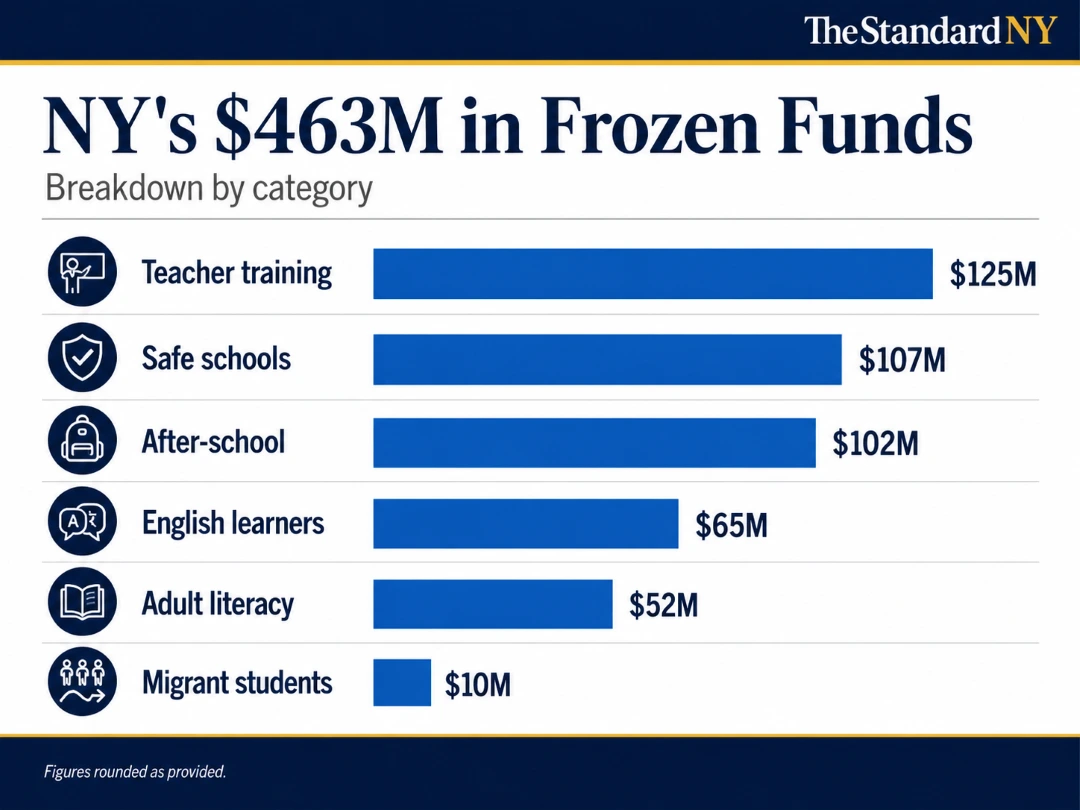 For New York State, that earlier freeze alone amounted to more than $463 million in blocked funding, representing roughly 13 percent of the state's total K-12 education budget. The breakdown was specific and significant. More than $125 million was earmarked for teacher training and professional development. Another $107 million was set to support safe and effective learning environments. Over $102 million was designated for after-school and summer learning programs. An additional $65 million supported English learner and literacy initiatives, with $10 million targeted at migrant students and $52 million in adult literacy funding.
The money was supposed to flow to 730 school districts across the state on July 1, 2025. Instead, an email arrived on June 30 informing states that the disbursement would be delayed, with no timeline offered.
The consequences hit fast. Some summer programs were shut down before they could even open, leaving thousands of children without midday meals and their parents scrambling for childcare on short notice. In the North Country and other parts of upstate New York, districts described being in a "tough spot," with unstable budgets heading into a new school year.
New York State did not sit quietly. Attorney General Letitia James joined a multi-state lawsuit against the Trump administration, arguing that the withholding of congressionally approved funds amounted to an illegal impoundment under the Impoundment Control Act, a federal law specifically designed to prevent presidents from refusing to spend money that Congress has appropriated.
A Statewide Guide: Where Does New York School Money Actually Go?
U.S. Senator Kirsten Gillibrand also went on the offensive, holding a virtual press conference and sending a formal letter to Education Secretary Linda McMahon and OMB Director Russell Vought demanding answers on when, or whether, the money would be released. "This federal funding," her office noted, "amounted to 13.5 percent of total K-12 funding for New York" in the prior year. Senator Chuck Schumer and Representative Nydia Velazquez also co-signed the letter, raising legal concerns about potential Impoundment Control Act violations.
Congressmembers from both chambers have since written in protest. More than 150 House Democrats and 30 Senate Democrats have demanded the funds be released. Court hearings have been scheduled. The legal battle is ongoing, and the Supreme Court has not yet weighed in on whether the executive branch has constitutional authority to simply sit on funding that lawmakers have already approved and the president has already signed.
The new $2 billion freeze targeting fiscal year 2026 competitive grants adds a fresh layer of uncertainty for New York's schools and programs. While larger formula grants such as Title I funding for low-income schools and IDEA funding for students with disabilities are not currently on the withheld list, many critical supplementary programs are.
These include programs supporting community schools, school-based mental health services, literacy research initiatives, and teacher preparation pipelines. In New York specifically, community schools grants affecting districts in multiple regions have already seen funding discontinued or redirected in 2025, with legal challenges still working their way through the courts.
One particularly alarming element of the current freeze is the timeline. According to an Education Week analysis, nearly $1.4 billion of the withheld fiscal 2026 funds will expire and return to the U.S. Treasury in less than five months if OMB does not act. Once that money goes back to Treasury, it is gone, regardless of what Congress approved or intended.
Education advocates have been blunt about what that means. Every month of delay, as one policy expert told Education Week, "incrementally increases the pressures on schools and districts and community organizations."
There are a few critical factors that will determine how this plays out for New York.
First, the legal battles. The courts will ultimately determine whether the executive branch can legally impound congressionally approved education funds. New York is a party to ongoing litigation, and court hearings will continue through the summer and fall.
Second, the fiscal year 2027 budget process. Even as FY2026 funding hangs in limbo, Congress is beginning work on next year's budget. The Trump administration has again proposed eliminating or consolidating many of the same programs, this time pitching a single $2 billion block grant to replace more than $4.5 billion in targeted programs. If that proposal advances, the consequences for New York's most vulnerable students could be severe and permanent.
Third, the district-level response. The 730 school districts across New York that depend on these funds are not waiting for Washington to figure it out. Many are drawing on reserves, cutting non-mandated programs, or deferring planned spending. Parents and community members who rely on after-school programs, English learner support, or summer learning opportunities should ask their local districts directly what contingency plans are in place.
What is happening in Washington is not abstract. It is a direct threat to the educational infrastructure that hundreds of thousands of New York students, families, and educators depend on every single day. The money was approved. It was signed into law. And it is being held back by an administration that has made no secret of its desire to eliminate the very programs that money was meant to fund.
The courts, Congress, and advocates are pushing back. But the clock is ticking. Families, educators, and community leaders who want to take action should contact their local representatives, track their district's budget communications, and stay engaged as this situation develops. The Standard will continue to follow every development.


Comments (0)
No comments yet — be the first to share your thoughts.
Leave a comment