
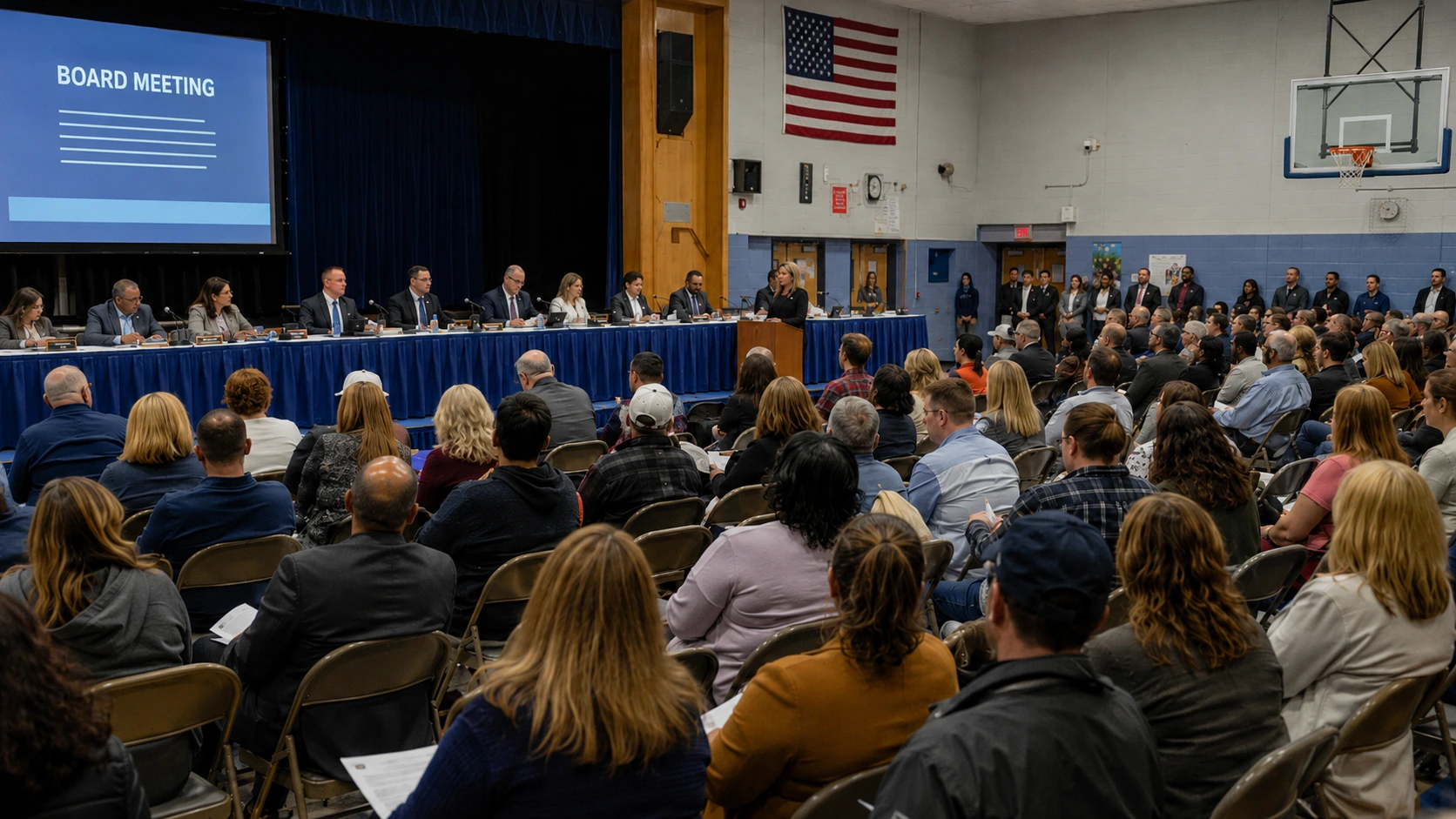
Right now in New York State, a charter school can be authorized to open, expand, or renew its operating agreement without a single public hearing in the community it will directly affect. No vote. No local input. Just an approval from a state-level charter entity, and the funding starts flowing out of your school district's budget whether your community supported it or not.
A pair of newly introduced state bills, Senate bill S.9568-A, sponsored by Senator Shelley Mayer of Westchester, and its Assembly companion A.10729-A, sponsored by Assemblywoman Nathalia Ramos, would change that. If passed, the legislation would require mandatory public hearings and either local district education council approval in New York City or a community vote in districts across the rest of the state, before any charter school could be authorized, expanded, or renewed.
The bills drop into the middle of one of the most contentious and financially consequential debates in New York education. And for families, educators, and taxpayers in communities across the state, the stakes are as real as the numbers in their local school budgets.
Under current state law, charter school applicants submit proposals directly to a charter-authorizing entity, which in New York can be a local school board, the State Board of Regents, or the SUNY Board of Trustees. Local communities have no formal approval power. They can comment, they can object, but they cannot stop a charter from opening in their district, even when that charter will pull millions of dollars out of their school system's operating budget.
The White House Is Sitting on $2 Billion for Schools - Here's What That Means for New York
S.9568-A and A.10729-A would restructure that process from the ground up. Charter applicants would be required to first apply to the community district education council or local board of education for approval, before their application could move forward to a state charter entity. Public hearings on proposed applications would be mandatory, not optional. The bills also establish clear and consistent timelines for acting on charter applications, giving school districts a framework to better anticipate and plan for the budgetary and enrollment impacts that come with a new charter's arrival.
In New York City, approval would come through the community district education councils, the locally elected bodies that represent parents and community members in each school district. In districts outside the city, where those councils do not exist, approval would require an actual public vote. For renewals and expansions of existing charters, the same process would apply.
The bill is a new introduction with no prior legislative history, and its fiscal implications are listed as "to be determined." But its policy logic is straightforward: decisions that carry significant local consequences should require meaningful local input.
To understand why this legislation matters, you have to understand how charter school funding actually works in New York. When a family chooses a charter school, money follows the student. The school district where the child is zoned pays a per-pupil tuition rate to the charter school, calculated based on the district's own spending levels. That money leaves the district budget and does not return, even though the district's overhead costs, its buildings, its administrative staff, its fixed expenses, do not shrink proportionally when students leave.
The dollar amounts are not abstract. Across upstate New York, districts pay an average of roughly $16,500 in charter tuition per student. In Albany alone, those payments totaled approximately $45 million in the 2025-2026 school year. As Albany City School District Superintendent Joseph Hochreiter put it directly, "Our expenses aren't reduced by the loss of that revenue. Our overhead is the same."
In New York City, where the charter sector is largest, the figures reach another scale entirely. The NYC Department of Education's budget now includes roughly $3.17 billion in annual charter school tuition payments, a figure that has grown substantially as charter enrollment has expanded over the past two decades. Approximately 182,000 students attend 343 charter schools across New York State, according to state budget documents. The state provides supplemental tuition support and facilities aid to help offset some of these costs, but the core financial pressure falls on school districts themselves.
The Education Law Center has documented that New York City alone would have received an estimated $2.62 billion in transitional aid from 2011 through 2022 to offset charter growth costs, if the city had been treated the same way as other districts under the state's transitional aid formula. Instead, that aid was excluded from flowing to the city, leaving district school budgets to absorb the impact directly.
Meanwhile, a separate bill sponsored by Senator Mayer, S.527-A, is also moving through the Legislature. That companion measure would limit charter schools from expanding into grade levels beyond those included in their original authorized school type, adding another layer of constraint on expansion decisions that currently happen largely without local input.
Charter school advocates will push back hard on S.9568-A, and they will not be wrong that the debate is complicated. The charter sector in New York has a significant constituency, particularly in communities of color where Black and Latino families have in many cases embraced charters as an alternative to persistently underperforming district schools. When tens of thousands of families march across the Brooklyn Bridge in support of their children's schools, as happened at a major September 2025 rally in New York City, that is not a message any legislator should dismiss lightly.
Charter advocates also raise legitimate points about funding equity. The NYC Charter School Center has argued that charter students actually receive less per-pupil public funding than their district school counterparts, once local tax dollars and facility costs are factored in. Some research has found that over the long term, districts with higher levels of charter enrollment can achieve efficiency gains, even if the short-term transition is financially painful.
Senator Mayer herself has been a consistent and outspoken critic of charter school practices that she views as operating outside appropriate accountability structures. As chair of the Senate Education Committee, she called for an investigation into the September 2025 charter school rally after documents suggested some schools had canceled classes and directed students to attend as part of a politically organized event. Charter operators disputed that framing, arguing the rally was a legitimate expression of civic advocacy.
The political environment around this bill is also notably complex in 2026. Mayor Zohran Mamdani, who has voiced skepticism of charter expansion, now controls New York City's school system following a state budget deal that extended mayoral control through June 2028. That extension gives Mamdani influence over how charter applications move through the city's community education councils, the very bodies that would gain approval authority under S.9568-A. Charter advocates spent much of the 2025 mayoral race expressing concern about Mamdani's position on the sector.
The geographic reach of this bill extends well beyond New York City. While the city captures most of the headlines in charter school debates, districts across the state, including Buffalo, Rochester, Albany, Syracuse, and communities across Long Island and the Hudson Valley, send significant sums in charter tuition annually and have watched their enrollment bases shift in ways that complicate budget planning. For families who want a fuller picture of how school funding actually flows in New York, The Standard's breakdown of the state's $89 billion education budget explains exactly how per-pupil dollars are calculated and why charter tuition payments hit some districts harder than others.
One separate Assembly bill already circulating, A.6902, takes an even more targeted approach, seeking to prohibit new charter schools entirely within or near the Hempstead, Uniondale, and Roosevelt school districts on Long Island, three districts that have faced intense fiscal pressure in part related to charter enrollment patterns.
What S.9568-A offers that those more targeted measures do not is a statewide structural solution. Rather than blocking charters outright, it inserts a democratic check into a process that has, until now, been conducted largely above the heads of the communities most directly affected. The creation of consistent timelines for charter application decisions is itself a meaningful reform, giving district budget officers a framework they currently lack for anticipating major enrollment and funding shifts.
Wherever you stand on charter schools as an educational model, the question this legislation poses is fundamentally about democratic governance. Should decisions that redirect tens or hundreds of millions of dollars annually out of a community's school budget, decisions that reshape how thousands of children are educated, be made entirely at the state level with no formal role for local families and elected school boards?
The bill's sponsors say no. And the case they are making is not primarily about whether charter schools work. It is about whether communities should have a meaningful voice in decisions that directly and significantly affect them. That is an argument that has traction far beyond the traditional fault lines of the charter debate, and it is why S.9568-A deserves close attention from parents, educators, school board members, and local officials across every district in New York State.
The Standard will continue to track this legislation as it moves through the Education committees of both chambers. Parents who want to weigh in should contact their state senator and assembly member directly, and attend any public Education Committee hearings where the bills are scheduled for discussion.


Comments (0)
No comments yet — be the first to share your thoughts.
Leave a comment