


For most of the last three decades, federal child online safety law has meant one thing: a 1998 statute written before most social media platforms existed. That changed, at least on paper, on June 29, when the House passed the Kids Internet and Digital Safety Act in a bipartisan 267 to 117 vote. It is a genuinely large bill, stitched together from fourteen separate proposals that had been stuck in various committees for years. For families in this state, though, the more interesting question is not what changed in Washington. It is how much of this Washington already assumed New York had figured out first.
What the KIDS Act Actually Does
The bill, formally H.R. 7757 and sponsored by Reps. Brett Guthrie and Frank Pallone, folds in pieces of the Kids Online Safety Act, an updated Children's Online Privacy Protection Act, and a handful of narrower proposals targeting AI chatbots and app stores. The updated COPPA provisions extend privacy protections that previously stopped at age 12 all the way to age 17, and ban targeted advertising to anyone under 18. Platforms would be required to build in parental controls that let a parent see how much time a child spends on an app. A newer and more unusual piece addresses AI chatbots directly, requiring them to disclose that they are not human, offer mental health resources when relevant, and build in prompts encouraging users to take breaks rather than design for compulsive engagement. Age verification requirements would also extend to pornography sites, an area where enforcement has historically been almost nonexistent.
The Piece That Got Left Out
What is not in the bill is, by most accounts, the reason it passed at all. Earlier versions of the Kids Online Safety Act included a legal standard known as duty of care, which would have required platforms to actively design their products to avoid known harms rather than simply disclose risks after the fact. House negotiators stripped that provision out over concerns it would function as a backdoor censorship mandate, letting the bill clear the two-thirds threshold needed for a fast-track floor vote. The removal is also the loudest complaint from the bill's critics. Senators Richard Blumenthal and Marsha Blackburn, who co-authored the original Kids Online Safety Act, said in a joint statement that they would not greenlight what they called hollow reforms that leave Big Tech's underlying business model intact. Digital rights groups have raised a separate concern: an age verification mandate this broad may require every user, not just minors, to submit identifying information just to prove they are old enough to be exempt from the very rules meant to protect someone else.
Why This Reads Differently From Albany
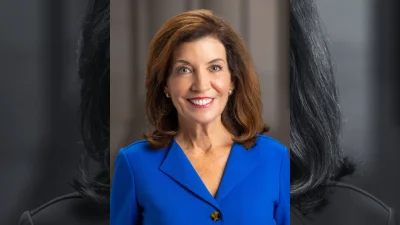
New York families encountering this news are, in one sense, arriving late to their own party. Two years before Congress acted, Governor Kathy Hochul signed the SAFE for Kids Act and the Child Data Protection Act, a pair of state laws that in some respects go further than what just passed the House. The SAFE for Kids Act already restricts algorithmically personalized addictive feeds for anyone under 18 unless a platform gets verified parental consent, and bars overnight push notifications between midnight and 6 a.m. for the same age group. The Child Data Protection Act already prohibits platforms from collecting, sharing, or selling a minor's personal data without informed consent, enforceable through the Attorney General's office with civil penalties of up to 5,000 dollars per violation. Attorney General Letitia James closed the public comment period on formal implementing rules for both laws this past December, meaning New York's version of this fight is already well into the rulemaking stage that Washington's bill has not even started.
New York has kept building on that foundation since. The state has also enacted first-in-the-nation safeguards for AI companion chatbots specifically, requiring them to redirect conversations touching on self-harm toward mental health resources, a provision that anticipates almost exactly what the federal bill is now proposing nationally. That combination of laws, along with the state's bell-to-bell school cellphone policy, was enough to earn New York the top ranking in a recent national index evaluating how well states protect children online. For parents wondering how to translate any of this into an actual conversation at home, The Standard's guide to talking with your teen about social media walks through what the state's law changes in practice and what still comes down to judgment at the kitchen table, a theme Family Symposium's digital parenting hub also covers in more depth for younger kids.
The Part That Actually Matters for New York
The practical question for families here is not whether the KIDS Act helps, but whether it could accidentally undo what the state already built. Earlier federal proposals in this space have included broad preemption language that would have wiped out stronger state laws in favor of a single national floor, a structure most Republicans have favored and most Democrats have resisted. The version that passed the House instead uses what is known as a conflicts-based standard, which is narrower: it displaces a state law only where the two directly contradict each other, and otherwise leaves stronger state protections, like New York's, standing. If that framework survives the Senate, the practical effect for New York families would be additive rather than disruptive, a new federal floor sitting underneath rules the state already enforces.
What Happens Next
The bill's path from here runs through a Senate that has, for years, preferred the original Kids Online Safety Act with its duty of care provision intact, and where a competing, tougher bill already has broader support than what the House sent over. Reconciling the two chambers means resolving exactly the fights that stalled federal children's privacy law for a quarter century: whether platforms should be legally required to design for safety or merely to disclose risk, how aggressively to preempt states that have already acted, and how to verify a user's age without building a surveillance system to do it. None of those questions get easier just because one chamber found a version everyone could stomach for one vote. For New York parents, the more durable protections, for now, are still the ones already written into state law and already being enforced out of the Attorney General's office in Albany, not the ones waiting on a conference committee in Washington.


Comments (0)
No comments yet — be the first to share your thoughts.
Leave a comment