

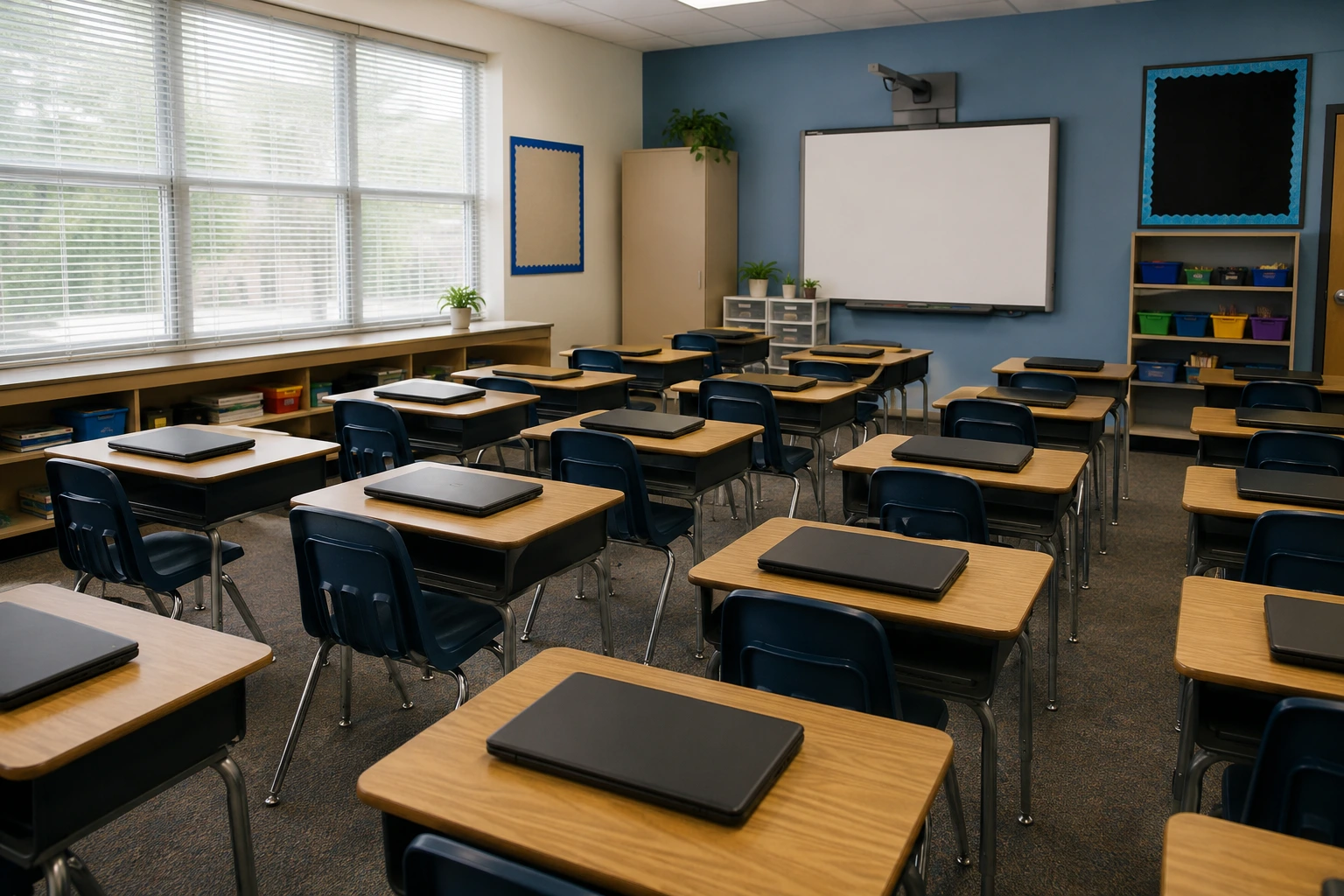
New York City runs the largest public school system in the country, more than 900,000 students across roughly 1,600 schools, and as of this week, that entire system is not allowed to buy new classroom software. Chancellor Kamar Samuels told principals in a Monday email to pause purchases of educational technology until the Education Department finishes a policy on artificial intelligence that was supposed to arrive last month, then the month before that. The freeze is not a ban. It is something more telling: an acknowledgment that the city does not yet know what rules it wants its own technology to follow, and would rather stop buying than buy the wrong thing twice.
What Actually Got Paused
The mechanics are straightforward even if the politics are not. Samuels' email, first reported by the Daily News, told principals that technology purchases should wait until updated guidance arrives later this summer, warning that policy changes "may potentially impact your technology buying decisions." Education Department spokesperson Nicole Brownstein framed the pause as a safety measure, saying it exists to ensure proper protocols are in place around privacy and oversight. Central staff will now review software orders closely, and Samuels acknowledged directly that some purchases may end up "delayed or denied" once the new rules land. For a system this size, the freeze effectively puts an entire procurement season on hold heading into the fall.
How a March Draft Became a Summer Standoff
To understand why the city is here, it helps to rewind to March, when the Education Department released a draft AI policy built around a traffic light framework, sorting different classroom uses of artificial intelligence into categories of acceptable, limited, or restricted. The draft allowed teachers to use AI in lesson planning but drew a firm line against using it for grading or discipline. That distinction did not calm anyone down. Parents packed school board meetings. Protesters gathered outside City Hall. An online petition calling for a two-year moratorium on AI in schools collected nearly 4,700 signatures, and more than half of the City Council signed a letter demanding an immediate pause. By the time officials faced a City Council hearing on the matter this month, public comment on the draft had reached almost 6,500 submissions, and the promised June release date had already slipped to September.
Samuels has not been shy about distancing himself from his predecessor's early enthusiasm either. He has publicly said the department's own draft policy "missed the mark," calling AI potentially the most invasive technology schools have encountered, and has signaled the final version will apply stricter limits to the system's youngest students than the March draft did.
The Union That Changed Its Mind
The backlash inside classrooms has been sharper than the one outside them. In May, American Federation of Teachers president Randi Weingarten called for banning AI outright in elementary schools, barring companion chatbots for anyone under 16, and stopping screens entirely from pre-K through second grade, a notable hardening from a union that had opened an AI training center in Lower Manhattan with Microsoft, OpenAI, and Anthropic as partners just the year before. New York's statewide teachers union has moved in a similar direction. NYSUT passed its own resolution urging the state to pull individual devices and student-facing AI out of the earliest grades entirely, a measure The Standard covered in detail in our earlier report on what New York teachers are proposing for screens and AI. Leonie Haimson of the Coalition for an AI Moratorium described the city's pause as evidence that officials are finally taking parents and teachers seriously, saying she hopes it signals a real effort to prevent damage to children's minds "before it is too late to repair."
Not everyone in the system shares that read. Former Chancellor David Banks grew increasingly bullish on the technology before leaving office, arguing AI could revolutionize everything from college advising to how student work gets assessed, though he left without ever issuing the clear policy his successor now has to write. Some educators still see AI literacy as inevitable and worth teaching deliberately, rather than something to wall off entirely. The Panel for Educational Policy, the body that reviews and votes on the district's ed-tech contracts, formed its own task force on technology and artificial intelligence last month, a sign the disagreement runs through the system's governance, not just its public comment period.
What This Actually Means Right Now
For a parent trying to figure out what changes tomorrow morning, the honest answer is: very little, yet. Existing classroom technology stays in place. What stops is new purchasing, not current use, and city officials themselves have acknowledged there are still, in the words of one City Council member, "huge gaps" in understanding exactly how AI tools are already being used school to school. Some classrooms in the city are actively building AI literacy into instruction. Others have effectively banned the technology on their own, well ahead of any citywide guidance. The freeze does not resolve that inconsistency. It mostly just stops it from getting more expensive to reverse before the Education Department decides which way it is actually going.
Why This Reaches Beyond the City
New York City is one district, but it enrolls close to a third of the state's public school students, and decisions made in Manhattan tend to become the template other districts either adopt or explicitly reject. A statewide teachers union already pushing for early-grade AI restrictions, a big-city system now formally pausing its own purchasing, and a Governor's office that has spent two years building out one of the country's most aggressive frameworks on kids and technology are all pointing in a similar direction at once. Whatever guidance New York City lands on in September will not stay contained to its five boroughs. Districts across the state are watching to see whether the country's largest school system decides AI belongs in a first-grade classroom, or does not belong there at all.


Comments (0)
No comments yet — be the first to share your thoughts.
Leave a comment