

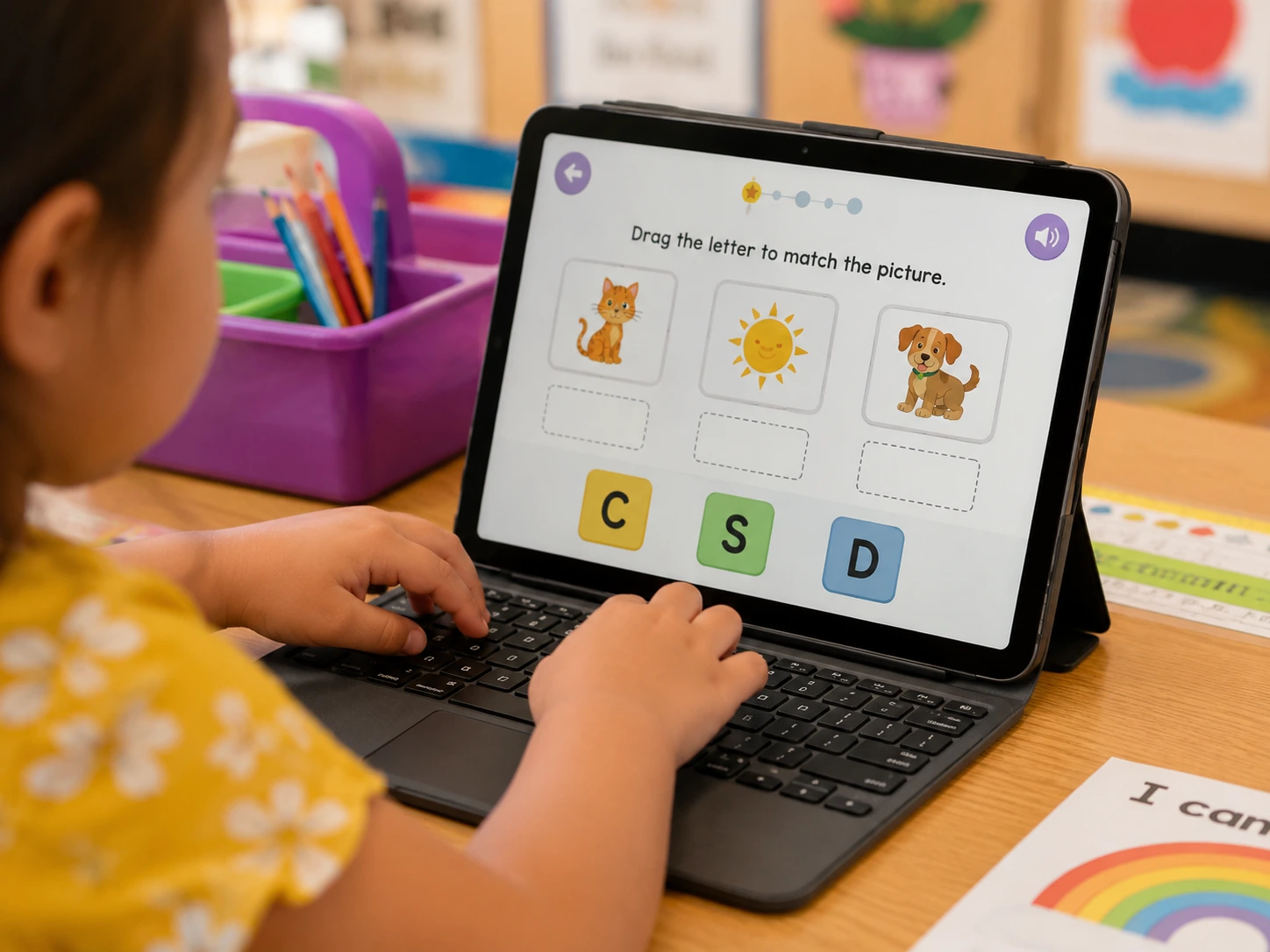
New York's largest teachers union is calling for the state to pull individual devices and student-facing artificial intelligence out of its earliest grades, a move that could reshape how millions of children across the state learn to read, write, and think. The push lands one year into New York's nation-leading cellphone ban, and it signals that the conversation about technology in schools is no longer about phones in hallways. It is about the laptops, tablets, and AI tools sitting on desks in kindergarten rooms from Buffalo to the Bronx.
Here is the short version for busy parents. The New York State United Teachers board recently passed a resolution urging an end to one-to-one screens and student-facing AI for children in pre-kindergarten through second grade, a ban on non-educational AI in grades three through eight, and a hard stop on so-called social companion chatbots for anyone under sixteen. It is a recommendation, not yet a law. But given how the cellphone debate played out, families across New York would be wise to pay attention now.
The resolution from NYSUT, the umbrella organization for educators statewide including New York City's United Federation of Teachers, is specific. For the youngest learners, it would do away with school-issued laptops and student-facing AI entirely. For grades three through eight, it would block any AI tool that is not directly educational. Across every grade, it insists that any classroom AI be supervised, educator-led, and built to strengthen critical thinking and digital literacy rather than replace a teacher's judgment.
The union is also pushing back on how children are tested. Since the pandemic, districts across the state have leaned on screen-based assessment tools like i-Ready and MAP Growth, sometimes starting in kindergarten. NYSUT's resolution calls for guaranteed paper-and-pencil options for all students, a demand tied to its broader "More Teaching, Less Testing" report. As New York moves toward fully digital standardized exams for students in grades three through eight, some educators worry that even test prep will pull more screen time in schools into the daily routine.
NYSUT President Melinda Person framed the effort not as a rejection of progress but as a defense of childhood. "Educators are not anti-technology. We are pro-child," she said. The exceptions in the resolution reflect that balance, carving out room for students with documented needs such as special education services or translation support.
It would be a mistake to read this as a New York City story. The momentum is genuinely statewide, and in many districts it is already underway. In West Irondequoit, near Rochester, administrators are weighing screen time limits for younger children and considering a move away from one-to-one devices in the earliest grades. Students there describe what changed once phones disappeared from the school day.
"We've been able to interact more and have more meaningful conversations with the people around us," one West Irondequoit senior said of life under the phone ban.
In the North Country, NYSUT board director Bob Ladouceur pointed to the surgeon general's warnings about excessive device use and put the union's case plainly, saying the goal is "more about being pro-child and what's best for them." Local leaders in the region, including BOCES officials, have signaled that reduced screen exposure could benefit students in their communities. This is the pattern across New York schools right now. The pressure is not coming from one city or one union office. It is bubbling up from classrooms in every region, which is exactly how the statewide bell-to-bell cellphone ban gathered force before it became law.
NYSUT's resolution did not appear out of nowhere. It follows a national plan from its parent union, the American Federation of Teachers, whose president Randi Weingarten recently unveiled a ten-point framework she calls "devices down, eyes up, hands-on." That plan also calls for a screen ban through second grade, an end to student-facing AI in elementary schools, and a prohibition on companion chatbots for children under sixteen.
Weingarten was careful to position the plan as a recalibration rather than a rejection of technology. "I'm not calling for an AI ban or a Chromebook bonfire," she said, arguing instead for getting the balance right so schools capture the benefits of education technology while limiting the harms. Her case leaned on research suggesting that national reading and math trends shifted downward as digital tools spread through classrooms, along with surveys showing teachers nationwide reporting shrinking student attention spans.
At least a dozen states have introduced or passed legislation limiting unnecessary classroom screen time, and the Los Angeles Unified School District has moved to ban screens through first grade. New York, now the largest state in the country with a full cellphone ban, has become a closely watched test case for whether these limits actually deliver.
Governor Kathy Hochul gave the movement a notable boost this week. Marking the first year of the cellphone ban, her office released a survey of roughly 600 educators across every region of the state. About 80 percent reported that the phone-free policy produced positive results, and 76 percent described better classroom behavior, including improved attention and stronger peer relationships. Hochul said the results show the policy "is working," though she acknowledged there is not yet data on academic impact.
Asked whether she would extend limits to screens for younger children, the governor signaled she is open to it. "My gut tells me that's the way to go," she said, while adding that she wants to study the question the same methodical way she approached cellphones, by traveling the state and gathering evidence before committing to policy. For New York families, that is the clearest tell yet. The same process that produced the cellphone law is the process Hochul described for a possible screen time rule.
Cellphones were a relatively clean target. Artificial intelligence in classrooms is far messier, and New York City is learning that in real time. Schools Chancellor Kamar Samuels recently called AI the "most invasive technology that we've seen" and indicated the city may draw clearer guardrails for its youngest students after its initial draft policy drew heavy criticism. The city just finished collecting public comment from parents and educators on its proposed approach.
Not everyone agrees that bans are the answer. Some education technology experts argue that children already encounter AI through voice assistants, online video, and smart toys, which makes teaching responsible use more practical than prohibition. As one specialist put it, an "outright ban is just not the right approach," favoring intentional guardrails and thoughtful design over blanket restriction. That tension, between shielding young children and preparing them for a world saturated with AI, is the question every New York district will have to answer. It echoes the warning in Pope Leo XIV's recent encyclical that technology can quietly erode critical thinking, a concern New York schools are still struggling to address with any consistency.
For parents, the practical takeaway is that change may be coming, but you are not powerless in the meantime. Districts set much of their own technology policy, and budget season is when those decisions get made. New York spends roughly 89 billion dollars a year on public education, and a meaningful share of that flows into devices, software licenses, and digital assessment platforms. Understanding where your district's money actually goes gives you real leverage when school boards weigh whether to renew a one-to-one device contract or invest in something else.
There is also a longer view worth holding onto. The skills these debates keep circling back to, critical thinking, communication, and the kind of digital literacy that lets a person command technology rather than be commanded by it, are the same skills that hold their value as automation reshapes the job market. Families thinking about the road past graduation can see that connection clearly in the kind of future-proof career paths that AI cannot easily replace, where human judgment is the entire point.
For now, NYSUT says it intends to work with parents, experts, and community partners to lead the conversation, especially around early elementary students. Whether that conversation ends in a statewide rule on AI chatbots and screens, or in a patchwork of district choices, will likely be decided the way most big education questions in New York are: slowly, loudly, and with parents in the room. The line has been drawn. What happens next is up to the people who show up.



Comments (0)
No comments yet — be the first to share your thoughts.
Leave a comment