

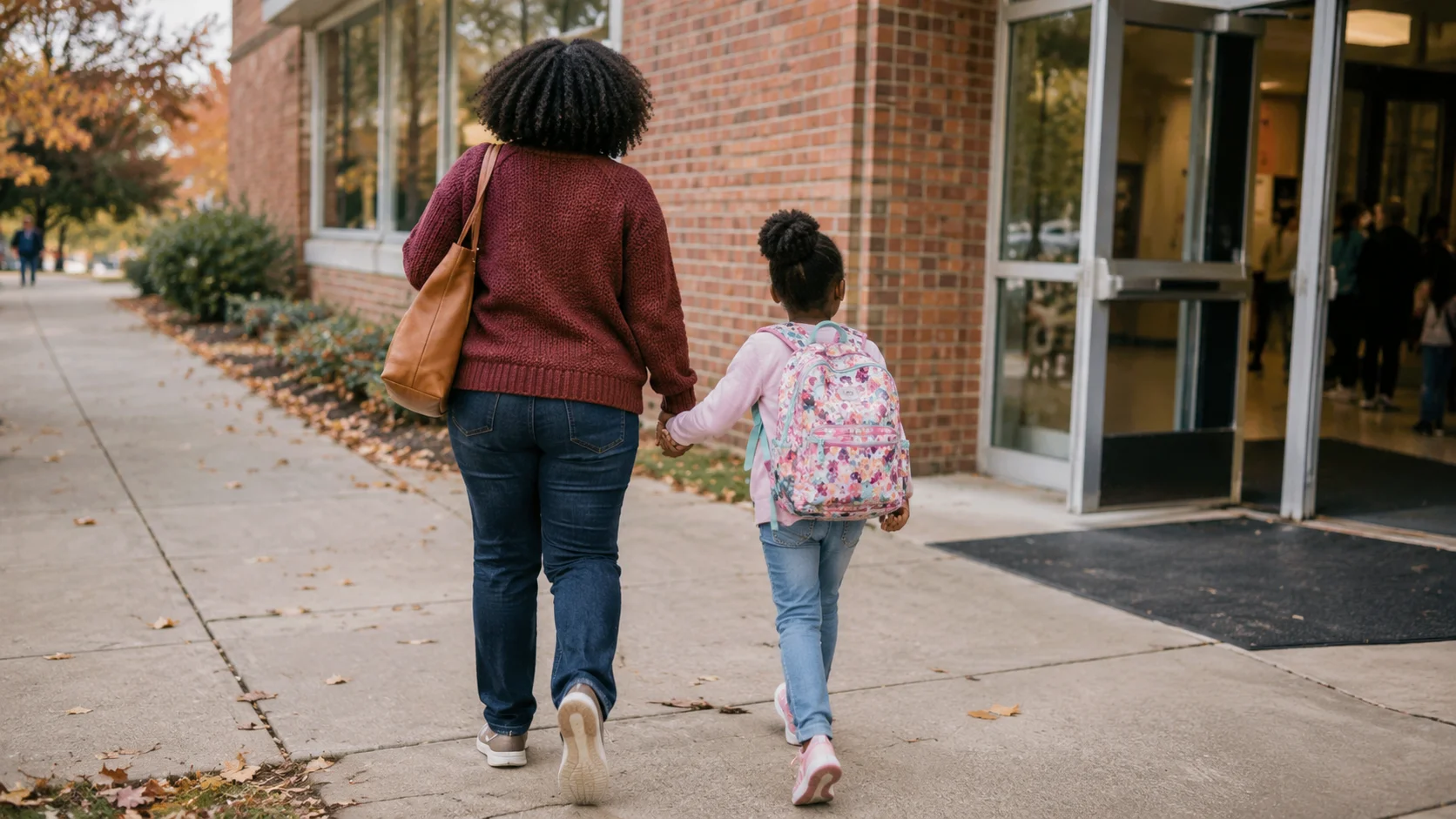
In April, near the end of first grade, a mobile crisis team at P.S. 11 in Clinton Hill, Brooklyn, called 911 about a 6-year-old boy who had recently been diagnosed with autism. His mother raced to the school knowing that police and an ambulance were already on the way. If she did not get there first, they would take her son to an emergency room that nobody at the school could name. "I just kept thinking: 'Cops? For a 6-year-old?'" she said in an interview for a Nov. 12 Chalkbeat investigation into school 911 calls.
When she reached the building, she found her son standing silently between two police officers while two more came through the door. He was unhurt and had not been handcuffed, but he came home afterward calling himself "a bad kid," a phrase his mother said he had heard from a teacher.
New York already regulates almost everything that can happen to a child in a moment like that, with the single exception of the 911 call itself. State rules that took effect in August 2023 ban prone restraint and seclusion in every school and require same-day notice to parents after any restraint. Since the 2024-25 school year, those rules have also required each restraint to be reported to Albany, yet nowhere does the text mention police, law enforcement or 911. The Board of Regents should close that gap by counting school-initiated 911 removals the same way it counts restraints.
Section 19.5 of the Commissioner's regulations is specific about when staff may use force on a child. A school may physically restrain a student only when immediate intervention involving reasonable physical force is necessary to prevent imminent danger of serious physical harm to the student or others. Even then, staff may act only after less restrictive interventions and de-escalation techniques would not prevent that danger. Face-down restraint is prohibited outright, and so is confining a child alone in a room the child cannot leave.
The rule then builds a paper trail around every use of force. A school that restrains a child or places one in timeout must notify a parent the same day and hand over a copy of the incident documentation within three school days. Beginning with 2024-25, public districts, BOCES, charter schools and state-operated schools must report every physical restraint and timeout to the State Education Department through its student information system. The same report must list substantiated and unsubstantiated allegations of corporal punishment, mechanical restraint, prone restraint and seclusion.
The State Education Department describes the package as holding schools to the highest standards of oversight, monitoring and data collection. One clause shows exactly where that oversight stops, binding school resource officers to the same limits on force as staff "except when a student is under arrest" and handcuffs are needed for safety.
A 911 call routes around every one of those safeguards without triggering a single report. The officers and paramedics who answer are not school employees, the call is not a restraint, and the trip to an emergency room is not a timeout. The most serious intervention a school can set in motion therefore leaves no mark in the statewide report that Albany began requiring with the 2024-25 school year.
New York City is the one place in the state where the count exists, and it exists because families sued. Nelson Mar, a senior attorney at Legal Services NYC, led a 2013 lawsuit whose settlement produced the city's first formal limits on school 911 calls, including quarterly reporting and crisis-intervention training. In 2023, the City Council passed a law requiring police to document whether a school had tried to de-escalate before officers or EMTs got involved.
Those city reports are the only reason anyone in New York knows the scale of the problem. City schools call 911 on students in emotional distress well over 2,000 times a year. Since 2016, when the city first started tracking the numbers, schools have called more than 5,000 times on children younger than 10. Hundreds of times each year, children end up in handcuffs, some of them 6 and 7 years old. The calls fall far more heavily on students with disabilities and on Black students than on their classmates.
Outside the five boroughs, nothing in Section 19.5 or the state's reporting instructions obliges a district to keep that number at all. A parent in a small district upstate now lives under a rule that makes her child's school report every restraint to the state. No rule makes that same school report how often staff picked up the phone and handed a child to the police.
The remedy does not require a new law or a new bureaucracy, only an amendment the Regents already have the authority to write. They could revise Section 19.5 so that any police or emergency medical removal a school initiates by calling 911 triggers the three obligations the rule already imposes on a restraint. A parent would hear the same day, receive written documentation within three school days recording what de-escalation staff tried first, and see the call counted in the annual report districts already file.
That change would cost districts a few fields on a template they already use. It would also hand families the same record they receive after a restraint, the document they need to request a functional behavioral assessment or press for services through an IEP or a 504 plan. In October, the federal Education and Justice departments told state attorneys general that schools must obtain written parental consent before a mental health screening. It is hard to defend a system in which a questionnaire about a child's feelings requires a signature while a police response to those feelings requires no record at all.
School leaders will argue that some calls are unavoidable, and they are right that some are. Onika Richards, a spokesperson for New York City Public Schools, said in an emailed statement that "Under no circumstance is 911 ever called simply for a student's behavior." She added that the department calls 911 only as an alternative, once an emotional or behavioral crisis has outrun what school staff can handle safely. Teachers carry real limits on what they can manage alone, which is one reason state law gives them a formal process for removing a disruptive student from class, with its own deadlines and records.
If the call is truly a last resort, a reporting requirement costs schools very little and proves their case. If it is not, families and the Regents deserve to find that out from data rather than from one mother's drive across Brooklyn. Mar put the problem plainly: "Calling 911 doesn't make anything better at school the next day."
The Regents spent years writing a rule that tells schools exactly how much force they may use on a child, when they must call a parent, and how they must account for it afterward. The next update to Section 19.5 is the natural place to add the one intervention the rule never names. Districts already file the annual behavioral intervention report through the state's student information system, so the change asks staff to log one more kind of event they are already explaining to families. A principal who calls 911 today still has to account for the call to a parent, and the amendment would require that account to arrive in writing and be counted.
After the 911 call, Mar helped the boy transfer to P.S. 20, another school in Clinton Hill, where he was assigned a paraprofessional within weeks. His mother is still working to secure the special education services he needs.


Comments (0)
No comments yet — be the first to share your thoughts.
Leave a comment