

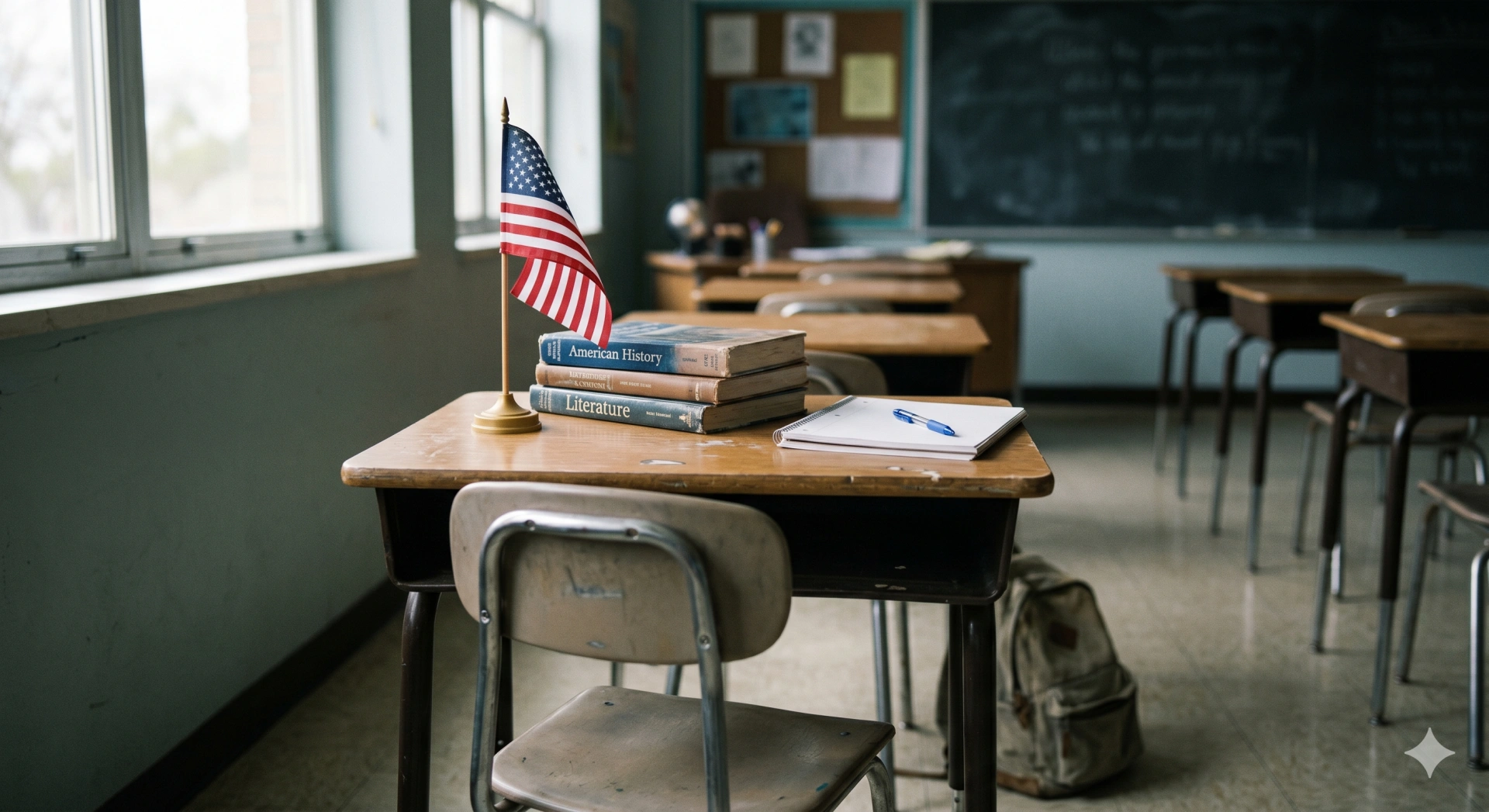
Every year on the last Monday of May, flags drop to half-staff, parades move through small towns and big city streets, and families gather at cemeteries across New York State to honor the men and women who died in military service to this country. It is one of the most solemn civic traditions in American life. But when students return to classrooms the next morning, many of them carry no deeper understanding of why the holiday exists than they did the Friday before. That gap between ceremony and comprehension is at the center of a growing conversation among educators, veterans advocates, and parents across New York State.
The question is not whether New York schools observe Memorial Day. Of course they close for it. The real question is whether they are actually teaching it, and the answer, depending on where your child goes to school, varies dramatically.
New York is what the State Education Department officially calls a "non-adoption" state. That means NYSED cannot mandate a specific textbook, curriculum product, or instructional resource. The New York State K-12 Social Studies Framework, adopted by the Board of Regents in 2014, is designed as a guide, not a mandate. It sets out key ideas, conceptual understandings, and content specifications for each grade level, but it explicitly leaves curricular decisions to local school districts.
The Framework does include civic readiness as a cornerstone of K-12 education. It calls for students to develop civic knowledge, skills, and mindsets across all grade levels, including understanding "the impact of individual and collective histories" and engaging with American military and political history in both elementary and secondary school. But Memorial Day as a specific teaching moment, and veterans history as a sustained unit of study, are not spelled out with the same clarity as other required content areas.
In practical terms, this means that whether a fifth grader in Buffalo learns the origins of Memorial Day, or whether a tenth grader in Syracuse understands the difference between Veterans Day and Memorial Day, depends almost entirely on the priorities of their individual school district and the individual teacher standing in front of them.
New York City launched its Civics for All initiative in 2018, creating a K-12 civics curriculum developed by a team of NYCDOE staff, teachers, and cultural partners. It is organized around four grade bands and is designed to complement the Passport to Social Studies program. It covers government structures, civic participation, rights and responsibilities, and community action in genuine depth.
What it does not consistently center, however, is military history and sacrifice-based civic memory. The distinction matters. Civics education, as it is typically structured in New York City schools, tends to focus on living civic systems: how laws are made, how to vote, how to engage in local government. The question of why those freedoms were paid for, and by whom, is treated as historical content rather than civic content. That separation leaves Memorial Day without a natural classroom home in many NYC schools.
Outside the city, in suburban districts like those in Westchester, Nassau, or Erie County, individual teachers often fill this gap on their own. A fourth grade teacher in a Long Island district might spend the week before Memorial Day walking students through the history of the holiday's origins after the Civil War. A high school U.S. history teacher in Saratoga Springs might devote a full lesson to the National Moment of Remembrance. But these are individual choices, not systematic ones.
A Statewide Guide: Where Does New York School Money Actually Go?
Here is something many parents and even educators may not know: New York State already has a formal program specifically designed to bring military history into the classroom. The New York State Legislature passed legislation creating the Veterans Speaker Education Program, which allows public and private schools across the state to invite veterans into classrooms as speakers to supplement instruction on particular eras in American military history.
The New York State Department of Veterans' Services manages the program, maintaining a pool of approved veteran speakers who have completed an application and interview process. Teachers and school administrators can formally request a speaker by contacting DVS directly. The program is free, it is available statewide, and it connects students to living, first-hand accounts of military service in a way no textbook can replicate.
Awareness and participation in the program, however, remain uneven. In communities near Fort Drum in Watertown or the U.S. Military Academy at West Point, military life is part of the local fabric, and schools tend to be more naturally connected to veteran voices. In urban districts where fewer students have family members with military backgrounds, the program often goes untapped, not because teachers oppose it, but because they simply do not know it exists.
It is important not to flatten New York's educational landscape into one story. The state covers 54,000 square miles and 700 school districts. The experience of a student in a rural Jefferson County school near Fort Drum, where roughly 12,000 military children attend local schools, is fundamentally different from that of a student in a Brooklyn middle school.
In upstate communities with strong ties to the National Guard, active military installations, and multigenerational veteran families, Memorial Day tends to carry more instructional weight. Local ceremonies are larger, community connections to service are more direct, and many teachers personally know veterans or are veterans themselves. Districts in areas like the Southern Tier, the North Country, and the Mohawk Valley often integrate military service history more organically into their social studies units.
The challenge is more acute in large urban districts, particularly New York City, where school calendars are dense with competing priorities and curricula are managed at scale. NYC public schools do not observe Veterans Day as a school holiday in recent years, a decision that drew community criticism, including from veterans advocates who argued that removing the holiday sent the wrong signal about the value placed on military service. That controversy points to a larger cultural gap that plays out in the classroom too.
The point of teaching Memorial Day is not to produce a specific political outcome or uncritical reverence for any military action. The goal is to give students the civic foundation to understand why the holiday exists, what it marks, and what it means to live in a country that asks some of its citizens to give their lives in its defense.
At the elementary level, that might look like age-appropriate lessons on what it means to serve, who Memorial Day honors, and how communities remember those they have lost. At the secondary level, it can open into deeper discussions about war and democracy, military history across different conflicts, the demographics of who serves, and the uneven burdens that military service places on working-class and rural communities.
New York's Seal of Civic Readiness initiative, which NYSED has positioned as a capstone of civic education for high school students, calls for students to develop civic knowledge, skills, and mindsets. Memorial Day is precisely the kind of topic that serves all three. Understanding that the holiday originated after the Civil War as "Decoration Day," that it was formalized through the National Moment of Remembrance Act in 2000, and that it has evolved from a regional to a national day of mourning, is genuine civic knowledge. Engaging with veteran speakers is a civic skill. Reflecting on what sacrifice means in a democratic society is a civic mindset.
Parents across New York State, particularly those in veteran families, have been vocal about wanting schools to do more than simply close for the holiday. Their ask is not complicated: acknowledge the day before the break begins. Invite a veteran to speak. Show students the flag ceremony. Explain what the moment of silence at 3 p.m. is for. These are small, low-cost interventions that carry significant meaning.
Veterans advocacy groups and educators aligned with NYSED's civic readiness goals have begun pushing for more structured integration of military history education into the K-12 framework, not as a replacement for other content, but as a consistent thread woven through American history instruction at every grade level. The argument is that civic literacy cannot be complete if students graduate without understanding the role military service has played in shaping the country they are being asked to participate in.
If you want to know whether your child's school is doing anything meaningful with Memorial Day education, the honest answer is: it depends on the district, the building, and the teacher. New York State has the framework, the legislation, the civic readiness initiative, and a formal Veterans Speaker Program already in place. What is missing is a consistent expectation that schools use them.
Parents can ask their school administrators directly whether veterans have ever spoken in classrooms, whether social studies lessons around Memorial Day are built into the curriculum, and whether the Veterans Speaker Program has ever been accessed. Those questions open conversations. And those conversations are how change actually happens at the local level, which, in a non-adoption state like New York, is the only level where it can.
The parades will come and go. The flags will rise and fall. What lasts is whether the next generation understands what they are actually honoring when they stand at attention, and that understanding starts in the classroom.


Comments (0)
No comments yet — be the first to share your thoughts.
Leave a comment