
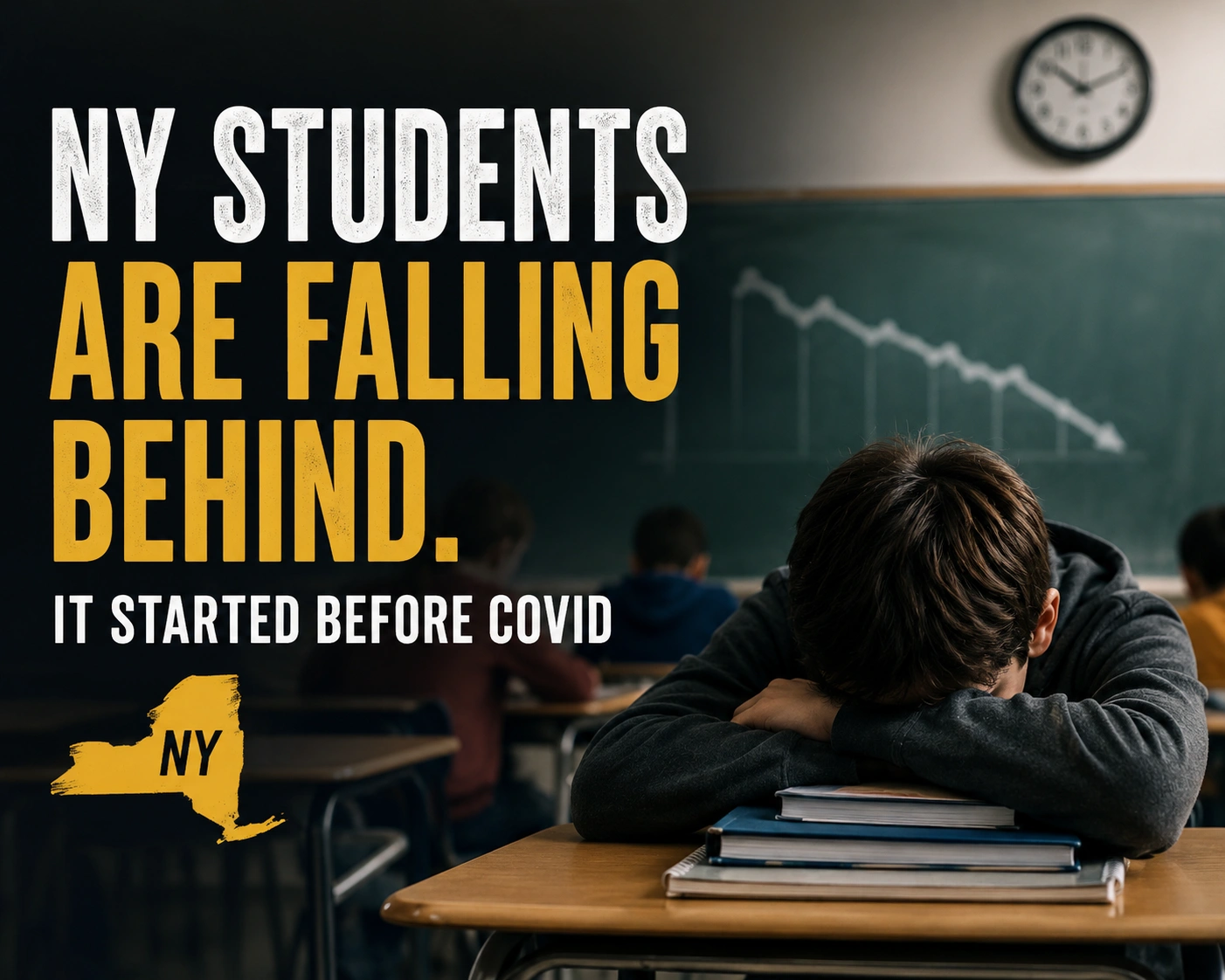
Two landmark reports dropped this week, and if you are a parent, a teacher, or anyone who cares about the future of this city's children, you need to read them. A Stanford University analysis published May 13, 2026, confirmed what many educators have feared for years: American students were already in a "learning recession" seven years before COVID-19 ever arrived. The pandemic did not create this crisis. It exposed one that was already underway.
The same day, a CNN investigation reinforced the finding with sobering national data. Taken together, these reports paint a picture that New York families deserve to see clearly, especially since New York spends more money per student than any other state or country in the world, and still lands around the national average in results.
Reading scores have been falling since 2013
The Stanford report, backed by data from roughly 70 million students in grades 3 through 8 spanning 2009 to 2025, is one of the most comprehensive analyses of American student achievement ever conducted. The findings are not subtle.
From the early 1990s through 2013, public school students made dramatic gains in both math and reading, improving by more than two grade levels in math over roughly two decades. Then, starting in 2013, those gains reversed. Reading scores have been falling since 2013 for eighth graders and 2015 for fourth graders, according to the National Assessment of Educational Progress (NAEP). Today, eighth-grade reading scores sit at their lowest point since 1990.
"The pandemic was the mudslide that had followed seven years of steady erosion in achievement," said Thomas Kane, a Harvard professor who helped develop the Education Scorecard. That framing matters because it shifts the entire conversation. The goal for New York schools should not simply be returning to 2019 performance levels. Those levels were already part of a decade-long decline.
Nationally, students currently remain nearly half a grade level behind pre-pandemic reading scores and only slightly better in math. Nearly four in ten eighth graders now score below the Basic level on what is known as "The Nation's Report Card." The achievement gap between high- and low-performing students has reached historic highs, with the steepest declines recorded among girls, low-income students, Black and Latino students, students with disabilities, and multilingual learners.
New York's Report Card: Spending Big, Scoring Average
Here is where the story gets particularly uncomfortable for New York. The state spends approximately $35,000 per student in the 2025-26 school year, more than any other state and more than virtually any developed country on the planet. Massachusetts, the top-performing state in the country, spends 24 percent less per pupil. Mississippi, which has outperformed New York on fourth-grade reading assessments, spends only 40 percent of what New York spends.
On the 2024 NAEP results, only 31 percent of New York fourth and eighth graders tested as proficient or advanced in reading. The national figure was essentially identical at 30 to 31 percent. In math, 37 percent of New York fourth graders and 26 percent of eighth graders were proficient or advanced, compared to 40 and 28 percent nationally.
NYC Is Spending $43 Billion on Public Schools. Will Test Scores Improve?
New York did show some fourth-grade math improvement between 2022 and 2024, earning a spot among 13 states with higher scores in that category. But eighth-grade reading declined by five points from both 2022 and 2019 baselines. And a closer look at the state's reported gains raises a red flag. After New York lowered its proficiency threshold in 2023, the state reported across-the-board score improvements. Researchers at FutureEd noted that several states, including New York, posted large apparent gains partly because they changed what it takes to be called proficient, not necessarily because students learned more.
"We would love to celebrate this increase in scores," said Zilvinas Silenas, President of the Empire Center for Public Policy. "However, New York State Department of Education needs to dispel doubts on whether we are observing a genuine and long-overdue improvement or merely changes to the definition of what constitutes proficiency."
Inside New York City: A District-by-District Divide
Within New York City, the picture is one of sharp inequality. Among the most recent state test results for grades 3 through 8, District 2 in lower Manhattan posted the highest ELA proficiency rate in the city at 78 percent. District 12 in the Bronx had the lowest at 37 percent. In math, District 20 in Brooklyn led the city at 73 percent proficient, while District 24 in Queens sat at just 35 percent.
Beyond the five boroughs, the disparities become even more striking. Rochester reported only 19 percent of students proficient in ELA and 15 percent in math. Syracuse came in at 24 and 17 percent respectively. Buffalo recorded 28 percent in ELA and 22 percent in math. These are not marginal gaps. These are generations of students in New York's major urban centers receiving a fundamentally different educational outcome than their suburban peers, despite the state's record-level investment.
NYC Reads, Mayor Adams' signature initiative requiring all elementary schools to use city-approved, phonics-based reading curricula, did produce some measurable momentum. About 56 percent of NYC public school students were considered proficient in reading in 2025, a seven-percentage-point jump. But experts cautioned against declaring victory. "If there's real growth, it should be sustained," noted Columbia University education researcher Aaron Pallas. "That requires looking at scores over the next couple years."
What Louisiana and Alabama Got Right That New York Has Not
The Stanford report identified something important beneath the national gloom: a small group of states actually moved the needle. Louisiana is the only state that beat its pre-pandemic average in reading by 2025, with 87 percent of traditional public school students attending a district where scores exceed 2019 levels. Alabama posted standout gains in both reading and math and was one of only two states where math scores were higher in 2025 than before the pandemic.
Neither Louisiana nor Alabama is a wealthy state. What they have in common is a deliberate, system-wide commitment to evidence-based instruction. Alabama passed a law requiring every school to use phonics-based reading instruction, trained teachers extensively, and then modeled its math reforms off those reading successes with the Numeracy Act in 2022, which standardized math instruction and mandated intervention for struggling students.
Louisiana's recovery unfolded alongside a 34 percent increase in education funding over the past decade, but the money came with specific instructional mandates and accountability measures, not open-ended allocations. New York, by contrast, has increased per-pupil spending by 214 percent in inflation-adjusted terms since 1968, with consistently mediocre results to show for it on national benchmarks.
The lesson here is not that New York needs to copy the South. It is that structured, evidence-backed instruction with real accountability produces results in ways that spending alone does not.
The Absenteeism Crisis Nobody Wants to Talk About
Layered on top of the academic decline is a chronic absenteeism problem that New York has yet to solve. Nearly one in three New York public and charter school students was chronically absent during the 2022-23 school year, according to State Comptroller Thomas DiNapoli. New York City high schools hit a 43.1 percent chronic absenteeism rate that year. The citywide rate still hovered near 35 percent in the most recent Mayor's Management Report, compared to roughly 25 percent before the pandemic.
Navigating the New Crosswalks: A Playbook for NY School Leaders
Nationally, 23 percent of students were chronically absent in the 2024-25 school year, far above the pre-pandemic rate of 15 percent. But New York is performing worse than that national figure, and the students being left behind are disproportionately from lower-income communities. Higher-poverty schools carry chronic absenteeism rates roughly 14 percentage points higher than their wealthier counterparts within the same city.
Alabama and Virginia have come closest among all states to returning to pre-pandemic attendance levels, with chronic absenteeism rates of around 15 percent in 2023-24. That is less than half New York City's rate. Researchers consistently find that attendance is one of the strongest predictors of academic outcomes, making it impossible to separate the absenteeism crisis from the learning crisis.
What makes this especially troubling is that the New York State Education Department proposed eliminating the chronic absenteeism metric altogether in favor of a new "attendance index rank" system. Parents deserve to ask: why remove the clearest measure of a problem at the exact moment it demands more scrutiny, not less?
What New York Families Should Do Right Now
Understanding the scope of this crisis is step one. But knowledge without action leaves children in the same position. Here is what parents and community members can do:
Request your child's actual test score data, not just whether they passed or failed. Ask teachers and principals directly where your child stands relative to grade-level expectations. Many families are shocked to learn their child is performing below grade level despite receiving passing marks, because grade inflation has made report cards unreliable as a standalone signal.
Ask your school what reading curriculum it uses and whether it is phonics-based. Phonics-based, or "science of reading"-aligned instruction is the approach with the strongest evidence behind it. If your child's school is still using older, whole-language approaches, that is worth raising with your principal and school board representative.
Attend your local school board and Community Education Council meetings. These are the bodies that influence curriculum adoption, budget allocation, and accountability at the district level. Chronic absenteeism, reading instruction, and student outcome transparency are all agenda items that benefit from engaged parent voices.
And if your child has missed significant school time, take that seriously as a learning loss issue, not just an administrative one. Every 18 missed school days, statistically, translates to real gaps in reading fluency and math comprehension that compound over time.
The Standard's Takeaway
New York's leaders have been largely silent about what the data actually shows: a state spending more than any other on education, producing outcomes that match the national average, in a nation that has been declining for over a decade. The new Stanford and CNN findings remove any remaining ambiguity about whether this is a post-pandemic recovery problem. It is a structural, systemic failure that predates COVID by years.
The states making real progress are not the richest. They are the ones that committed to evidence-based instruction, honest accountability, and showing up for students every day. New York has the resources to do the same. The question is whether it has the political will, and whether enough families will demand it.


Comments (0)
No comments yet — be the first to share your thoughts.
Leave a comment