

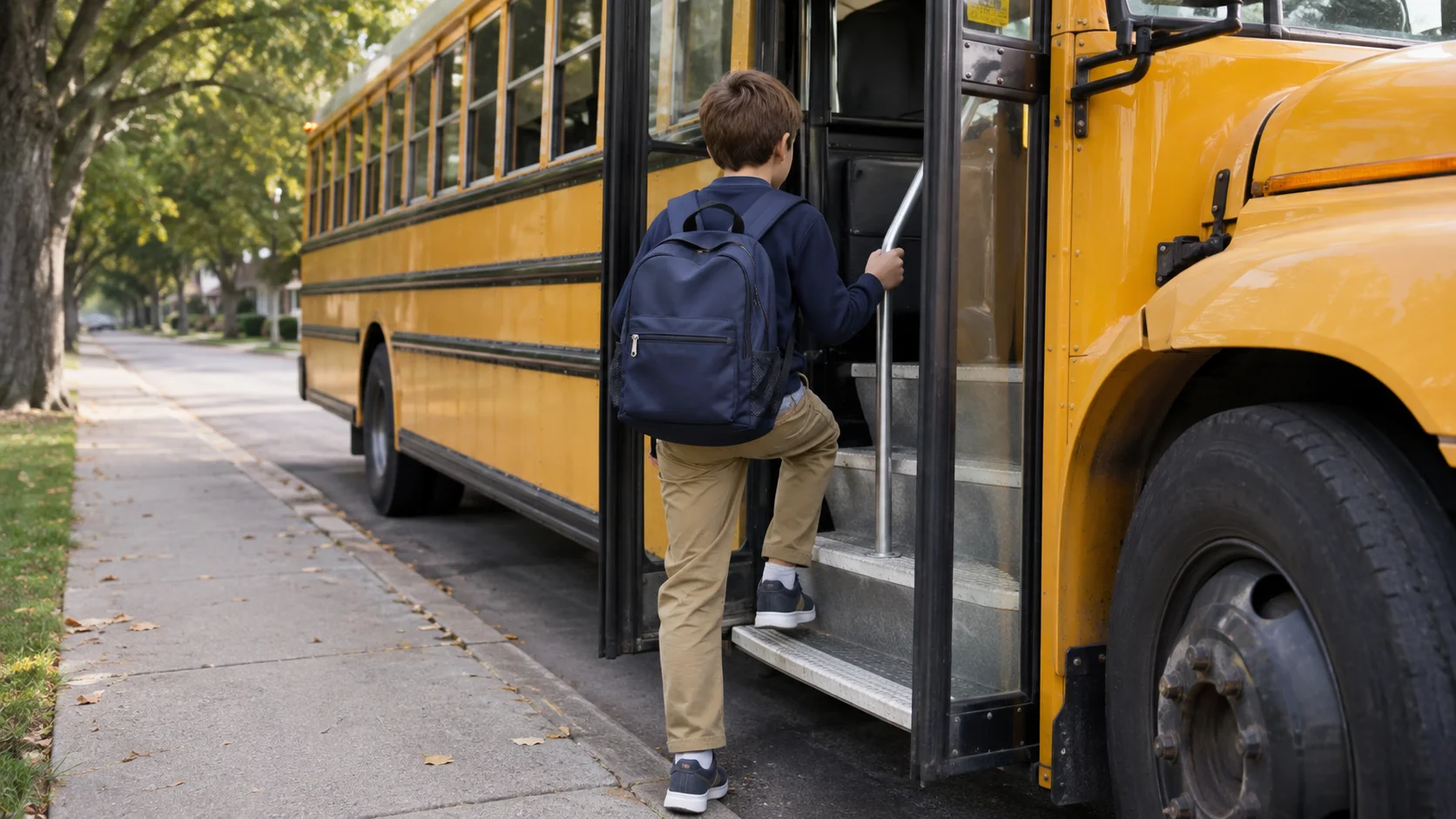
A kindergartner whose family is placed in a Bronx shelter in October keeps a legal right to the Brooklyn classroom where she started the year. Under Section 3209 of New York's Education Law, her parent can designate that school of origin, and the responsible district must transport her there, generally up to 50 miles each way. Getting an actual bus to the shelter door has proven far harder than writing the guarantee, and the city's own leaders have spent most of the fall arguing about why.
The newest count was published on Tuesday, Nov. 10, by Advocates for Children of New York. More than 138,000 New York City public school students, about one in eight, experienced homelessness during the 2025-26 school year, according to the group's analysis of state data. More than 50,700 of them spent time in a shelter, while 81,100 lived doubled up with relatives or friends because their families could not afford a place of their own. The total fell 10 percent from the year before, driven largely by a 22 percent drop in the number of students living in shelter.
Maria Odom, the group's executive director, said the data was "no cause for celebration," since it marked the eleventh straight year in which more than 100,000 city students went without permanent housing. That population is roughly the size of Albany, and the Capitol in Albany is also the place with the most direct power over how those children reach a classroom each morning.
The group measured the academic toll with some precision in its educational indicators for 2024-25, which it released in April. That year, 63 percent of students living in shelter were chronically absent, which means they missed at least one school day in every ten. Nearly half of all students in temporary housing crossed the same threshold, and one in five shelter students changed schools at least once, more than four times the transfer rate of permanently housed classmates.
Test scores track the attendance closely, with 33 percent of homeless students in grades 3 through 8 scoring proficient on the 2025 state English exams, against 60 percent of their permanently housed peers. The burden is concentrated by geography as well as income, because the Bronx had the highest rate of student homelessness in the city during 2025-26 and Staten Island the lowest. More than one in five students was homeless in District 9 (Highbridge and Grand Concourse), District 23 in Brownsville and District 32 in Bushwick. In District 23, more than one in eight students lived in a shelter, roughly triple the citywide rate.
Jennifer Pringle, who directs the group's Learners in Temporary Housing Project, said that "every child in New York City deserves a permanent place to call home." She paired that statement with a call to overhaul the city's decades-old bus contracts, which govern how those children get to class while they wait. By her count, about 37 percent of families in shelter are placed in a different borough from their children's school, and those families stay for an average of 14 months.
A new bus assignment for a student in temporary housing, Pringle said, typically takes more than a month to arrive. For a child who lands in a new shelter in the fall, that wait stretches across the same weeks in which the absence figures above begin to accumulate, one missed morning after another.
The contracts behind that wait are enormous, and some of their terms date to the late 1970s. When then-Comptroller Brad Lander audited the system last December, his office counted roughly 145,000 riders carried by 48 private vendors at an annual cost of nearly $2 billion. About 62,000 of those riders were students with disabilities, and 14,000 of them were homeless. Lander traced the dysfunction to 46-year-old contracts and said that "for decades, our City's school bus system has failed our students and families."
Instead of being competitively rebid, those agreements have been extended again and again by the city. The Panel for Educational Policy approved a three-year extension in November 2025, after rejecting a five-year renewal, and the current terms expire on June 30, 2028. On Wednesday night, Oct. 28, the panel voted unanimously to oppose any further extensions of the old contracts. It also urged Gov. Kathy Hochul and the Legislature to pass a state bill that would let the city rebid the work.
As advocates describe it, that bill would also protect drivers and bus matrons who lose their jobs when their company loses a contract. Those workers would get hiring priority with the new vendor at the same wages and benefits, a provision meant to head off the kind of strike that has followed past rebidding attempts. Gregory Faulkner, the panel member who introduced the resolution, measured the problem against the moon landing that night. "However, we can't get buses to pick up our kids and deposit them to school on time," he said.
Kevin Moran, the deputy chancellor for school operations, told the panel that the city is replacing its routing software and improving bus tracking. "We watch it daily, and it is functioning," Moran said during the meeting, shortly before the unanimous vote.
Three weeks later, the numbers arrived at a City Council oversight hearing on Wednesday, Nov. 18. Education officials testified that 467 students still had no assigned bus route, nearly three months after classes began in September. The system needed 928 more routes on the first day of this school year than it did a year earlier, according to the testimony. Curb-to-school riders have grown 31 percent over four years, to 71,915, and Moran told the Council that "it is important to understand how dramatically demand for transportation services has increased."
Officials did not say how many of the 467 students are homeless. Advocates for Children told the Council it has heard from families living in shelter who have been waiting all year for bus service, a ride those children are owed under state law.
The city has moved on the parts of the problem that it directly controls. It expanded Every Child and Family Is Known, a program that pairs homeless students and their families with designated school staff. It also dropped a rule requiring children to attend every housing meeting, and it widened community schools offering eye care and housing support in the districts with the most shelters. Pringle has suggested that shelter case managers check in with families about a week after they arrive, a step that would catch a missing route early. None of those changes reaches the contracts themselves, which the panel says the city cannot rebid without action from Albany.
Education Law 3209 binds every district in New York, from Buffalo to Riverhead, and not only the five boroughs. The transportation it requires is aidable under the state's transportation aid formula, which makes Albany a paying partner in every one of those rides. In a January 2025 report, State Comptroller Thomas DiNapoli counted 50,773 homeless children in New York in 2024, up from 20,299 in 2022. He also found that 32.1 percent of the state's homeless population was under 18, one of the highest shares in the country.
New York City accounted for 93 percent of the statewide increase in homelessness over that period, so the pressure has built fastest downstate. Families outside the city still have their own stake in how Section 3209 is carried out. In rural districts a school of origin can sit a long drive from the nearest motel, and some upstate cities have few shelter beds to offer.
Our guide to New York's school bus rules walks through the mileage limits and appeal rights that apply to every family in the state. For students in temporary housing, Section 3209 adds a separate and stronger obligation on top of those rules, one that follows the child from shelter to school.
State lawmakers hold the leverage to act on the rebid when the new session opens. Hochul returns to Albany with Democratic majorities in both chambers, including a Senate that Democrats now describe as veto-proof. The rebid bill sits squarely inside the Legislature's authority, and lawmakers could write a firm routing deadline for students in temporary housing into every new contract. With penalties a vendor would notice on its invoice, that clause would turn the guarantee in Section 3209 into a bus that shows up within days of a family's move.
Chancellor Kamar Samuels called support for these students "both a priority and shared responsibility" after the Nov. 10 report was released. The Legislature convenes in January, and the bus contracts it would need to change are scheduled to run until the summer of 2028.


Comments (0)
No comments yet — be the first to share your thoughts.
Leave a comment