

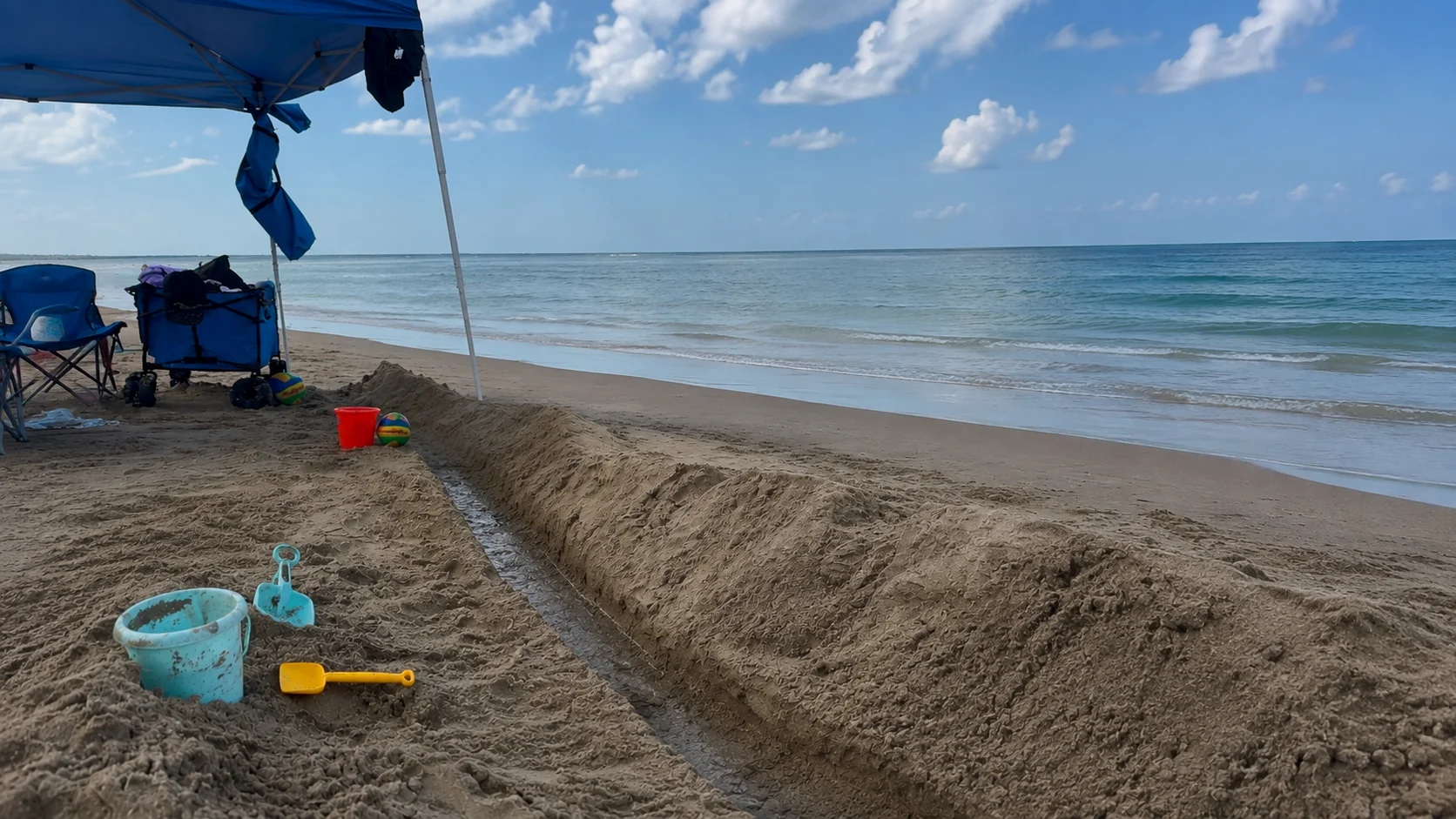
I wrote this story from a folding chair on Virginia Beach with sand drying on my feet and my phone tilted to block the sunlight. About five feet away, five children were digging a trench to slow the incoming tides. Two were mine; the other three had introduced themselves only minutes earlier. For a while, their sand barrier held.
The ordeal started the way beach days do, with chairs and an umbrella (well, we had a cabana with a bed), a cooler with cold drinks and food that tastes better outside. Music drifted down the sand from somebody else's speaker, and nobody was checking the time. My family was doing what my family does at the beach, which is eat, debate about everything, and saunter in and out of the water.
Then the tide started moving in on us. Each wave reached a little farther until the water started touching the legs of my beach chair. Rather than moving our belongings, my children and I tried a practical solution: We began digging a trench to redirect the water and reinforce the sand around us.
Three kids and a question
A few minutes in, three children walked over and asked if they could help. They were young, somewhere between six and nine years old as best I could tell, and not old enough to be doing anyone a favor. They asked politely, waited for an answer, and then went straight to work, which is the part I keep recalling.
Nobody had to direct them. One of them dropped to his knees and started packing the inside wall with wet sand, which is the step most kids skip because it is not the fun part. Another noticed the weak spot on the left where the water was cutting around, and moved over there without anyone pointing it out. When the ocean punched, and it did a few times, they widened the channel and blocked the water from penetrating.
There is a difference between a child playing at work and a child working, and anyone who has spent real time around children recognizes it on sight. These three were working, and nobody taught them that in the minutes before they walked up to us.
What arrives before the classroom does
I work in business and operations for a school district, which means my job, stripped of the spreadsheets, is making sure resources reach students, from books and technology to programs and staff. The rest is paperwork in service of that.
The work has also taught me the limits of what I can do from that seat. Two children can sit in the same classroom with the same teacher, the same materials, and the same instructional minutes, and walk out of that year in two very different places. I have seen it in the data and I have seen it in person, and the difference is rarely intelligence. More often it comes down to whether the child walked in already knowing how to stay with something hard.
Consider what we actually ask of a young student. Reading fluency is built on repetition, on thousands of encounters with the same letters and sounds and words, long past the point where any of it is interesting. A child who has been read to since age two arrives at kindergarten having banked hundreds of hours of that work. That child has also learned that a book is a warm thing that happens with someone who loves you. A child who has not is starting the same race well behind, and the school is asked to make up ground that was never lost for the kid one seat over.
Writing runs on the same fuel: a rough first draft is not a failure but the starting point for stronger work. Children who are not taught this process may mistake unfinished writing for evidence of limited ability and stop too soon. Effective writing instruction should therefore normalize struggle and make revision explicit. What we are teaching in that moment has less to do with grammar than with the willingness to look at unfinished work without flinching.
Math asks for it twice over. Number sense and fact fluency come from drilling the same operations until they turn automatic, and beyond that, math asks a child to sit inside not knowing for thirty or forty seconds without panicking. Most students who decide early that they are not math people are not short on ability, and were never taught to tolerate confusion long enough to reach the other side of it.
Every one of those is the trench, wet and repetitive and frustrating, performed at the exact point where it stops being fun.
What children are actually watching
Here is the part that is harder to hear as a parent, and I include myself in it, because children learn work by watching work. They do not learn it from being told about it, and they do not learn it from chores handed down as punishment. They learn it standing next to an adult who is doing something difficult, in a decent mood about it, who lets them in.
Those three kids asked if they could help, and a child only asks that question if asking has gone well before. Somewhere along the line each of them wanted to carry something, fix something, or stir something. The adult said yes on a day when saying no would have been faster and cleaner and would have left less mess on the floor.
That yes costs a parent something every time, in minutes and in quality and in patience you may not have that afternoon. I am convinced it is among the highest-return things a parent ever does. What the child keeps is not the task. It is the understanding that they are the kind of person who joins in when there is work in front of them. Some of that gets built in the empty hours, which is part of why the case for a deliberately boring holiday weekend keeps holding up. The rest gets built when a child is allowed to stand next to you while you do something that matters.
If a child never sees you read, reading becomes something school does to them. If a child never watches you work a problem out loud, whether it is a bill or a repair or a recipe that went sideways, difficulty reads as failure. In a house where the problem gets worked out loud, it reads as the ordinary middle of anything worth doing.
I do not know those three kids' parents. They were not standing over them this afternoon and did not need to be, because their work was already here, in three children who knew how to dig and thought to ask.
The trench is holding
The tide has come up twice since I started writing this, and the water is running down the channel and out to the side, exactly where the five of them sent it. Our chairs are sitting where we first placed them.
The kids are still at it. They stopped negotiating about who was in charge once the work sorted that out on its own, since whoever spotted the next weak point went to it and the others followed. My children are digging shoulder to shoulder with three kids whose names I just learned, and nobody has been told to share.
In a few weeks all five of them go back into classrooms where they will be handed books, assignments, problem sets, and tests. We will fund those classrooms as well as we possibly can, because that is my job and I take it seriously. What each of them does with any of it was largely settled somewhere else, at kitchen tables and in driveways and on afternoons like this one.
I will probably never see those three kids again, but I watched their parents' work this afternoon from a folding chair twenty feet away, and I hope somebody tells them it showed.


Comments (0)
No comments yet — be the first to share your thoughts.
Leave a comment