

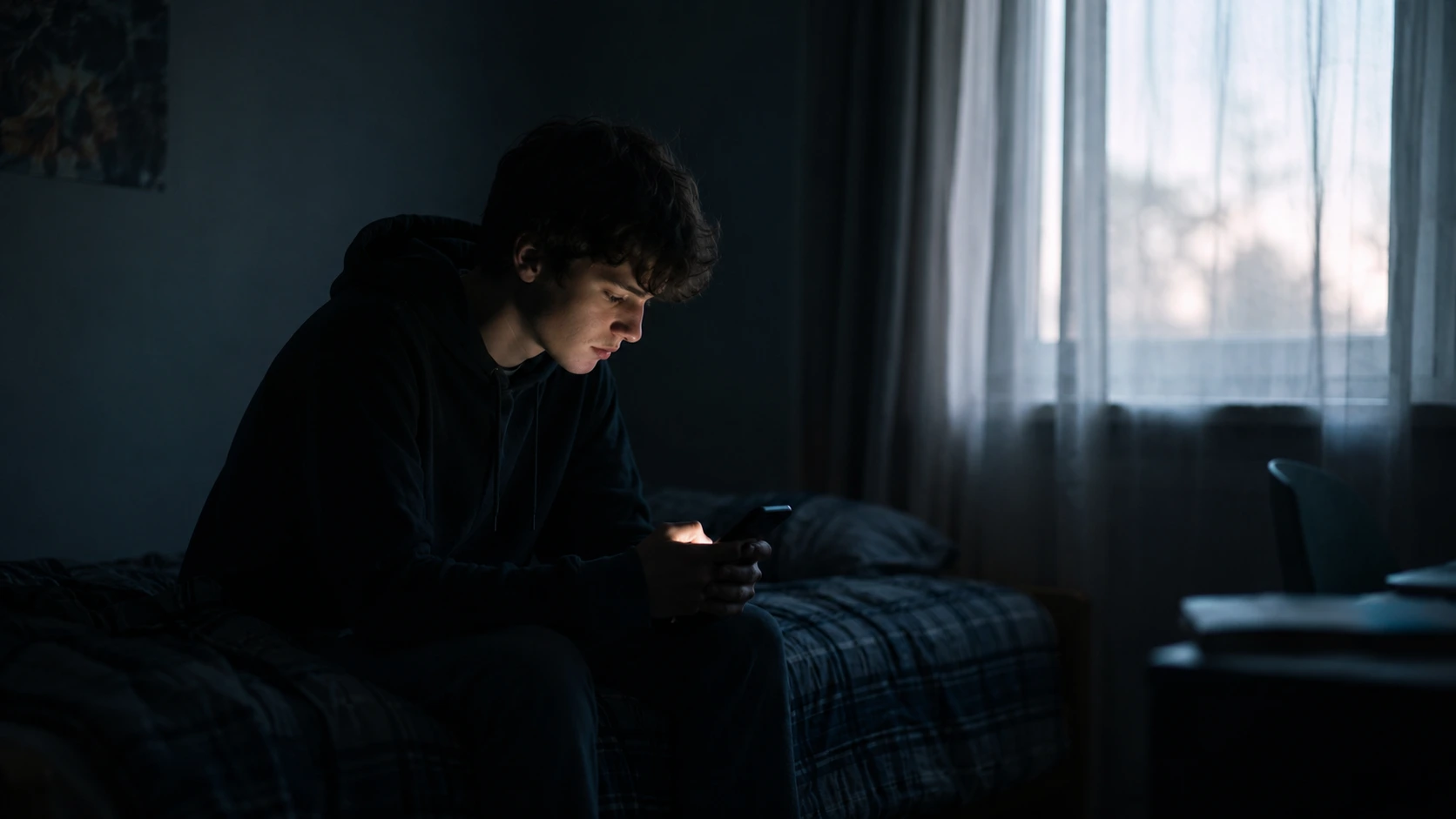
Ask a parent where their fourteen-year-old spent last Saturday and you will often get a pause, then a slightly defensive answer. In their room. On the phone. Around. The honest version, for a lot of families, is that there is no good answer anymore, because the places a teenager used to drift toward on an empty summer afternoon have quietly closed, shrunk, or priced themselves out of reach. We talk endlessly about the screen. We talk far less about the thing the screen replaced.
That missing thing has a name. The sociologist Ray Oldenburg called it the third place: not home, not school or work, but the informal public spot where people gather with no agenda and no entrance fee. The diner booth. The record store. The library reading room. The park bench by the courts. For generations of teenagers, third places were where you learned to be a person in public before anyone was grading you on it. Their slow disappearance is one of the least discussed forces shaping adolescence today.
The screen filled a vacuum we built
The numbers on teen phone use are, by now, familiar enough to be background noise. Pew Research Center finds that nearly half of American teens say they are almost constantly online, a share that has roughly doubled over a decade, with about a third reporting they are on at least one major platform almost without pause, according to its survey of teens and technology. What gets less attention is that teens are not naive about it. In a separate Pew report on teens and mental health, close to half said social media has a mostly negative effect on people their age, up sharply from a few years earlier, and roughly four in ten say they have actively tried to cut back.
So why don't they? Part of the answer is design, the engineered pull of the feed. But part of it is simpler and more damning to the rest of us. It raises a question almost nobody holding a policy lever wants to sit with: if a teenager is on a platform almost constantly, what exactly are they missing? The uncomfortable possibility is that for many teenagers, the phone is not swarming out a richer alternative. It's the only door still open. Strip a neighborhood of its free, unsupervised, welcoming places and you have not protected kids from screens. You have handed them the screen as the path of least resistance.
This is a connection problem, not just a tech problem
Framing all of this as a battle over screen time quietly misses the point. The deeper issue is social connection, and the public health establishment has started naming it as such. In 2023 the U.S. Surgeon General issued a formal advisory on loneliness and isolation, warning that thinned-out social ties carry measurable risks to physical and mental health. Adolescence is exactly when the muscles for connection are supposed to be built, through low-stakes, repeated, in-person contact with people who are not your parents.
It is worth being precise about what teenagers actually lose without third places. They lose unstructured time in the company of others, the loose hours where social skills, boredom tolerance, and a sense of belonging quietly form. Pew's own data hints at the gap: most teens say their phones make it easier to pursue hobbies, but far fewer believe phones help young people build good social skills. The phone is a fine tool for interest. It is a poor teacher of presence. Teen loneliness is not a moral failing of a generation. It is, in part, an infrastructure problem, and infrastructure is something a community can choose to rebuild.
What rebuilding actually looks like
The encouraging news is that some of the most durable third places never fully left, and policy can lean into them. Public libraries remain the rare civic space that asks nothing of a teenager except that they show up, and many now run summer programming, maker spaces, and teen rooms specifically designed as somewhere to simply be. They are the closest thing we have to a third place with a public mandate, which is why protecting their hours and funding is a youth-wellbeing issue and not just a budget line.
States are also quietly funding a different kind of third place: a job. New York's Summer Youth Employment Program was announced under a banner that says the quiet part out loud, "Get Offline, Get Outside," and it placed roughly 21,000 young people in paid summer roles at parks, camps, cultural centers, and community organizations. The state's separate Youth Jobs Program, expanded statewide and reauthorized through 2027, works the same lever. A first job is more than a paycheck. It is a structured reason to be somewhere, around adults and peers, doing something that matters, which is precisely the function summer youth employment shares with the old corner hangout.
Beyond formal youth programs, the everyday third places still exist if families and towns defend them: rec centers, courts and fields with open hours, teen nights at a community center, a coffee shop that does not glare at a table of sixteen-year-olds nursing one drink for two hours. None of it is glamorous. All of it competes, directly, with the bottomless feed.
What a parent can do this summer
You cannot legislate a third place into your own kid's life, but you can stack the deck. Treat "somewhere to go" as a real summer goal, not an afterthought, and help your teenager find one or two recurring places and times to be out of the house and around people. A library teen program, a volunteer shift, a part-time job, a pickup league, a free meal-and-hangout site, any of them beats a bedroom and a charger. The point is not to confiscate the phone. The point is to make the offline world worth choosing.
That work pairs naturally with the conversations happening at home about devices. Our guide to talking to teens about social media covers the judgment-first approach that holds up better than any blanket ban, and if you are building a summer with real places in it, the library is the cheapest anchor you have; our look at making summer reading work on any budget doubles as a map of free programming most families never fully use. For parents weighing organized options, Family Symposium's breakdown of the true cost of free summer programs is a useful gut check before you commit a season to one.
The teenagers are not actually lost. They are mostly home, on the device that was waiting when everything else closed. The question facing families and communities is not how to pull them off it by force. It is whether we are willing to rebuild the places that once made looking up the obvious choice.



Comments (0)
No comments yet — be the first to share your thoughts.
Leave a comment